Cultural Global
Chen Ruiqing: The merger of DramaBox and GoodShort reduces internal friction and will not weaken external competition.

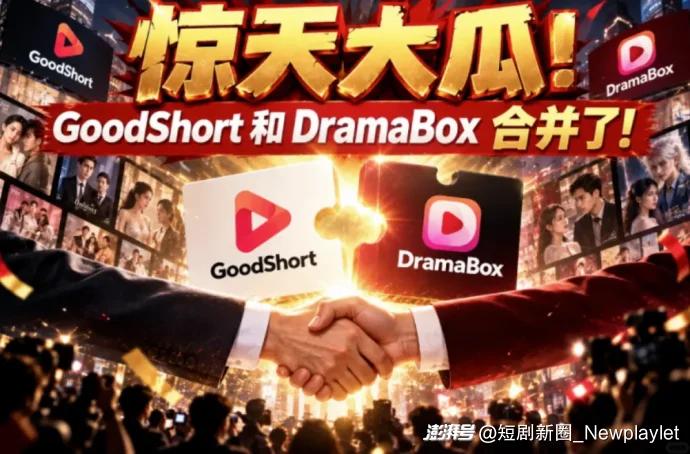
The names of these two platforms together carry considerable weight. According to data from Sensor Tower, in Q1 2026, DramaBox ranked first in the global short drama app in-app purchase revenue list, and GoodShort ranked fifth. On the download list, they took the 4th and 10th places respectively.
The first reaction from the media was excitement. The strong alliance between leading companies that is about to reshuffle the industry rankings counts as a major event in any sector. In addition, Hu Zexin, the founder of GoodShort, used to be the CTO of Dianzhong Technology.
The trend of casual onlookers gossiping has finally blown to the overseas short drama circle. But gossiping is not our style.
We talked to Mr. Chen Ruiqing about this merger, and what he told us presents a calmer, more objective and more responsible version of the story.
Note: This article is reposted from GrowData
The merger will not reduce competition
When leading companies merge, the most obvious thought for the outside world is that "one less competitor means less money burned". DramaBox and GoodShort were already in the top tier of overseas short drama operators, with overlapping covered markets. The integration of the two companies allows them to pool the funds previously spent separately on user acquisition, reducing unnecessary internal consumption.

We put this idea to Chen Ruiqing, and he did not quite agree.
"Even if I do not compete with him, I still have to compete with others, there is no difference at all."
He went on to say that after the merger, neither side can stop growing, and the investment "will only be more, not less".
His words are very straightforward. What the merger can change is how the two companies organize resources, but it cannot make other competitors exit the market automatically. ReelShort, DramaWave, NetShort and ShortMax are still competing for users, and local players in various segmented regional markets are also emerging one after another, each with independent capital support and content supply.
However, there are two things that need to be analyzed separately here.
"Competition will not decrease" is a judgment of the external market; "investment will not decrease, and may even increase" is a judgment of the post-merger business strategy. The former can be partially observed from the current market pattern, while the latter needs to be verified by actual post-merger operating data.
The fact that competitors still exist does not mean that every cost cannot be reduced; conversely, the reduction of certain costs does not mean that competitiveness will be weakened as a result.
This is not a tongue twister. Only by clarifying the difference between the two can we understand the value of the merger that Chen Ruiqing talked about next.
The real advantage is to do repeated things once
If the purpose is not to spend less on user acquisition, then what exactly do DramaBox and GoodShort want to achieve through the merger?
Chen Ruiqing's answer mainly focuses on complementary resources and reduction of redundant investment.
He said that both sides have their own advantages, with different accumulations in overseas short dramas, online novels and other businesses, and their business strategies and user groups are also complementary. Even if the two had a good relationship before, they were still two separate companies after all. At most, they could learn from each other, and it was not easy to integrate their capabilities for joint use.
He gave a very specific example: AI tools.
When the two companies operated independently, they might both develop similar tools, technologies and workflows. Previously, each side invested in the same work separately. After the merger, there is no need to do exactly the same things twice. Chen Ruiqing said that in terms of cost, "the overall calculation will definitely be lower", but he did not take this as the sole purpose of the merger. Immediately after that, he mentioned another point: with more resources, the two sides can carry out new explorations.
This is more specific than the general statement of "strong alliance". The potential value of the merger is not only the expansion of scale, but also the opportunity to jointly use the experience, tools and capabilities that were previously scattered in the two separate organizations.
Chen Ruiqing also repeatedly mentioned the trust relationship. After the merger, Hu Zexin will serve as CEO, and Chen Ruiqing himself will take the position of chairman. He believes that the founding teams of the two sides are familiar with each other and share the same values, which can reduce the internal friction that often occurs in ordinary mergers. He even said frankly: "This is the part that makes our merger different from others."
This is the part where he has the most confidence in this merger.
When two companies merge, their equity, business and assets can be combined on paper, but the actual implementation still has to deal with people, teams, systems and decision-making methods. The two companies were already familiar with each other before, which can indeed reduce frictions during integration.
Of course, the trust relationship is a necessary condition, but whether the two sides can really reduce redundant work and combine the advantages of both still depends on the actual execution.
The four-fold homogenization dilemma
Chen Ruiqing told us more than once that everyone is talking about how promising the overseas short drama track is, but in reality it is very difficult to make profits, and the track puts very high requirements on comprehensive capabilities.
Indeed, if we only look at the overall market data, taking Sensor Tower's data as an example, in the first quarter of 2026, the total number of global short drama app downloads exceeded 850 million, a year-on-year increase of 140%, and the in-app purchase revenue was about 750 million US dollars, a year-on-year increase of 20%.
Growth is real, but growth does not equal profitability.
In addition to the well-known user acquisition cost, the costs of short drama companies also include copyright cost, labor cost and bandwidth cost. Adding all these costs together, how many companies are actually making profits? Only the operators of these companies know the real data.
The situation where companies can neither out-compete their peers nor easily give up is closely related to the four-fold homogenization of the overseas short drama industry.
The first is content homogenization.
Themes like overbearing CEOs, revenge, and counterattack are repeatedly copied in overseas markets. Once a hit work comes out, thirty copycat scripts will follow immediately. The cycle of user aesthetic fatigue is shortening, but the differentiation of content supply has not been widened. If you cover the platform names on the combined playlists of GoodShort and DramaBox, it is very difficult to tell which work belongs to which platform.
This is not the problem of a single company, but is determined by the content production mechanism of the entire industry.
The short creation cycle, low trial-and-error cost and fast data feedback of short dramas, when combined, naturally encourage replication rather than innovation. Whoever takes the lead in making differentiated content has to bear a longer verification cycle and higher sunk cost. At the current moment when user acquisition cost is high, no player dares to take the risk.
The second is product homogenization.
The interaction logic, paywall position and unlocking rhythm of various apps are highly similar. Users can switch from DramaBox to GoodShort with almost no learning cost. This sounds like a good thing, but in fact it means that the product itself does not constitute any migration barrier.
A user finishes watching a drama on DramaBox today, opens GoodShort tomorrow, finds that the operations are exactly the same and the content is similar, then why would he stay? Because of the brand? Short drama users' loyalty to the brand is far lower than their loyalty to a specific drama. Once they finish the drama, they will leave.
The third is monetization model homogenization.
From the IAP payment model, to IAA advertising monetization, and then to the hybrid model that combines IAP and IAA, different monetization routes have emerged in the industry. But different routes do not mean that every enterprise has established its own advantages.
Paid platforms will study how to set up paywalls and arrange unlocking rhythm; free platforms will study how to improve advertising display and viewing efficiency; the hybrid model needs to handle both payment conversion and advertising monetization at the same time. The models can be different, but the gameplay on the same route is very easy to imitate.
The last is customer acquisition path homogenization.
Everyone acquires customers on Meta, Google and TikTok, and faces similar advertising bidding mechanisms. The actual customer acquisition cost of each company is certainly different, but in the end everyone competes on who can increase the user life cycle value under similar customer acquisition costs, and the user life cycle value depends on content quality, payment conversion and retention rate.
After going around in circles, we are back to the old problem of homogenization.
Chen Ruiqing said he hopes that after this merger, they will have the resources and energy to do some innovative things. To be honest, as observers, we also very much hope to see some real changes happen.
This article is sourced from The Paper.