Cultural Global
New regulations on cross-border capital business of multinational corporations take effect: nationwide promotion to facilitate fund pooling and alloc

【Global Finance Comprehensive Report by Huanqiu.com】To better facilitate the coordinated and integrated use of cross-border funds by enterprises, the People's Bank of China and the State Administration of Foreign Exchange jointly issued the Circular on Issues Concerning the Centralized Operation of Domestic and Foreign Currency Cross-border Funds of Multinational Corporations (hereinafter referred to as the "Circular") on August 14. The Circular clarifies that the centralized operation business of domestic and foreign currency cross-border funds for multinational corporations will be rolled out nationwide, and this regulation shall take effect as of September 14, 2026.
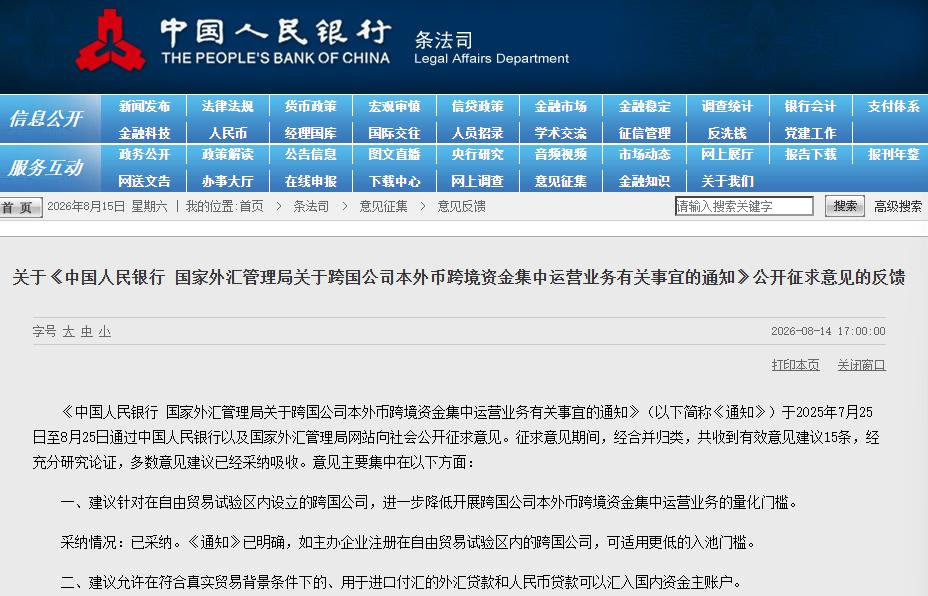
The picture is a screenshot of the official announcement released by the People's Bank of China.
Multinational corporations are enterprise alliances connected by capital, composed of affiliated enterprises inside and outside China, covering both Chinese-funded multinationals expanding overseas and foreign-funded multinationals operating in China. Due to the frequent cross-border flow of funds, enterprises have objective demands for unified fund pooling, surplus and deficit adjustment, coordinated collection and payment, and overall deployment. Since 2021, the two authorities have launched relevant pilot programs in Beijing, Guangdong and other regions to support multinational corporations in the centralized operation and management of domestic and foreign currency funds, so as to reduce liquidity management costs. Compared with the integrated capital pool service for large multinational corporations, the centralized operation business of domestic and foreign currency cross-border funds for multinational corporations has a relatively lower applicable threshold, which can benefit more small and medium-sized multinational corporations.
In December 2025, the two authorities announced that the pilot program of the integrated domestic and foreign currency capital pool for multinational corporations would be extended to the whole country. After the implementation of the Circular, the pilot program of the centralized operation of domestic and foreign currency cross-border funds for multinational corporations will also be promoted nationwide to benefit more market entities. It is worth noting that if the host enterprise is registered in a Pilot Free Trade Zone, the threshold for establishing the capital pool can be further lowered to continuously release policy dividends.
Pang Ming, member of the China Chief Economist Forum, said that in the past, the pilot phase was mainly limited to some regions and enterprises. The full rollout now means that multinational corporations will have higher freedom in the deployment, centralized pooling and unified payment of domestic and overseas funds, which helps reduce capital precipitation and cross-border settlement costs.
In terms of specific business arrangements, the Circular further facilitates multinational corporations to pool and allocate domestic and foreign currency cross-border funds. It stipulates that the limits of foreign debt and overseas lending of member enterprises can be pooled, allows multinational corporations to independently determine the pooling ratio, uses a single account to manage domestic and foreign currency funds, realizes coordinated deployment at the group level and flexible use at the member enterprise level, and encourages enterprises to give priority to using local currency to carry out related businesses.
The business filing and registration process has been optimized and simplified. The Circular stipulates that the SAFE branch at the location of the host enterprise will handle the business filing and registration through a "one-stop window", and some change registration matters are entrusted to cooperative banks, reducing the unnecessary operating costs for enterprises. The Circular clarifies the business handling specifications and the regulatory requirements during and after the process, to effectively prevent the risks of cross-border capital flow.
Pang Ming believes that on the whole, this new policy is an important institutional arrangement to serve the real economy and promote the internationalization of RMB. It will significantly improve the fund management efficiency of multinational corporations and boost the use of RMB in cross-border capital flows. (Wen Xin)
Article source: Huanqiu.com