Cultural Global
Chinese tea drinks are creating a new market in the United States | Overseas Expansion Insights



Author | Zhu Ming
Editor | Xiang Qing
Source | Growth Factory
On the streets of the United States, cups of freshly made tea drinks from the East are quietly changing the beverage habits of local consumers and subtly influencing the fate of Chinese tea drink brands.
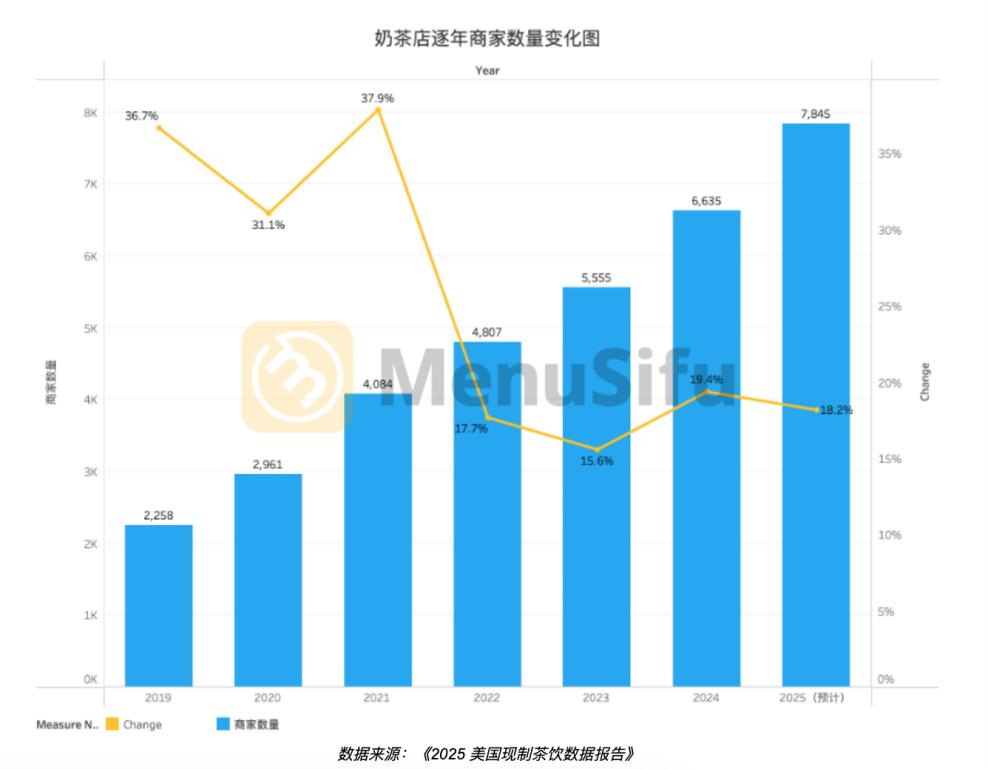
Before 2010, the "tea drinks" in the eyes of Americans were limited to lemon tea or Thai milk tea in coffee shops. However, with the arrival of Taiwanese brands such as Gong Cha and Tiger Sugar, the bubble tea craze quickly swept across the United States. According to the "2025 US Freshly Made Tea Drink Data Report" by MenuSifu, in recent years, with the entry of Chinese mainland brands such as Heytea and CHAGEE, the number of milk tea shops in the United States has soared to 6,636 in 2024 and is expected to reach 7,845 in 2025.
Moreover, the market size of the freshly made tea drink market in the United States is 2.6 billion US dollars and is still growing rapidly at an average annual rate of 9.1%.
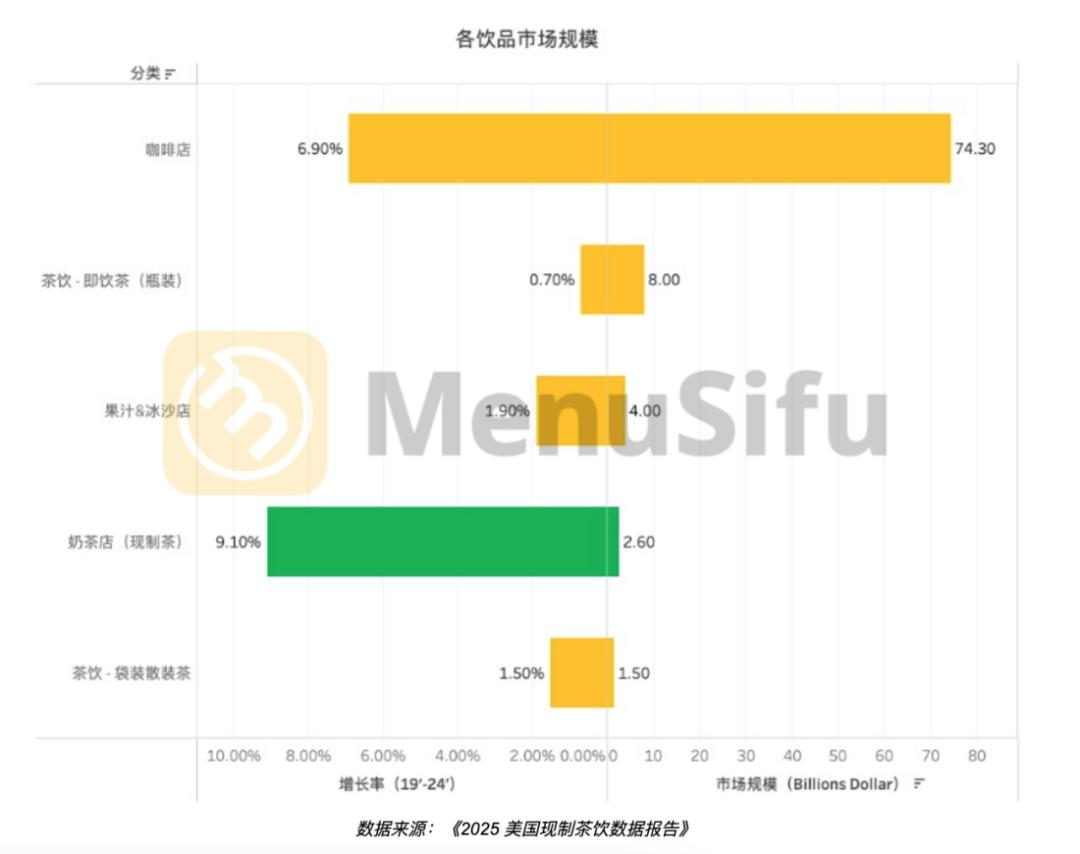
Behind this figure is the collective desire of Chinese tea drink brands for new growth after the domestic market has become extremely competitive. The "Report" shows that in the next decade when the millennial generation becomes the main consumer group, the potential milk tea market in the United States may expand by 5 to 10 times. The "Report" also points out that currently, no single milk tea brand in the US market has a market share of more than 5%, and the "Starbucks" of the milk tea industry has not yet emerged - this is in sharp contrast to the coffee market dominated by giants, which also means that the pattern is not yet set and opportunities still remain.
Heytea, CHAGEE, Mixue Ice Cream & Tea, Ningji... familiar names to domestic consumers are starting to appear on the streets of New York and Los Angeles. With completely different strategies and ambitions, they are trying to replicate and even surpass their success in China on this unfamiliar land.
However, this path is much more difficult than expected.
01 The Picture of Chinese Tea Drinks Going Global: Who is Entering the US Market?
In this wave of entering the US market, domestic tea drink brands have shown different entry strategies.
Heytea takes a high - profile approach. Its goal is clear: to directly compete with high - end beverage brands such as Starbucks and establish a high - end tea drink brand image in the US market. Its first overseas LAB store in New York's Times Square, located at the "Crossroads of the World," is a touchstone for the brand's strength. Heytea set the price of single items in this store at $9.9, significantly higher than in the domestic market, to test the US market's acceptance of the pricing. The results showed that on the opening day, customers queued up, and the sales volume exceeded 3,500 cups, initially verifying the feasibility of the high - end route.
Different from Heytea's high - profile approach, CHAGEE chose another way. Its first North American store in the Westfield Shopping Center near Beverly Hills in Los Angeles sold 5,000 cups on the opening day, but the pricing was significantly lower than Heytea - the large - sized Boya Juexian was sold at $5.95. It found a niche between Heytea and local brands. Behind this pricing strategy, CHAGEE is trying to carve out its own living space in the highly competitive North American market: it needs to maintain its brand tone while being acceptable to mainstream consumers.
Mixue Ice Cream & Tea also chose important locations but with a different strategy. It adopted a strategy of simultaneous layout on both coasts in the US market. Its first store was located at the prime location of 266 Canal Street in Manhattan, New York, with an area of 195 square meters. The subsequent store in Hollywood faced the TCL Chinese Theatre, targeting global tourist traffic. It can be seen that Mixue Ice Cream & Tea is using the strategy of "selling affordable products in expensive locations" in the US. It aims to build brand awareness with extreme cost - effectiveness in high - end business districts and tries to replicate the successful affordable tea drink model verified in China in the North American market.
In addition to these brands with heavy asset investments, some Chinese tea drink brands have adopted a more cautious and lightweight approach to explore the US market. For example, Cha Yan Yue Se started with e - commerce, and Ningji launched a new brand, BOBOBABA. Ningji's case is particularly typical. It abandoned the brand name "Ningji" because "ningji" is difficult to pronounce and has no clear meaning for Americans. Instead, it chose the more localized "BOBOBABA" - taken from the term "boba" that American young people use to refer to Chinese bubble tea.
As brands such as Cha Baidao and Mo Li Nai Bai have successively entered the US market, the global expansion of Chinese tea drinks has entered a new stage of parallel development through multiple paths from single - point exploration. However, the harsh reality of the US market is just beginning.
02 The Realistic Pressure Behind the Surface Glamour
The most immediate challenge is the high cost, which squeezes the profit margin.
In the United States, the high rent and labor costs, as well as the competition for prime locations, continuously drive up the operating costs. Chinese tea drink brands are forced to achieve much higher single - store revenue than in the domestic market to make a profit, which severely tests the feasibility of their business models. For example, in the United States, the investment cost of a single Heytea store exceeds 1 million US dollars, of which 600,000 is hard cost, and the remaining 400,000 mostly goes to the "entry qualification" for competing for prime locations. This scale of investment discourages many latecomers.
According to Hongcan.com, in the United States, even for a small store of dozens of square meters, including equipment, decoration, rent, and inventory, the total investment is as high as 500,000 US dollars, and for a large store, it is close to 1 million US dollars. Labor costs are also high. The minimum monthly salary of a waiter in the United States is 4,000 US dollars. If a tea drink shop has 4 waiters, the monthly labor expenditure alone will exceed 300,000 yuan. This means that there is uncertainty about whether Chinese tea drinks can replicate the affordable model in the United States.
In addition to the hard costs, the differences in the operating models between the Chinese and US markets also pose challenges.
After returning from the United States, Wang Jie shared her experience of pioneering in the overseas market with the media at the Shanghai headquarters. "As soon as I returned to China, I dyed my hair because I had too many white hairs and was extremely anxious," which shows the difficulty of expanding in the United States.
She took decoration as an example. The work that Chinese workers can finish in 7 days in China is subject to various restrictions in the United States. First, work cannot be done on Sundays, and then work cannot exceed the time limit or make noise outside the specified time. Only after passing the first - stage approval can the second - stage construction begin. "You have to wait for the approval. It takes one or two weeks for a reply to an email. Then you make revisions and send it again, and it takes another one or two weeks," Wang Jie said. "In the United States, it's not starting from scratch but from three floors underground."
This efficiency gap is more intuitively reflected in the data. Wang Jie frankly said, "On average, we sign 98 stores per month in China. The development speed achieved in three months in China may take three years to achieve in the United States."
In addition, another challenge comes from the cultural cognition gap. American consumers still regard tea drinks as "sweet beverages." The sugar content of domestic products is generally around 12. Now, many brands have reduced it to 8 - 9, but in the United States, the sugar content of products generally starts at 16. In addition, American consumers have limited knowledge of Chinese tea culture, and their understanding of "tea" is also different from that of Chinese consumers.
Looking to the future, the US market presents a dual - competition situation where local brands hold their ground and Chinese brands continue to compete fiercely with each other.
On the one hand, Chinese tea drink brands have to compete with local brands such as Boba Guys for the mainstream customer group. On the other hand, the competition among Chinese brands has also quietly begun. In San Francisco, the local brand Boba Guys has been operating for ten years and has a group of loyal customers. This brand founded by Chinese - Americans understands the taste preferences of American consumers and retains some Oriental elements to a certain extent.
Their store design is modern and minimalist, and their product line has made a lot of innovations on the basis of traditional bubble tea, such as using organic milk and local tea sources. All these pose direct competition to Chinese brands that have just entered the United States. In addition, MenuSifu points out that California, New York, and Texas account for 33.9% of all milk tea shops in the United States, but the "clustering effect" has also shrunk the profit margin. For Chinese tea drink brands entering the United States, the pressure is heavy, and the road is long. However, it is in such an adverse situation that the real way to break the deadlock begins to emerge.
03 The Way to Break the Deadlock: From Survival to Rooting
Facing the high costs, different business environments, and fierce market competition, if Chinese tea drink brands want to transition from short - term survival to long - term rooting, the key lies in whether they can completely break away from their dependence on the successful path in the domestic market and truly integrate into the new soil of the United States. This requires brands to make systematic adjustments and innovations in their strategies.
First of all, precise location selection is the foundation for standing firm.
In the United States, the success or failure of location selection directly determines the initial traffic and customer base of a brand. After analyzing big data such as population density, distribution of competitors, and passenger flow, the data team of MenuSifu found that there are at least 30,000 shopping malls and other concentrated commercial areas in the United States that can accommodate one or two freshly made tea drink brands. On average, a consumer base of every 50,000 people can support the operation of a milk tea shop.
This data provides quantitative guidance for brand expansion, but more precision is needed in practice. CHAGEE's first North American store took as long as 13 months to prepare. During this period, the team conducted a lot of market research and finally decided to adopt the follow - up strategy of "opening stores next to Starbucks" to capture customer flow by leveraging the mature business district effect of the coffee giant.
Currently, a common consensus in the industry is that in the initial stage, it is best to establish a foothold in the Chinese - populated areas, based on the familiar Asian customer group, and then gradually influence the local mainstream consumers. At the same time, the US market with a coexistence of multiple ethnic groups also requires brands to deeply understand the specific needs of different communities before opening stores.
On the basis of standing firm, product localization has become the key breakthrough point to撬动 a larger market.
There are significant differences between American consumers' perception and taste preferences for tea drinks and those in the Chinese market.
MenuSifu's report points out that in 2024, the sales volume of black sugar products in the US milk tea market soared by 48.7%, and matcha milk tea increased by 21.1%. Compared with Chinese consumers, American consumers have a greater demand for sweetness, matcha, and cream.
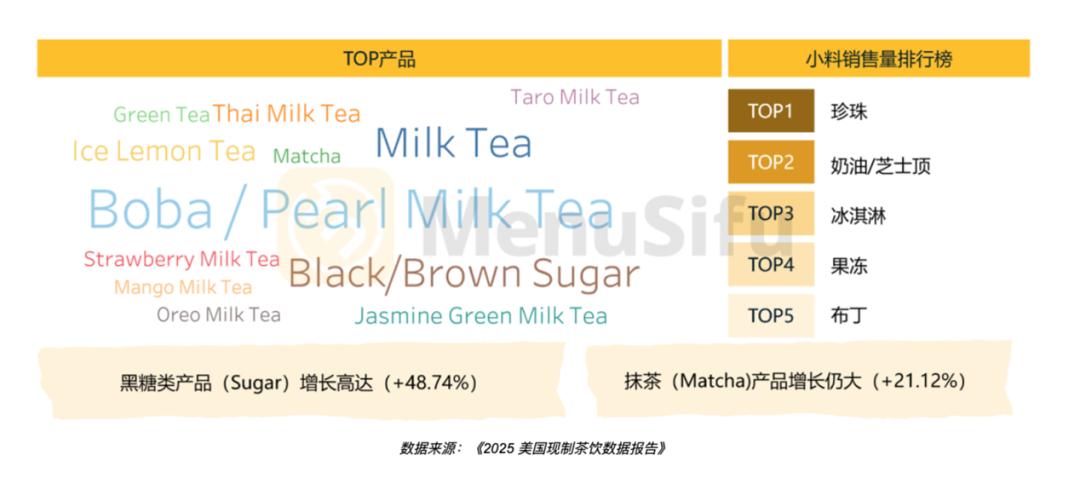
In response, brands must make active adjustments. Chi Xingyuan, the founder of Yuancha, consciously increased the sugar content by at least 30% compared with the domestic standard when developing products. In his opinion, this is not a compromise but a respect for the local market. He also said, "What we need to do is to make delicious products in the US market environment, rather than stubbornly adhering to the so - called authenticity." "American consumers also like a chewy texture. The bigger the pearls, the better. So we put boba in our bubble tea, and the second - best - selling topping is popping boba."
Heytea's region - specific drinks such as "California Sunset" developed for the US market cleverly incorporated local specialties such as navel oranges and honey. The monthly sales volume exceeded 3,000 cups, proving that innovative products combining local ingredients are more likely to be recognized by the market and are an effective way to differentiate from local homogeneous competition. When talking about the reason why Ningji focuses on bubble tea and American - style fruit tea in the United States, Wang Jie frankly said, "North American consumers prefer bubble tea. To achieve localization, we must cater to the taste of local consumers."
Complementary to product innovation is the expansion of consumption scenarios and the creation of experiential value.
Different from the domestic market where small stall - style shops are the mainstream, the US market mostly features large tea drink shops of more than 60 square meters. For example, many stores of Yuantea even have two floors. This forces brands to think about how to use the larger space to enhance the consumption experience. MenuSifu's data shows that up to 36% of US stores bundle milk tea with desserts, fried chicken, and even sushi to create a diversified consumption scenario of "milk tea +".
Therefore, some brands have added "milk tea companions": Yuantea's US stores offer desserts such as soufflés and dorayaki, accounting for nearly 20% of sales; the egg tarts of Jidong Burned Grass Jelly contribute 40% of the sales volume, with a maximum of 2,000 sold in a day; Lanji also sells pineapple buns in the United States. These combinations not only effectively increase the customer unit price but more importantly, attract many customers who were not originally interested in milk tea, creating new consumption demand.
However, for long - term sustainable development, the deepest support lies in the localization of the supply chain. This directly determines how far a brand can go overseas.
Heytea has adopted a heavy - asset investment model and has established a supply system of "regional central warehouse + forward warehouse" in North America to control costs and ensure product stability at the root. Wang Jie saw a more fundamental challenge. Due to the high cost of air freight, she publicly expressed her intention to grow lemons locally in the United States to solve the problem of local supply of core raw materials. This seemingly bold idea points out the core: without the localization of the supply chain, there is no real internationalization of the brand.
Ultimately, the dimension of competition needs to be elevated from the simple product level to the shaping of cultural integration and brand value.
The value of simply selling a cup of beverage is limited. However, if brands can provide American consumers with a "third space" different from standardized coffee shops and traditional fast - food milk tea shops through space design full of Oriental aesthetics and brand narratives containing tea culture, they may create incremental value beyond the product itself.
As Chi Xingyuan frankly said, "Doing business in the United States is a process of making money slowly." He believes that the myth of single - store sales of millions is often unsustainable. In the United States, it is quite good for a tea drink shop with stable business to earn a net profit of 10,000 US dollars per month. Excessive profits are difficult to last.
The journey of Chinese tea drinks in the United States is注定 to be a marathon. Wang Jie regards opening stores in the United States as a career that will last at least ten years. The initial excitement and hustle and bustle will eventually give way to a calm review of the essence of business. When Heytea makes Americans queue up in Times Square, CHAGEE stands firm in Beverly Hills, and Ningji tries to grow lemons in the United States, these Chinese brands are not just selling cups of tea drinks but embarking on a difficult and long - term journey of brand building and cultural integration.
This article is from the WeChat official account "Hangzhou Qiantang Enterprise Overseas Service Base", author: Zhu Ming.