Cultural Global
The funds "leaving the US" are flowing into emerging market countries.

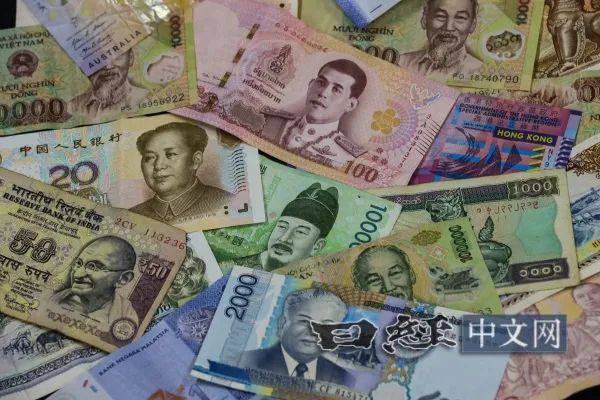
There are two reasons for the capital inflow into the assets of emerging market countries. First, investors have started to adjust their asset structures that are overly focused on the United States. Second, the intensifying depreciation of the US dollar is considered beneficial to the economies of emerging market countries. Triggered by the tariff policies of the Trump administration in the United States, the trend of capital flowing out of the United States has begun...
Global capital has begun to turn to the assets of emerging market countries again. Judging from the inflow and outflow of funds in stocks and bonds, May may see positive growth for the first time in eight months. The Brazilian stock market and others are hovering at high levels. Triggered by the tariff policies of the Trump administration in the United States, the trend of capital flowing out of the United States has started, and emerging market countries have also become an option. The expectation of a temporary halt in the appreciation of the US dollar and the expectation of central banks cutting interest rates are attracting the attention of investors.

The Institute of International Finance (IIF) daily statistics on the extent to which non-residents (overseas investors) invest in the stocks and bonds of emerging market countries, which is used as one of the indicators to measure market sentiment. As of the 22nd of May, the net inflow was 10 billion US dollars. If the positive growth continues until the end of the month, it will be the first time since September 2024 when the Federal Reserve (FRB) decided to cut interest rates after an interval of three and a half years.
Judging from the movements of national stock price indices, the phenomenon of capital flowing into the stocks of emerging market countries is also obvious. The Brazilian Bovespa Index hit a new high on May 20th. Major large-cap stocks such as Itau Unibanco Holding SA played a leading role. South Africa's All-Share Index also hit a new high on May 23rd. The MSCI Emerging Markets Index (calculated in local currency) has risen by 5% compared with the end of last year, outperforming the global index that includes stocks of developed economies.
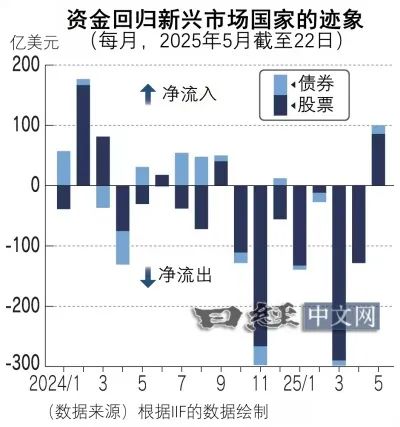
There are two reasons for the capital inflow into the assets of emerging market countries. First, investors have started to adjust their asset structures that are overly focused on the United States. Until last year, global capital flocked to large technology stocks in the United States and corporate bonds in the United States in pursuit of high returns. However, after the Trump administration came to power in the United States, concerns about the US economic outlook and fiscal situation have intensified, and more investors are considering diversifying their assets across regions. Europe, Japan, and emerging market countries have become candidates.
Second, the intensifying depreciation of the US dollar is considered beneficial to the economies of emerging market countries. JPMorgan Chase in the United States upgraded the investment rating of stocks in emerging market countries from "neutral" to "overweight" on May 19th. Regarding the reasons for adjusting the investment rating, it cited the continuous depreciation of the US dollar in the second half of 2025. Bank of America also cited reasons such as the depreciation of the US dollar in its report on May 16th, pointing out that "the opportunity has come" for the assets of emerging market countries.
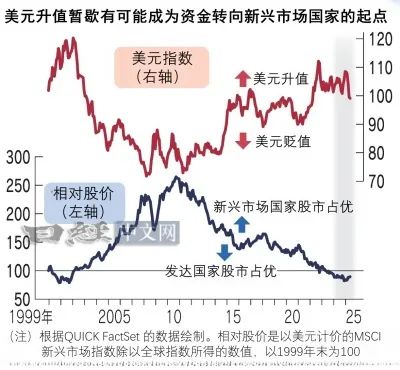
The US Dollar Index, which is an indicator of the US dollar, has been on a downward trend since 2025. Against the backdrop of investors moving away from US assets, the US dollar is more likely to be sold off relative to other major currencies. For the governments of emerging market countries, the depreciation of the US dollar helps to reduce US dollar-denominated debts, and for enterprises, it also helps to reduce the financing costs of US dollar funds. The expectation of an improvement in the credit ratings and finances of the governments and enterprises of emerging market countries may attract new capital.
For the central banks of emerging market countries, the depreciation of the US dollar and the appreciation of their domestic currencies may also increase the room for interest rate cuts. In a situation where the domestic currency is depreciating, central banks are vigilant against further depreciation of the currency and it is difficult to initiate interest rate cuts. This time, in a situation where the depreciation of the US dollar is caused by investors moving away from the United States, the risk of the currencies of emerging market countries depreciating due to interest rate cuts is relatively small. The inflationary pressure in emerging market countries has generally decreased, making it easier to support the economy through interest rate cuts.
Especially for the stocks of emerging market countries, the expectation of monetary easing will be a tailwind. The Central Bank of Mexico decided to cut interest rates for the seventh consecutive time at its monetary policy meeting on May 15th. The main stock index has risen by 18% compared with the end of last year. The Reserve Bank of India (the central bank) changed its monetary policy stance to "accommodative" in April, demonstrating its attitude of promoting economic growth. Supported by the expectation of easing, the Indian stock price index is hovering near the high point since the beginning of the year.
Looking at past situations of the depreciation of the US dollar, the stocks of emerging market countries also have an advantage over those of developed countries. For example, from 2001 to 2010, against the backdrop of the decline of the US Dollar Index, the returns of MSCI Emerging Markets stocks were higher than those of developed countries. After 2010, the US dollar showed an appreciation trend, and the stocks of emerging market countries began to be at a disadvantage. This time, with the expectation of a temporary halt in the appreciation of the US dollar and a shift to a depreciation trend, the attention to the assets of emerging market countries has increased again.
The focus in the future is whether the return of capital to the assets of emerging market countries will continue. The tariff policies of the Trump administration in the United States have brought chaos to global trade and will also affect the economies of emerging market countries. Although it is expected that the economy can be boosted through interest rate cuts, it is hard to say that the economic fundamentals are rock-solid.
The International Monetary Fund (IMF) revised down the growth rate forecast for emerging market countries in 2025 by 0.5 percentage points to 3.7% compared with January in its "World Economic Outlook" revised on April 22nd. The most notable among them is the downward adjustment of trade. The decline in the export growth rate of emerging market countries reached 3.4 percentage points, larger than that of developed countries, which declined by 0.9 percentage points.
Yuta Maeda, a senior economist in charge of emerging market countries and resource-rich countries at SMBC Nikko Securities, pointed out that "countries with a high degree of dependence on external demand, such as Indonesia and Malaysia, face the risk of economic stagnation due to tariffs." The main stock price index in Malaysia, the Kuala Lumpur Composite Index, has fallen into negative territory compared with the end of last year.
This article is from the WeChat official account "Nikkei Chinese Net", author: Nikkei Chinese Net.