Cultural Global
Southeast Asian countries restrict China's roundabout exports in an attempt to secure tariff concessions from the United States.

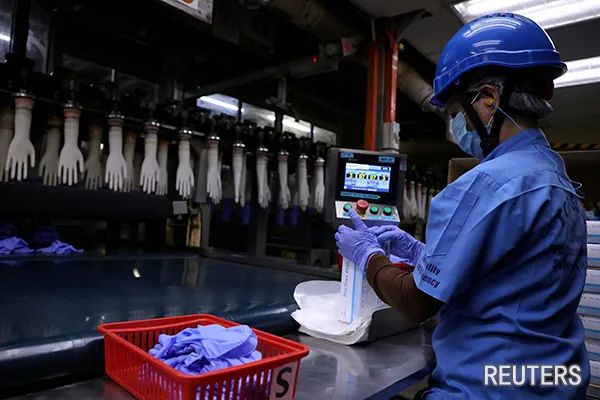
Rubber gloves are one of Malaysia's major export products. (A rubber glove factory in Malaysia, REUTERS)
Thailand and Cambodia will tighten the issuance of certificates of origin. Malaysia has also banned the export of rubber gloves produced overseas. The Trump administration has always regarded Southeast Asia as a base for China's roundabout trade with the United States. Southeast Asian countries are showing a cooperative attitude towards the United States, seeking the relaxation of US tariff policies...
The trend of restricting the roundabout export of Chinese products to the United States in Southeast Asia is expanding. Thailand and Cambodia will tighten the issuance of certificates of origin. Malaysia has also banned the export of rubber gloves produced overseas to prevent acts such as falsifying the place of origin.
Southeast Asian countries are showing a cooperative attitude towards the United States, which is vigilant against roundabout exports, in order to seek the relaxation of US tariff policies.

In late April, the Thai government announced the revision of the rules for issuing certificates of origin. It will conduct on - site inspections of factories for 65 categories of products such as photovoltaic panels and auto parts exported to the United States, and carefully examine the local procurement rate of raw materials and production costs. The issuance of certificates of origin for the targeted categories will also be unified under the Department of Foreign Trade of the Ministry of Commerce.
Previously, not only the Department of Foreign Trade of the Thai Ministry of Commerce, but also the Federation of Thai Industries (FTI) and the Thai Chamber of Commerce (TCC) formed by private enterprises issued certificates of origin. Thailand aims to eliminate discrepancies in reviews, clarify the responsibility for certificate issuance, and also intends to plug the loopholes in roundabout exports.
The Ministry of Commerce of Cambodia has also decided by departmental order that starting from the 12th, when issuing certificates of origin for the United States, relevant officials may need to inspect the production bases.
The Trump administration has always regarded Southeast Asia as a base for China's roundabout trade with the United States. The United States has stated that it will impose high - level reciprocal tariffs of 49%, 46%, 36%, and 24% on Cambodia, Vietnam, Thailand, and Malaysia respectively.
In fact, according to the Free Trade Agreement (FTA) between China and the Association of Southeast Asian Nations (ASEAN), Chinese products flow into the local area at low tariffs. Subsequently, there have been continuous cases where the products are exported to the United States after changing the origin label or temporarily storing the finished products in warehouses to change the place of origin and conceal that they are Chinese products.
The United States is the largest export partner of Vietnam and Thailand, and the second - largest export partner of Malaysia. The US reciprocal tariffs have a significant impact on the economies of the above - mentioned countries. It can be seen that these countries are showing their sincerity in preventing China's roundabout trade, with the intention of getting the United States to make concessions.
Vietnam, which shares a border with China and is considered to have become a base for roundabout exports, took the lead in taking countermeasures. In mid - April, the Ministry of Industry and Trade of Vietnam asked the issuance agencies of certificates of origin to strengthen countermeasures. In 2024, Vietnam's trade surplus with the United States exceeded 100 billion US dollars. Ranking third after China and Mexico, there is a strong sense of crisis that it is likely to become a target of the Trump administration.
According to reports from the National News Agency of Malaysia (Bernama) and others, the Malaysian government also decided in late April to only allow rubber glove export enterprises to export locally produced gloves. Rubber products are among the top five categories of Malaysia's exports to the United States.
There are expectations that such countermeasures by various countries will help protect domestic industries. For example, Chinese enterprises centered on electric vehicles (EVs) have successively entered Thailand, but some point out that most of the parts are made in China.
This article is from the WeChat public account “Nikkei Chinese Net”, author: Nikkei Chinese Net.