Cultural Global
The latest revision of the Foreign Trade Law provides the latest practical guide for enterprises going global | Overseas Insights


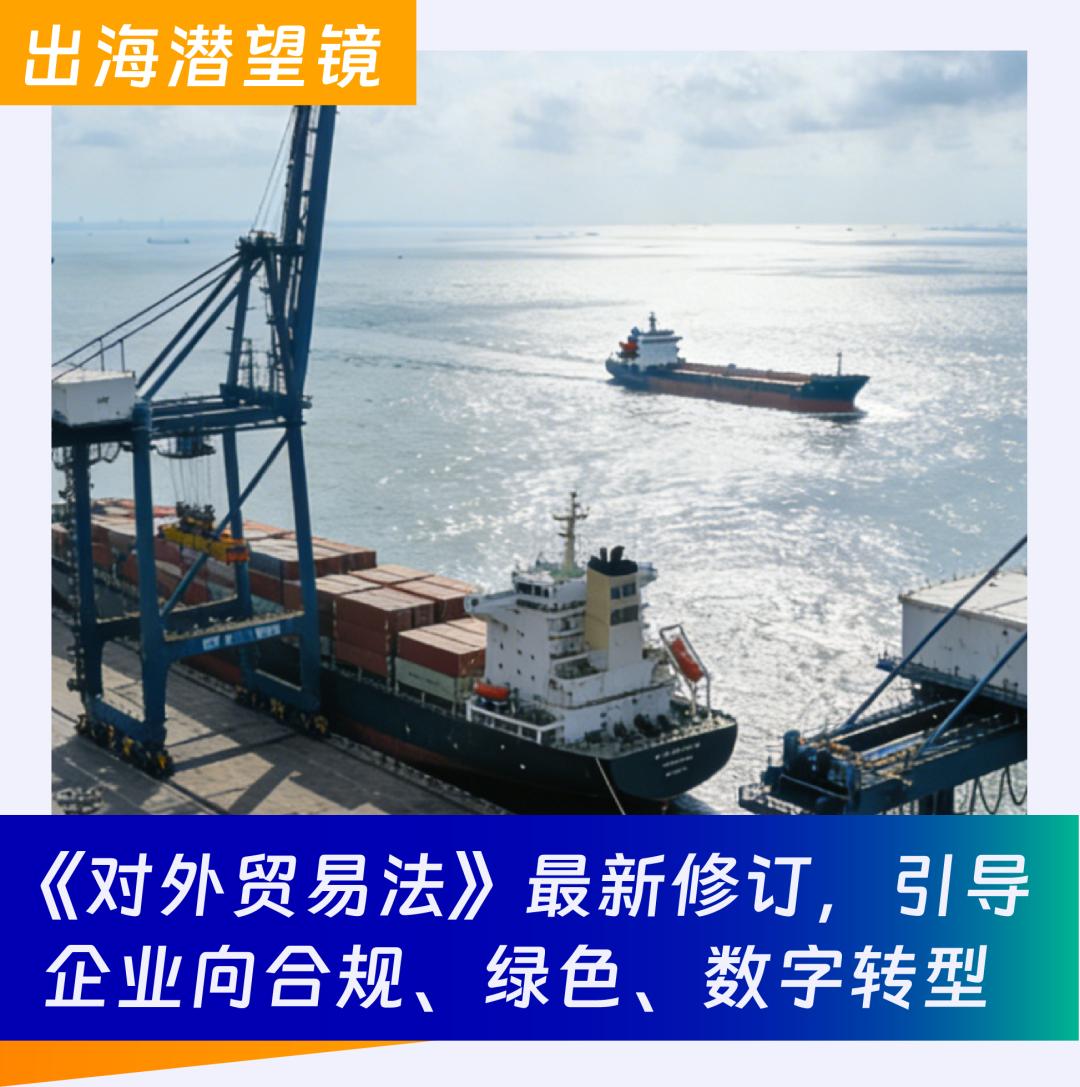
Against the backdrop of a significant increase in the implicit costs of global trade, China's foreign trade has shifted from a stage of high-speed growth to a stage of high-quality development. New business models such as cross-border e-commerce, digital trade, and green trade are booming. However, previously, there was a lack of clear legal positioning and regulatory requirements in these emerging fields, and most enterprises were operating in a vague state.
In early March, the newly revised Foreign Trade Law has officially come into effect, providing new practical guidelines for enterprises going global. On the one hand, enterprises are required to actively align with international high-standard economic and trade rules, especially new rules in areas such as green trade, digital trade, and intellectual property protection. On the other hand, enterprises are guided to transform from extensive exports to green, digital, and compliant operations. For example, if an enterprise fails to complete carbon footprint accounting and digital compliance certification in advance, it will face risks such as restricted market access and high additional costs. This prompts enterprises to actively adapt to new international rules and improve their compliance levels in the green and digital fields.
01
Strengthen the compliance bottom line of "Four Flows in One"
Compliance Bottom Line

The newly revised Foreign Trade Law clearly stipulates that enterprises shall not evade the payment of domestic taxes payable on exports and shall not defraud export tax refunds, imposing strict constraints on enterprises' previous fiscal and tax handling methods. Enterprises can no longer have a fluke mentality. They must conduct tax declarations and payments in accordance with laws and regulations.
At the same time, enterprises must hold fast to the basic bottom line of "Four Flows in One" to ensure that the information of the goods flow (or service flow), capital flow, invoice flow, and contract flow is completely matched. This requires enterprises to ensure that the information in these four aspects is mutually verified in each business transaction, clearly proving the authenticity, legality, and rationality of the business. For example, in import and export business, the information in various links such as the transportation documents of goods, the payment vouchers of funds, the issuance of invoices, and the signing of contracts should be consistent to cope with any possible tax inspections.
Since tax authorities can systematically obtain key tax-related information of operators on the platform through the platform, they can more comprehensively and accurately grasp the tax situation of enterprises and achieve penetrating supervision of taxes. This will make enterprises more standardized in their fiscal and tax behaviors. It also helps to create a fair competition market atmosphere and reduce unfair competition behaviors.
02
Implement the negative list management system for cross-border service trade
Negative List Management System

The negative list management model clearly defines the prohibited and restricted areas. Enterprises can freely carry out business in areas outside the list, and they can more boldly explore new cross-border service trade models and business areas without being overly restricted and fettered.
Although the list model gives enterprises more freedom, it also means that enterprises need to pay more attention to compliant operations. They must carefully study the content of the negative list to ensure that their business is not on the prohibited and restricted list. They must also strictly abide by relevant laws, regulations, and international rules during business operations to avoid being punished for illegal acts.
Due to the uncertainty in areas outside the list, this model requires enterprises to strengthen the construction of risk assessment and early warning mechanisms, comprehensively assess risks in aspects such as the market environment, policies and regulations, and cultural differences, and formulate response measures in advance.
03
Trade security review: From ex-post supervision to ex-ante pre - placement
Shift from Post - event Supervision to Pre - event Prevention

The revision of the new law establishes the governance principle of "emphasizing both opening up and security" and establishes a trade policy compliance mechanism through mandatory compliance assessment. Based on this, enterprises should conduct a comprehensive security assessment of their own business and incorporate it into their daily operation and management. Establish a regular security assessment mechanism, regularly conduct a comprehensive review of their business processes, supply chains, partners, etc., and promptly identify potential security risks.
Secondly, establish a strict screening mechanism for trading partners. At the front - end stages such as project initiation and cooperation negotiation, conduct detailed due diligence on trading partners. Not only should you understand the basic information, business reputation, and operating conditions of trading partners, but also focus on screening whether they are on the sanctions list and whether they have records of illegal acts. For example, before cooperating with a new supplier, an enterprise should investigate its background through official channels and professional third - party institutions, and start cooperation only after confirming that there are no trade security risks. At the same time, avoid providing technical, financial, or logistics assistance to third parties to evade countermeasures to prevent being implicated in illegal acts.
In addition, embed trade security prevention and control into the front - end stages such as project initiation and cooperation negotiation of enterprises, realize the pre - placement of the prevention and control mechanism. Fully consider trade security factors during the project planning stage and formulate corresponding security prevention and control measures and emergency plans. During the cooperation negotiation process, clarify the responsibilities and obligations of both parties in terms of trade security with trading partners and sign detailed contract terms to ensure that the trading activities of both parties meet trade security requirements.
04
Development and improvement of new trade fields
Development and Improvement of New Trade Areas

The revision of the new law officially incorporates digital trade and green trade into the legal framework. Relevant compliance certifications have been upgraded from bonus items for enhancing competitiveness to entry items for entering the international market, which means that only enterprises that obtain official certifications can obtain compliance qualifications in the digital trade and green trade tracks and enter the international market.
For example, in the field of green trade, after an enterprise obtains certifications such as low - carbon product certification and carbon footprint accounting reports, it can meet the demand for green products in the international market, and its products are more likely to be accepted by the international market, thereby expanding its market share. Therefore, enterprises need to accelerate the alignment with green trade standards and promote the electronicization of foreign trade documents to meet international mutual recognition standards. However, it should also be noted that all these require enterprises to invest a certain amount of human, material, and financial resources, which may become an obstacle for some small and medium - sized enterprises to enter the new trade fields.
The government may introduce a series of policy support measures, such as financial subsidies, tax incentives, and financial support. Enterprises can make full use of these policy supports to reduce their operating costs and improve their profitability. For example, the government provides financial support to digital trade enterprises, and enterprises can obtain low - interest loans or financing guarantees to solve their capital problems.
In addition, enterprises need to continuously update and upgrade their technical equipment and management systems to meet the development needs of new trade fields, otherwise, they may be eliminated by the market. For example, by mastering new technologies such as big data, artificial intelligence, and blockchain, enterprises can improve their digital operation capabilities; by researching and applying green production technologies and energy - saving and emission - reduction technologies, they can reduce the impact on the environment.
05
Effectively use the new law to protect the intellectual property rights of enterprises going global
Effectively Utilize the New Law to Protect the Intellectual Property Rights of Enterprises Going Global

The new law strengthens the coordinated protection of foreign trade and intellectual property rights. Enterprises should carry out overseas intellectual property layout in advance and complete standardized registration. Before exporting products, enterprises should conduct in - depth research on the intellectual property laws and regulations of the target market, and understand information such as the scope of intellectual property protection, application procedures, and protection periods in the local area.
According to the needs and characteristics of the target market, enterprises should apply for patents, register trademarks, and register copyrights for their core technologies and products to ensure that their intellectual property rights in the overseas market are legally protected. For example, when a technology enterprise is preparing to export a new product to the US market, it should apply for relevant patents and trademarks at the US Patent and Trademark Office in advance to prevent the product from being infringed in the US market.
In addition, it is recommended that enterprises establish cooperation with foreign - related law firms and arbitration institutions, establish an overseas rights - protection emergency plan, and clarify the response procedures for intellectual property infringement and trade remedy investigations. When encountering intellectual property infringement disputes, enterprises can quickly启动 the emergency plan and take effective response measures. For example, when finding infringing products in the overseas market, enterprises should promptly entrust foreign - related law firms to conduct investigations and collect evidence, and collect evidence of infringement; according to the infringement situation, choose an appropriate rights - protection method, such as sending a warning letter, filing a lawsuit, or applying for arbitration. At the same time, enterprises should maintain close communication with arbitration institutions, understand the arbitration procedures and rules, and ensure the smooth progress of the rights - protection process.
In addition to advance layout and emergency plans, enterprises should also strengthen internal intellectual property management, establish and improve intellectual property management systems and processes, strengthen intellectual property training and education for employees, and improve employees' awareness and protection ability of intellectual property rights. For example, enterprises can formulate intellectual property confidentiality systems to strictly protect the core technologies and trade secrets of the enterprise; they can also establish an intellectual property incentive mechanism to encourage employees to carry out technological innovation and intellectual property creation; they can also regularly evaluate and audit the intellectual property status of the enterprise to promptly discover and solve existing problems.
*The information and views contained in this article do not constitute any investment advice and are for reference only.
This article is from the WeChat official account "Comprehensive Service Port for Zhejiang Enterprises Going Global", author: Zhejiang Enterprises Going Global.