Cultural Global
Six emerging stars from Hangzhou ring the bell at the Hong Kong Stock Exchange. Coohom becomes the world's first publicly-listed company in spatial i



On April 17th, Qunhe Technology officially listed on the Hong Kong Stock Exchange, becoming the first listed company among the "Six Little Dragons of Hangzhou". The IPO issue price was HK$7.62, and it opened with a more than 171% increase, reaching HK$20.7. As of press time, Qunhe Technology's stock price was reported at HK$17.80, with a market value exceeding HK$30 billion.
According to a report by Frost & Sullivan, in terms of 2024 revenue, Qunhe Technology is the largest provider of space design software in China, holding a market share of approximately 23.20%. In 2025, Qunhe Technology's core product, "Cooljia", had served more than 47,400 enterprise customers and over 400,000 individual customers.
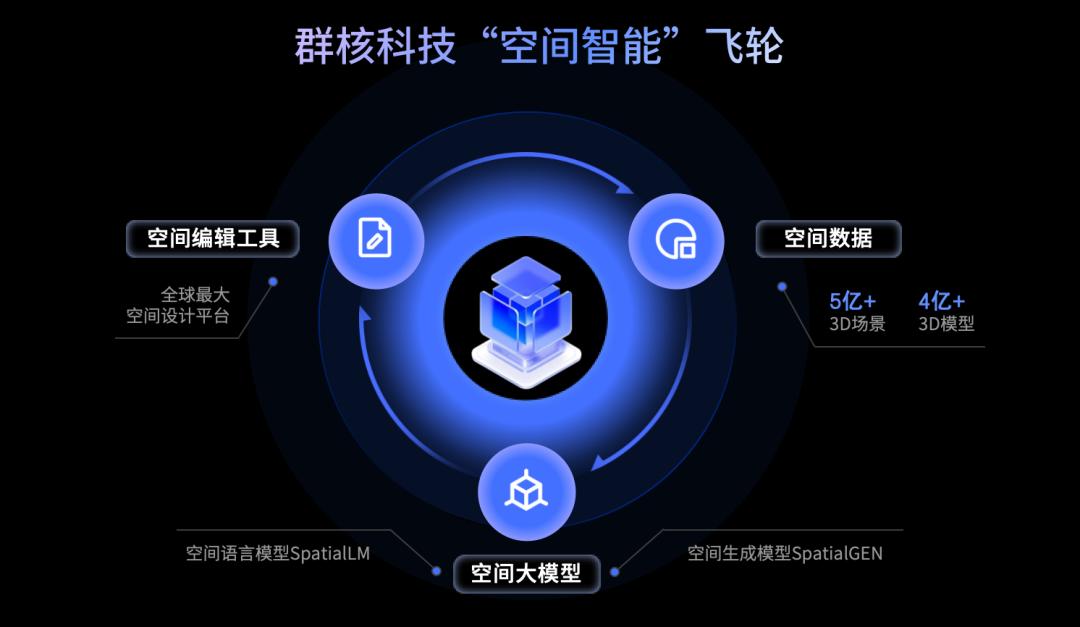
In the era of AI intelligence, Qunhe Technology's business scope is expanding from the space design field to space intelligence. It has currently launched the space intelligence platform SpatialVerse, released the space language model SpatialLM and the space generation model SpatialGen, as well as the open platform Aholo, opening up its space intelligence capabilities to the outside world in the form of APIs.
Overseas, Qunhe Technology adopts differentiated strategies for different global market regions. In the South Korean market, it has deeply tied up with industry leaders to achieve stable business growth; in North America, it focuses on product refinement to open up the local market; in India, it quickly promotes its products through "offline + online" methods to gain the initiative in the market.
01
Domestic market share exceeds 60%
Business expands to space intelligence

According to the prospectus, from 2023 to 2025, Qunhe Technology's revenue increased from RMB 664 million to RMB 820 million, and its gross profit margin also rose from 76.80% to 82.20%. During the same period, the company's annual losses were RMB 646 million, RMB 513 million, and RMB 428 million respectively. However, it is worth noting that in 2025, Qunhe Technology reached an inflection point in its performance. Measured by non-IFRS, the company's annual adjusted net profit reached RMB 57.127 million, achieving a turnaround from losses.
Looking at the revenue structure, the subscription fees for the Cooljia product contributed almost all of the revenue. The rendering speed of traditional design software depends on the performance of the user's own computer GPU. In contrast, Cooljia deploys the software on the cloud and conducts parallel computing by mobilizing a large-scale GPU cluster, greatly shortening the rendering time and thus quickly seizing the market. Chen Hang, the co-founder and CEO of Qunhe Technology, said in a public speech in 2025 that Cooljia's market share in the home design field exceeds 60%.
This choice of technological path is related to the previous work experience of Huang Xiaohuang, the founder of Qunhe Technology. He once worked as a software engineer at NVIDIA and found that CUDA (Compute Unified Device Architecture) could significantly accelerate graphic rendering, so he applied it to GPU computing power cloud services.
Looking at the user structure, currently, more than 80% of Qunhe Technology's revenue comes from B2B enterprise customers, of which 45.70% is contributed by large customers, covering industries from home customization to chain catering, such as Mengtian Home, Shiniman, and Xijie Fried Chicken Skewers. Taking Xijie Fried Chicken Skewers as an example, Qunhe Technology provides it with the BIM design tool of Cooljia, helping Xijie Fried Chicken Skewers output 3D visual store design plans for franchisees, and providing services such as AI model quick matching, direct generation of 3D models from 2D layouts, and automatic annotation of cloud rendering.
In 2025, the number of C2C individual customers decreased slightly year-on-year, but the overall revenue increased by 49.21%, mainly due to the increase in the subscription revenue per customer. The prospectus shows that the average revenue contributed by individual customers increased from RMB 216 in 2023 to RMB 302 in 2025, a rise of approximately 39.82%.
Currently, Qunhe Technology's business focus is shifting from indoor design and effect rendering to space intelligence. In 2024, Qunhe Technology launched the space intelligence platform SpatialVerse for training embodied intelligence and robot models, and has reached cooperation with embodied intelligence enterprises such as Zhiyuan Robotics, Galaxy Universal, Qiongche Intelligence, Zhifang, Songying Technology, Digua Robotics, and Mouxianfei.

In 2025, Qunhe Technology released the space language model SpatialLM and the space generation model SpatialGen, which have the ability to understand and generate three-dimensional environments. In specific applications, SpatialLM can recognize the spatial structure in CAD drawings, and SpatialGen can generate 3D scenes based on the input text, completing some operations on the basis of understanding spatial relationships, so that designers no longer need to start modeling from scratch.
In the same year, Qunhe Technology also launched the open platform Aholo, opening up its space intelligence capabilities to the outside world in the form of APIs. Huang Xiaohuang recently said in a public interview that as the number of people actually involved in work decreases and the usage of machine computing power increases, Qunhe Technology's charging model is gradually shifting from charging per person to selling computing power.
02
Overseas revenue share gradually increases
Adapt to local conditions in different markets

In 2018, Qunhe Technology launched the international version of Cooljia, Coohom. As of the end of 2024, the number of registered users of Coohom exceeded 10 million, and the proportion of overseas revenue has also been increasing year by year.
Although the current proportion of overseas revenue is still relatively small, Qunhe Technology said in the prospectus that it will continue to expand its reach in the global market. Although overseas expansion requires the addition of private computing clusters, increasing the complexity and cost of operations, the unit pricing of international business is also higher than that in the domestic market, which is beneficial for Qunhe Technology to maintain its overall profit margin.
According to Chen Hang's previous introduction, the products and services provided by Qunhe Technology in the overseas market are mainly divided into two categories: one is 3D cloud design tools and middle platforms that support multiple languages; the other is whole-house customization design tools and integrated design and production solutions for custom furniture manufacturers and retailers.
Looking at the segmented markets, South Korea, Southeast Asia, the United States, and India are the core overseas markets.
Among them, the South Korean market is the first stop for Qunhe Technology's overseas expansion. In 2019, Qunhe Technology established a cooperation with Hanssem, a leading home furnishing enterprise in South Korea, integrating Coohom into Hanssem's overall marketing, sales, quotation, order, production, delivery, and installation systems, enabling Hanssem to achieve information management and production automation. Currently, the revenue from the South Korean market accounts for 30% of Qunhe Technology's total overseas revenue.
In contrast, Qunhe Technology's expansion in the North American market has experienced some twists and turns. In 2018, Qunhe Technology signed its first batch of North American customers by participating in exhibitions, but later found that the user usage rate and retention rate were not high. According to previous public information, Chen Hang analyzed that the main reason for the cold reception in the North American market was the huge difference in user habits between North America and China.
To address this, Qunhe Technology made adjustments to its product design: first, it simplified the interaction interface to meet the preferences of local users; second, it expanded the brand models according to industry characteristics and adapted to product coding rules (such as "B12"); third, it followed local output specifications, including imperial units, drawing annotations, and list formats. In addition, Qunhe Technology's North American team also specially developed kitchen and bathroom and cloakroom design tools, and finally achieved a breakthrough in the number of customers.
In the Indian market with a unique geopolitical environment, Qunhe Technology adopted a completely different localization strategy: by recruiting a large number of local teams and making large-scale investments in online channels to seize the market, it avoided local distributors from privately selling products and disrupting the price system.
If "product going global" is the obvious line for Qunhe Technology's overseas expansion, then "technology going global" by providing "virtual photo studio + 3D AI technology" for cross-border e-commerce merchants is more like a hidden line. A common pain point faced by cross-border sellers is how to quickly produce diverse product pictures that meet the aesthetics of different regions according to the iteration speed of new products.
In response, Qunhe Technology's Cooljia e-commerce studio shooting platform replaces traditional on-site shooting with "virtual photo studio + 3D AI technology", and has launched more than 5,000 selected studios in different styles and more than 300,000 accessory models for cross-border e-commerce enterprises to use, reducing the production cycle of a single set of product pictures from several days to several hours. Aoji Co., Ltd. is also a major customer of this business. According to the prospectus, in the first half of 2025, the revenue from the cross-border e-commerce virtual studio shooting business increased by 188% year-on-year.
In the future, Qunhe Technology will also continue to expand into a broader global market. In public information, Chen Hang once summarized it like this: "From software going global to empowering Chinese enterprises to go global, Qunhe's AI going global has also evolved from 'landing' overseas to 'ferrying' more enterprises overseas."
*The information and views contained in this article do not constitute any investment advice and are for reference only.
This article is from the WeChat official account "Comprehensive Service Port for Zhejiang Enterprises Going Global", author: Zhejiang Enterprises Going Global.