Cultural Global
China's auto exports hit the brakes hard.


Reuters reported that BYD is advancing the strategic transformation of its European business, shifting from EVs to emphasizing PHVs. Data from the China Association of Automobile Manufacturers shows that the export of new energy vehicles only increased by 6.7% in 2024, and the annual export volume in 2025 is expected to increase by 6% year-on-year. This will be significantly lower than the growth rate before 2024...


Source | Nikkei Chinese Net (ID: rijingzhongwenwang)
Cover Source | Nikkei Chinese Net
The export growth of Chinese automobile enterprises is continuously slowing down. From 2021 to 2024, the annual growth rate reached 20% to 100%, but it is expected to drop to 6% in 2025. This is due to the sluggish demand for pure electric vehicles (EVs), in which Chinese manufacturers have an advantage in Europe and Southeast Asia. Enterprises such as BYD are shifting from pure electric vehicles to placing more emphasis on plug-in hybrid vehicles (PHVs), and various automakers are forced to re-examine their export strategies.
At the Shanghai International Automobile Exhibition, the world's largest auto show that ended on May 2nd, despite facing headwinds in exports, major automakers still successively launched strategic models targeting overseas markets, showing no sign of decline on the surface.
The emerging pure electric vehicle manufacturer Shanghai NIO announced that it will launch the high-end pure electric small car brand "Firefly" in 16 countries within 2025. It will also launch its first right-hand drive vehicle and export it to Southeast Asia and Europe. The starting price in China is 119,800 yuan. Qin Lihong, the president in charge of overseas business, said that in the future, NIO will expand its business in major right-hand drive vehicle markets around the world.
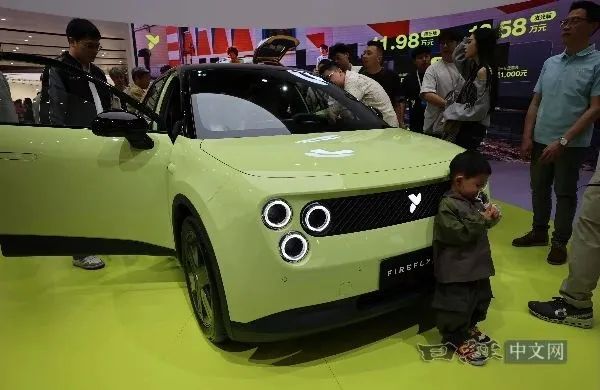
NIO's "Firefly" at the Shanghai Auto Show (Photographed by Shin'ya Sawai in Shanghai, China on April 26th)
Against the backdrop of increasingly fierce domestic competition, major Chinese automobile manufacturers have been seeking opportunities in the export market. From 2021 to 2024, China's automobile exports increased by one million vehicles annually, with an annual growth rate of up to 20% to 100%. In 2023 and 2024, China's automobile export volume jumped to the top in the world in the statistics by country.
Smartphone manufacturer Xiaomi also launched the pure electric vehicle it introduced in the spring of 2024 at the Shanghai Auto Show. Xiaomi plans to expand into overseas markets starting in 2027 and set up a pure electric vehicle R & D base in Germany. GAC Group introduced a pickup truck concept car designed for overseas markets. It is reported that mass production will start around 2027.
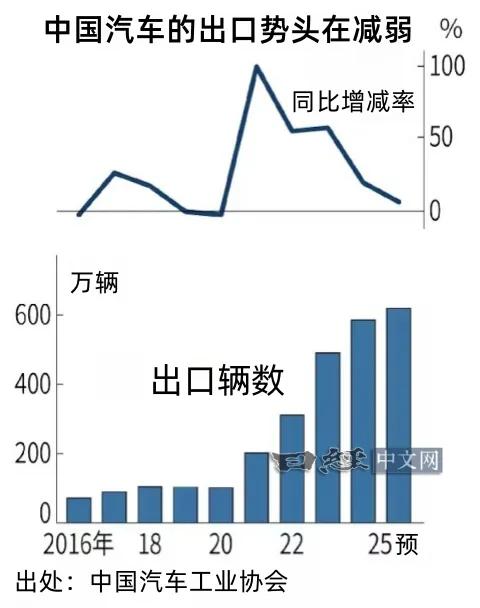
However, data from the China Association of Automobile Manufacturers shows that in 2024, the export of fuel vehicles increased by 23.5%, while the export of new energy vehicles only increased by 6.7%. If limited to pure electric vehicles, exports decreased by 10.4%. After entering 2025, the slowdown trend became more obvious. The export volume in March 2025 only increased by 1%. The association predicts that the annual export volume in 2025 will reach 6.2 million vehicles, a year-on-year increase of 6%. This will be significantly lower than the growth rate before 2024.
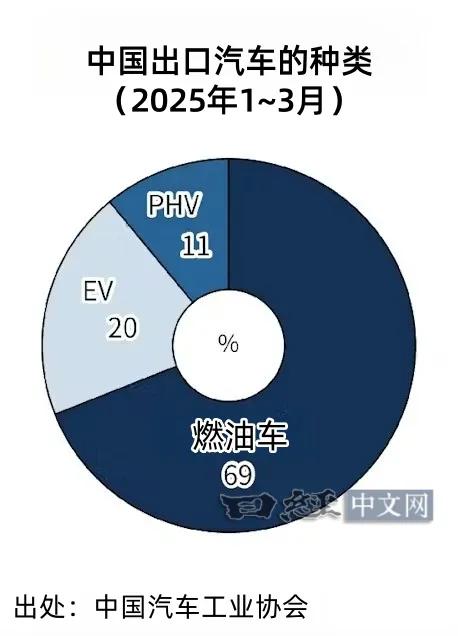
Behind this trend is the slowdown in EV exports. From January to March 2025, the total export volume of Chinese automobiles was 1.42 million vehicles, of which EVs accounted for about 20%, but the growth was weak. In Southeast Asia, Thailand, the largest market, tightened the approval of auto loans due to concerns about the rise in household debt. At the same time, the construction of charging infrastructure required for the popularization of EVs is still incomplete. Although BYD started local production in Thailand in 2024, its sales in Thailand decreased by about 10% compared with 2023.
In Europe, the EU imposed additional tariffs on Chinese EVs in October 2024. Although the EU is expected to negotiate with China and consider setting a minimum price instead of the tariff increase measure, the overall situation remains severe. At the Shanghai Auto Show, a designer from a large European automaker also said: "Although Chinese cars perform well in terms of technology, European cars have stronger brand influence."
Reuters reported that BYD is advancing the strategic transformation of its European business. It is reported that BYD has adjusted its strategic approach, shifting from EVs to emphasizing PHVs. BYD has hired executives from local large enterprises such as Stellantis in Europe and appointed them as the heads of markets in various European countries.
An executive of SAIC Maxus said in an interview with Chinese media that the overseas sales strategy will shift from using agents to direct management.
Analysis by Goldman Sachs in the United States shows that China's EV production capacity in 2023 reached 1.2 times the world's demand. The domestic market with sluggish consumption alone cannot fully absorb it. It is expected that China will continue to focus on exports, and the vigilance of export destinations may further increase.
This article is reprinted from Nikkei Chinese Net