Cultural Global
Costing $7 billion! China to help Saudi Arabia connect the Arabian Peninsula

As the final negotiations on costs and financing are nearing completion, Saudi Arabia is preparing to officially start the construction of the $7 billion Saudi Land Bridge project early next year.
Transport and Logistics Minister Saleh Al-Jasser announced at a forum in Riyadh last year that Saudi authorities are in talks with the Saudi-China Land Bridge Consortium (SLCC) to finalize the project's budget and financing arrangements. The investors in SLCC are the Saudi Railways Organization (SAR) and the China Civil Engineering Construction Corporation.
China Civil Engineering Construction Corporation (CCECC), formerly the Foreign Aid Office of the Ministry of Railways of the People's Republic of China, organized and implemented China's largest foreign aid project - the Tanzania-Zambia Railway. It has successively undertaken and implemented representative projects such as the railway restoration and renovation in Nigeria, the railway renewal and renovation in Botswana, the Djibouti Business and Technical School, the Thilawa Road-Rail Bridge in Yangon, Myanmar, the Rwanda National Stadium, the urban overpass in the UAE, the highways in Kuwait, the Nepal International Conference Center, the Hong Kong West Rail, the Macau Ximen Bridge, and the Macau Border Inspection Building.
▍Connecting the Peninsula: Obstacles to Project Implementation
Since the feasibility study was launched in 2003, building a railway on the Arabian Peninsula has long been the focus of attention for decision-makers and economists in the Gulf Cooperation Council due to its strategic and economic significance. However, over the past two decades, various political, financial, and economic factors have hindered the completion of the project.
First, the aftermath of the 2008 global economic crisis led to the postponement of many infrastructure projects (including railways) in the Gulf Cooperation Council region. The sovereign wealth funds of the Gulf Cooperation Council suffered significant losses, estimated between $450 billion and $600 billion, as the value of investment assets declined or creditworthiness deteriorated during the economic downturn.

After years of economic impact, the global oil price decline in 2015 followed. According to Kamco Investment Company, the total budget deficit of the Gulf Cooperation Council countries approached $160 billion that year. The International Monetary Fund estimated that the annual income of oil-exporting countries in the Middle East and North Africa also decreased by approximately $390 billion compared to 2014.
Subsequently, due to the financial impact of the COVID-19 pandemic, these financial challenges resurfaced more severely between 2020 and 2021, affecting many strategic projects in the Gulf region.
Due to the postponements caused by the above objective reasons, the Saudi Land Bridge remains one of the most anticipated infrastructure projects in Saudi Arabia. Crown Prince Mohammed bin Salman reaffirmed the government's commitment to the project when he launched the National Transport and Logistics Strategy in June 2021.
During President Xi Jinping's visit to Saudi Arabia on December 9, 2022, the two countries issued a joint statement reaffirming their intention to strengthen cooperation in transport and logistics, including railway modernization. The statement emphasized accelerating the completion of relevant studies for the Saudi Land Bridge project. Nearly two years later, Saudi Arabia's land bridge plan is finally back on the agenda.
▍Saudi Land Bridge: A Key Infrastructure Plan
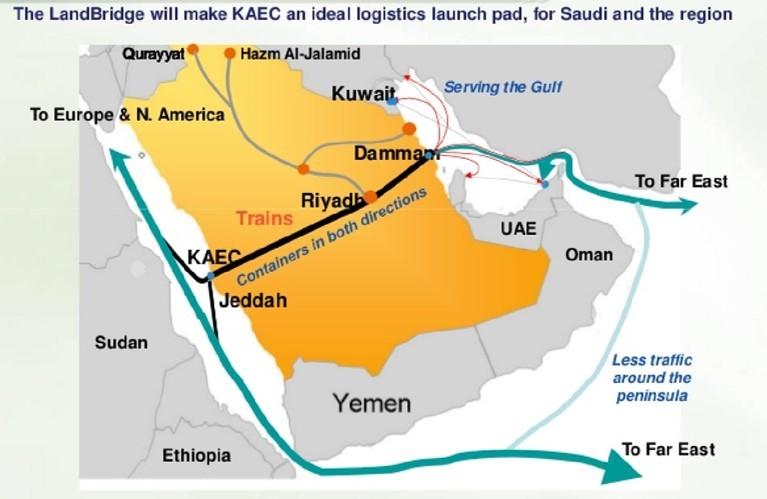
The Saudi Land Bridge project will be one of the largest infrastructure projects in Saudi Arabia, led by the Saudi National Railway Authority. The project consists of six main railway lines:
Jubail Industrial City: The first line upgrades the internal network of Jubail Industrial City, adding 10 kilometers of new tracks. Construction has already begun.
Jubail to Dammam: The second line extends 35 kilometers and is currently under construction, enhancing connectivity between Jubail and Dammam.
Dammam to Riyadh: This line involves upgrading the existing 87-kilometer track between Dammam and Riyadh.
Riyadh Bypass Line: The fourth line, known as the Riyadh Bypass Line, will connect the northern and southern parts of the city's network. The project is divided into two sections, with track lengths of 67 kilometers and 35 kilometers respectively.
Riyadh to Jeddah and King Abdullah Port: The fifth line connects Riyadh and Jeddah, extending to King Abdullah Port, with three stations at Jamuma, Moya, and Al-Doadmi. The Riyadh to Jeddah line is 920 kilometers long, and the line to King Abdullah Port will add another 146 kilometers.
King Abdullah Port to Yanbu: A new 172-kilometer line will connect King Abdullah Port and Yanbu Industrial City.
In addition to these lines, seven logistics centers will be established, including facilities in Jubail Industrial City, Dammam Dry Port, the relocated Riyadh Dry Port, King Khalid International Airport in Riyadh, Jeddah Dry Port, King Abdullah Port, and Yanbu Industrial City.