Cultural Global
From "going it alone" to "clustered overseas expansion", 20 Years of Chinese Enterprises' Venturing into Thailand | Overseas Periscope


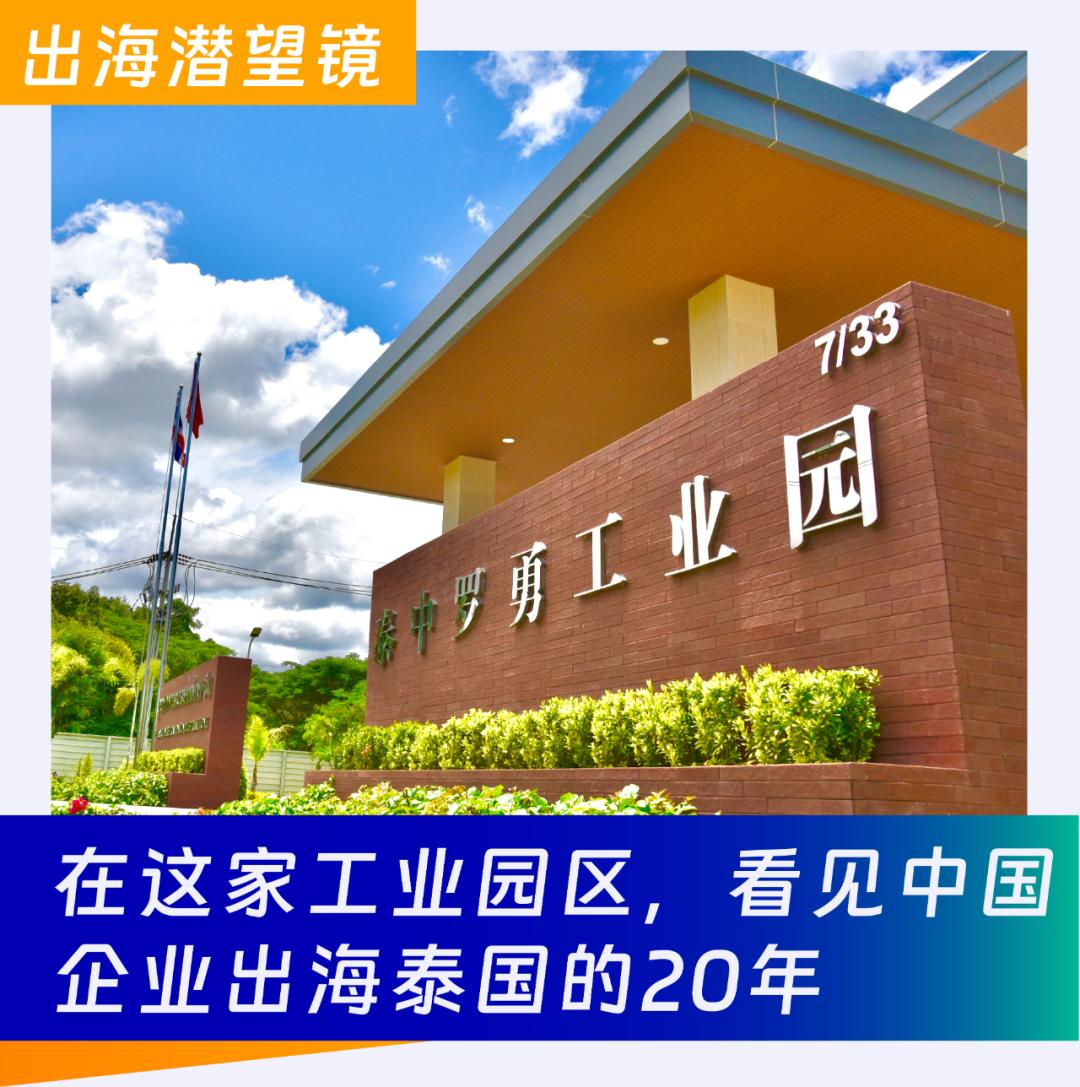
In 2005, when Zhao Bin first set foot on this land in Rayong, the Thai-Chinese Rayong Industrial Park had not yet been launched. As far as the eye could see, there was only undeveloped red soil and stretches of rubber plantations. Back then, he could not have imagined that 20 years later, this place would one day become one of the largest industrial clusters for Chinese enterprises in Southeast Asia.
Today, signs in Thai, Chinese and English hang at the entrance of the park. During the daily morning rush hour, more than 70,000 workers in different work uniforms ride motorcycles into the park gates, about 90% of whom are local Thais.
Zhao Bin is now the President of the Thai-Chinese Rayong Industrial Park. Having witnessed the park's development over more than two decades, he now sees nearly 300 Chinese-invested enterprises gathered here. The park was initially dominated by light industry, hardware and auto parts companies, but now more new energy vehicle, energy storage, new material, electronics and electrical appliance enterprises have settled in. The industrial structure has been continuously iterated along with the pace of China's industrial upgrading.
Unlike the early overseas enterprises that went to Thailand alone, facing problems of regulations, supply chains and labor with only one factory and several production lines, most of the enterprises gathered in the park now are in the upstream and downstream relationship of the industrial chain. Centering on the leading enterprises of the industrial chain, they build industrial clusters overseas under the "protection" of the Chinese park.
01
An Electric Meter Factory
How It Grew Into A Cluster Of 300 Enterprises
In the early 2000s, Thailand's infrastructure was relatively sound among ASEAN countries, but still relatively backward. The supporting facilities of the energy system could not meet the needs of a large number of foreign investment layouts; although there were sufficient ordinary labor resources, skilled technical industrial workers were scarce.
At that time, Holley had accumulated years of technical and manufacturing experience in the domestic electric meter industry. As the company set "internationalization" as one of its three major development strategies, Holley accelerated the pace of overseas expansion and boldly made a decision that was not mainstream at the time: to build an electric meter factory in Thailand.
At that time, a Thai electric meter agency had a long-term cooperative relationship with Holley and was relatively familiar with local technical requirements, so Thailand became Holley's first stop to go global.
"The reason why the company dared to make the decision was based on several factors: Thailand is located in the center of ASEAN, geographically close to China; China-Thailand relations are good with low political risks; Thailand has full market economy status and extensive free trade agreements with economies such as Europe and the United States," Zhao Bin recalled.
When Holley first arrived in Thailand, the team members could not speak Thai and were completely unfamiliar with local laws and regulations, labor systems and tax systems. Every step from company registration, qualification project approval to construction permit application had to be explored by themselves, and they often took detours because they were not familiar with the process. Due to the language barrier and the difference between local production standards and domestic ones, many raw materials and parts could only be shipped from China, and the delivery time was uncontrollable.
In those years, Holley recruited and trained local workers while exploring and understanding Thailand's labor laws and tax systems, gradually gaining a firm foothold in Thailand. Its products were also able to enter Thailand's power system, and a number of stable local customers were accumulated.
These four to five years of practical experience gave Holley an in-depth understanding of the Thai market. An idea began to take shape within Holley: since the company had stepped in so many pitfalls and explored so much experience, why not share these experiences with more Chinese enterprises that wanted to come to Thailand?
In 2005, the Thai-Chinese Rayong Industrial Park was officially launched for development. The initial park area was small, there were not many enterprises willing to settle in, and investment attraction was not easy. Holley talked to enterprises one by one in China, shared its own experiences and lessons in Thailand, helped them calculate costs, review policies and find sites.
The Thai-Chinese Rayong Industrial Park plays the role of a "guide" in Thailand, relying on its own platform capabilities, it organizes scattered Chinese enterprises and provides a full range of services, from pre-settlement policy consultation, company registration, qualification project approval, construction permit application, to post-settlement personnel recruitment, compliance operation, financial support, and all kinds of services required in the enterprise operation process.
02
Changes of Settled Enterprises
Reflect the Evolution of Chinese Enterprises' Overseas Expansion
Over the past 20 years, the structure of enterprises settled in the Thai-Chinese Rayong Industrial Park has gone through several rounds of changes, from which the evolution of the entire wave of Chinese enterprises going global can be glimpsed.
Zhao Bin divides this change into four stages:
The first stage was the early 2000s. At that time, Japanese automakers were the "main force" going to Thailand, most of which had been deeply cultivated in Thailand for more than 40 years and established a mature automotive industry chain. Therefore, Thailand was known as the "Detroit of the East", and the market share of Japanese cars exceeded 90% at its highest. Under such an industry background, the Chinese enterprises settled in the Thai-Chinese Rayong Industrial Park were mainly small and medium-sized companies in the traditional light industry, hardware auto parts and home appliance parts industries, mostly engaged in processing and assembly. Most of these enterprises already had mature production capacity in China, and some even had saturated production capacity. They came to Thailand hoping to avoid high tariffs on Chinese products in European and American markets and explore overseas consumer markets.
The second stage was around 2010. On January 1, 2010, the China-ASEAN Free Trade Area was officially completed, and zero tariffs were realized for 93% of traded products. With the substantial reduction of tariffs, export-oriented enterprises coming to Thailand began to increase, mainly manufacturing enterprises focusing on light industry, home appliances and hardware.
The third stage was the period of Sino-US trade frictions around 2018. At that time, export enterprises targeting the US market were widely affected, and they moved their production capacity to Southeast Asia one after another.
The fourth stage is the wave of new energy vehicles going global since 2020. With the implementation of Thailand's EEC (Eastern Economic Corridor) policy, BOI (Board of Investment) has issued a series of preferential policies for new energy vehicles. Chinese automakers including BYD, Great Wall, SAIC, Changan, GAC and Chery have successively built factories in Thailand, driving a large number of upstream and downstream supporting enterprises to settle in the park. Energy storage and smart home appliances have become popular, and high-tech industries such as semiconductors, optical communications and data centers have also poured in rapidly in the past two years.
03
The Localization Rate Is Only 20%
The Hardest Part Of Going Global Is Not Building A Factory
In contact with a large number of enterprises going to Thailand, Zhao Bin found that many enterprises' understanding of Thailand deviates greatly from the facts.
A common misconception is to regard Thailand as a low-cost country. In fact, the cost of labor and land in Thailand has been rising for many consecutive years, and enterprises relying on low-cost advantages cannot gain a firm foothold locally.
In addition, the window of opportunity for entrepôt trade is also shrinking. As Thailand's rules of origin become more and more strict and the requirements for the proportion of localization continue to increase, simple entrepôt trade can no longer meet the rules of origin standards.
Zhao Bin believes that the real core advantage of Thailand at present is no longer the cost advantage, but the relatively complete and mature logistics, transportation and industrial supporting system, stable and continuous business environment and preferential policy system, and the radiation capacity to ASEAN and major global economies, coupled with the strong growing demand for consumer markets such as new energy vehicles and smart home appliances in Thailand and surrounding countries.
At present, the self-sufficiency rate of local supply chains of Chinese home appliance and new energy vehicle enterprises in Thailand is generally low. Only leading enterprises have a high localization rate, and a large number of small and medium-sized enterprises are still in the stage of "domestic procurement and Thai assembly", and most of the raw materials and semi-finished products need to be imported from China.
In Zhao Bin's view, the difficulty in increasing the localization rate first lies in the capability of local suppliers. "Many times, it is not that local suppliers do not want to do it, but that they cannot do it - the precision is not enough, the color is not accurate, and the delivery time is unstable."
More importantly, many of the existing local suppliers are supporting Japanese and South Korean enterprises, whose standards and systems are not fully compatible with Chinese enterprises, and they operate independently from Chinese-funded supply chains with little mutual penetration. Even if Chinese enterprises find local suppliers, the quotations of local suppliers are often more expensive than the cost of domestic procurement plus sea freight, which makes enterprises have no incentive to purchase locally.
Even so, localization is still an unavoidable path for enterprises that want to take deep root in Thailand.
On the one hand, Thailand continues to launch localization-oriented policies. For example, in the field of new energy vehicles, automakers are encouraged to increase the proportion of local parts supporting. The government gives rewards to complete vehicle and parts enterprises that meet the requirements of localized procurement through tax reductions and tariff preferential measures, guiding multinational automakers to increase procurement and investment in Thailand.
On the other hand, the vulnerability of cross-border supply chains has been repeatedly verified, abnormal sea freight, port congestion, geopolitical conflicts... Any problem in any link may lead to production line shutdown. "Only by building the supply chain locally can we shorten the delivery time, improve the response speed, and deeply participate in the local market competition. In the short term, the cost is higher, but in the long run, it is a required course for enterprises to survive and develop in Thailand," Zhao Bin said.
He suggested that when there is no suitable local supplier, enterprises can first adopt the "group going global" model, bringing domestic supporting enterprises to the local area together, to form a mutually supportive cluster effect from factory planning, production line automation to digital system construction.
"Going global is never as simple as moving a domestic factory to another country. It is a restart of entrepreneurship from scratch, which requires continuous investment in re-understanding the market, building supply chains, and cultivating teams, and operating as a local enterprise," Zhao Bin said. "All the enterprises that have gained a firm foothold in Thailand have gone through such a path."
*The information and opinions contained in this article do not constitute any investment advice and are for reference only.
This article is from the WeChat official account "Zhejiang Enterprises Overseas Comprehensive Service Port".