Cultural Global
Panorama of Overseas Development of China's New Energy Vehicles: Everything You Need to Know About Europe and Four Major Emerging Markets | Overseas

Data newly released in July this year by the China Association of Automobile Manufacturers shows that China's new energy vehicle exports have accounted for more than 50% of total auto exports for two consecutive months. In the past, China's auto exports were long dominated by fuel vehicles, while new energy vehicles are now becoming a new engine driving export growth.
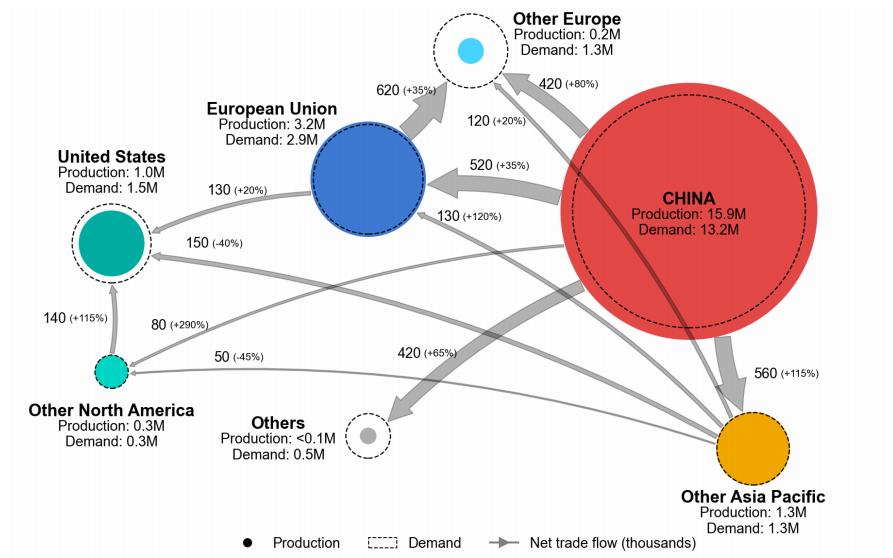
Illustration: Output, demand and net trade volume of electric vehicles in major global markets
Source: International Energy Agency (IEA)
According to the *Global EV Outlook 2026* released by the International Energy Agency (IEA), China's new energy vehicle overseas market generally presents two major characteristics:
Stable sales growth in mature European markets
Accelerating penetration in emerging economies
Sales of Chinese-made electric vehicles in the European market in 2025 nearly doubled compared with 2024, reaching about 940,000 units. But at the same time, the proportion of Europe in China's total electric vehicle exports continues to decline, dropping to about 40% in 2025, and more than half of overseas sales flow to emerging markets such as Southeast Asia (+130%), Latin America (+55%), the Middle East (+60%) and Africa.
Leading position of local Chinese automakers strengthened
The report shows that 80% of Chinese-made electric vehicles sold overseas in 2025 are manufactured by Chinese independent brands, while this proportion was less than 40% in 2021. Brands including BYD, Chery, Geely, Leapmotor and SAIC MG rely on advantages such as high cost-effectiveness and rich performance, their sales share in overseas markets has been rising year by year. Although the total export volume of foreign-funded automakers such as Tesla, Renault Dacia and BMW remains stable, their combined export share has dropped by nearly 40% year-on-year.
This article sorts out five major new energy vehicle markets in Europe, Southeast Asia, Latin America, the Middle East and Africa, presents the unique consumer characteristics, competition patterns and policy trends of each market, and shows the opportunities and challenges faced by Chinese new energy vehicles in overseas markets.
Europe
The top destination for China's new energy vehicle exports
01

IEA data shows that for the whole year of 2025, new energy vehicle sales in the 27 EU countries reached 4.2 million units, a year-on-year increase of over 30%, accounting for 28% of all new car sales. In the first half of 2026, electric vehicle sales in Europe surpassed fuel vehicles for the first time (ACEA).
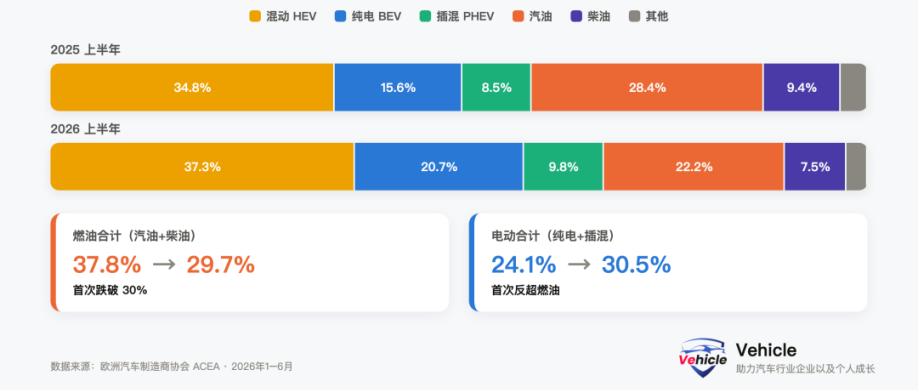
Illustration: Powertrain structure of newly registered vehicles in Europe
Source: Vehicle Official Account
In terms of specific national markets, IEA data shows that for the whole year of 2025, sales in developed Western European countries such as Germany, France and the United Kingdom rank at the top, the fastest growing markets are Turkey (+200%), Poland (+125%), Spain (+80%) and Italy (+65%), and the highest penetration rate appears in Nordic countries such as Norway (97%).
Europe has always been the top destination for China's new energy vehicle exports. According to statistics from the China Passenger Car Association, China exported 1.08 million electric vehicles to Europe in 2025, accounting for 40% of total exports, a year-on-year increase of about 50%. Bloomberg cited Data Force data that in June 2026, the market share of Chinese brands in newly sold plug-in hybrid electric (PHEV) vehicles in Europe has exceeded one third.
Consumer characteristics
High brand loyalty
A 2025 survey by Zeekr shows that European consumers have high loyalty to local brands, and they prefer products from established European automakers, Japanese and South Korean automakers when purchasing cars, but the overall public impression of Chinese electric vehicles is improving: nearly half of the respondents recognize the outstanding cost-effectiveness advantages of Chinese electric vehicles, and 40% of respondents believe that Chinese high-end pure electric models can compete head-to-head with competitors such as Tesla.
LCP Delta, a European energy research institution, pointed out that consumers in countries such as the United Kingdom, Spain and Poland have the highest acceptance of Chinese electric vehicles, and about three quarters of respondents hold an open and receptive attitude; while consumers in Nordic countries such as Norway and Sweden are still relatively cautious about Chinese brands.
Competition pattern
Tripartite confrontation of "Tesla - local automakers - Chinese brands"
Autohome pointed out that the competition landscape of the European electric vehicle market is being reshaped by three forces: Tesla, local European automakers and Chinese brands.
Tesla still retains the advantage of single-model sales. CleanTechnic data shows that Tesla Model Y and Model 3 topped the new energy sales list in Europe in the first half of 2026, but due to factors such as aging product lines, delayed delivery rhythm and intensified industry competition, its sales declined in 2025.
Facing the competition of new energy vehicles, local European automakers are striving to cope. Volkswagen Group, Stellantis and Renault Group are accelerating the launch of pure electric models covering mainstream price ranges, relying on their existing sales networks, service systems and brand awareness to recapture market share. However, shortcomings still exist: intelligence and software experience are relatively lagging behind, the supply chain of some key components still relies on China, and there is structural pressure in cost control.
In contrast, Chinese brands, relying on extreme cost-effectiveness and vertically integrated industrial chain capabilities, are the biggest variable in the current European market. Data Force data shows that in April 2026, the combined sales of Chinese brand pure electric vehicles in Europe reached 38,281 units, a year-on-year increase of more than 100%, and their share in the European pure electric vehicle market exceeded 15% for the first time, hitting a record high.
However, Chinese brands still face challenges in the European market such as insufficient brand premium, imperfect after-sales service system, and policy risks such as EU anti-subsidy tariffs. In the long run, building overseas factories, carrying out local OEM cooperation and deepening local operation will be the core path for Chinese automakers to enhance brand influence and avoid trade barriers.
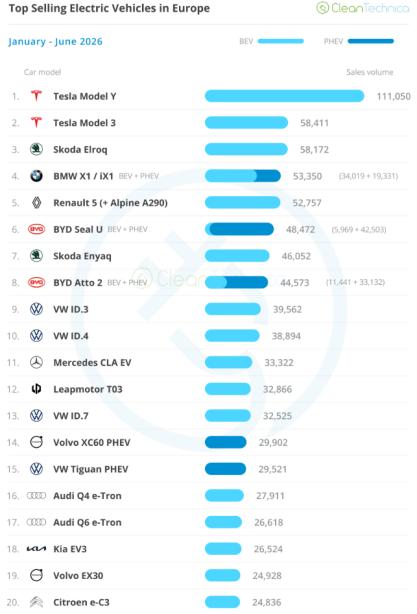
Illustration: Sales ranking of various new energy vehicle models in Europe from January to June 2026
Source: CleanTechnica
Policy trend
The electrification trend remains unchanged, but compliance and localization pressures are increasing
The new energy vehicle-related policies in Europe have both advantages and disadvantages for Chinese brands, with both opportunities and pressures. On the one hand, Europe has long adhered to the general direction of electrification emission reduction, continuously releasing demand for new energy vehicles. The European Union and its member states continue to launch supportive policies for the development of new energy vehicles, including the adjustment of the 2035 fuel ban policy, the *Automotive Industry Package*, the *Critical Raw Materials Act*, the *Industrial Acceleration Act*, etc.
On the other hand, subsidies are increasingly tied to local production, supply chain transparency and life cycle carbon footprint requirements, bringing higher compliance and localization pressure to automakers that mainly rely on local manufacturing in China. The EU plans to expand the scope of anti-subsidy duties to plug-in hybrid (PHEV) models, and will launch the "Supply Chain Diversification Tool" and the *Public Procurement Act* in September this year, which will bring challenges to Chinese automakers such as rising tariffs, supply chain compliance, and restricted access to the public market.
Southeast Asia
The world's fastest growing new energy vehicle market
02

According to IEA statistics, total electric vehicle sales in Southeast Asia in 2025 increased by 100% year-on-year to 500,000 units, with one electric vehicle in every five new cars on average. In terms of specific countries, sales in Vietnam and Indonesia both rose by 100% year-on-year, and Thailand's sales increased by 70% year-on-year, the three countries lead the sales across the region. Although electric vehicle sales in Malaysia and the Philippines are growing rapidly, the overall market penetration rate is still low; Singapore, with a high penetration rate of over 60%, has become a mature electric vehicle market second only to Norway.
Consumer characteristics
High price sensitivity
PwC's *ASEAN-6 eReadiness Survey Report* shows that Southeast Asia as a whole is in the early stage of a rapidly growing electrification transformation. Among the respondents, only 11% already own electric vehicles, 76% are potential buyers, and 13% are wait-and-see or resistant consumers.
For a large number of potential buyers, economic practicality is the primary consideration. According to PwC statistics, 48% of people in the six ASEAN countries have a car purchase budget of less than 46,000 US dollars, 15% of people have a budget within 11,000 US dollars. New energy potential customers are concentrated in light luxury groups, technology enthusiasts and early adopters, while the willingness of the largest base of ordinary working class and thrifty people is relatively low.
Competition pattern
Led by Chinese automakers, local VinFast is rising
The IEA report shows that the current new energy vehicle market in Southeast Asia has obvious market segmentation: relying on localized factories and affordable product matrices, Chinese brands contribute more than half of new car sales; Vietnamese automaker VinFast, backed by local industrial policies and its own charging ecosystem, has long monopolized the new energy market in Vietnam.
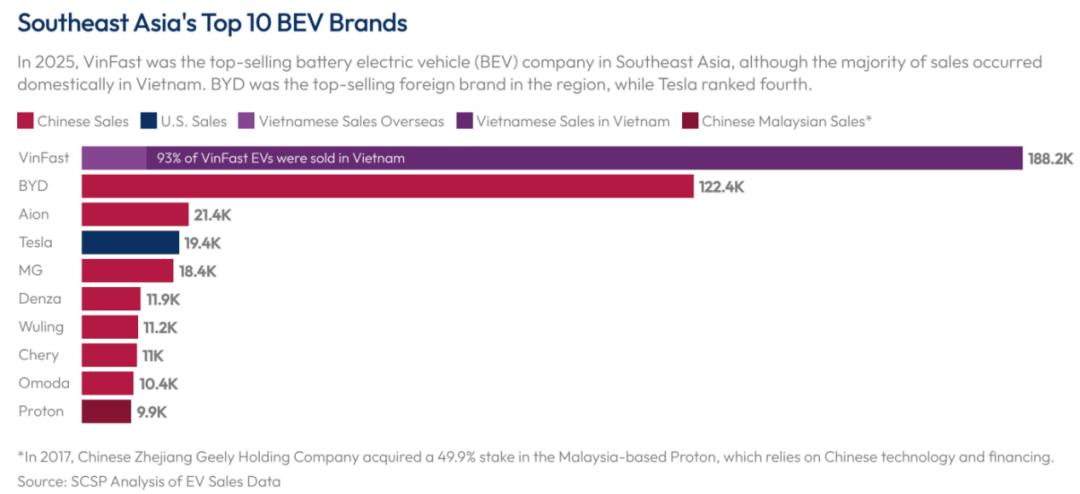
Illustration: Top 10 brands of battery electric vehicle (BEV) sales in Southeast Asia
Source: Special Competitive Studies Project (SCSP), USA
In the short term, Chinese automakers' position as the leader of electric vehicles in Southeast Asia is relatively stable, but internal competition is also fierce:
BYD's regional sales are far ahead, occupying about one third of the market share in Thailand, the largest pure electric vehicle market in ASEAN, and its Indonesian factory was officially put into operation this year;
Chery entered the Malaysian market in 2022, adopting a differentiated route of two brands: Omoda for trendy young people and Jaecoo for off-road high-end positioning, and it is one of the fastest growing Chinese automakers in the local area;
GAC Aion focuses on the positioning of affordable family cars, cooperates with Indonesian dealer Indomobi to expand channels, and its Aion Y Plus model has become the first choice for affordable practical family electric vehicles in Thailand;
Leapmotor, with the help of Stellantis' mature distribution network, quickly lands in the existing dealer systems of Thailand, Malaysia and other countries; SAIC Group reduced consumers' unfamiliarity with the brand by acquiring the British sports car brand MG, and its MG ZS model has become one of the best-selling Chinese electric vehicles in Southeast Asia;
Geely acquired 49.9% of the shares of Malaysian brand Proton in 2017, which is a vivid case of Chinese automotive groups penetrating the Southeast Asian market (JustChinaCars).
Policy trend
Shifting from import dividend to local manufacturing
According to *China Auto News*, the stage in which Southeast Asia rapidly drove electrification relying on zero tariff for complete vehicle imports has come to an end. Since 2026, Thailand, Malaysia and Indonesia have successively introduced new restrictive policies for new energy vehicles. The policy focus has shifted from stimulating end consumption to attracting investment and cultivating local complete vehicles and upstream and downstream supply chains, forcing overseas automakers to abandon the pure trade model and set up local CKD production lines.
Latin America
An emerging market dominated by Chinese enterprises
03