Cultural Global
Build an ecosystem, advance global co-creation, and accelerate the overseas expansion of Chinese online literature, presenting a fascinating China to


Web novel *Lord of the Mysteries* and its card and other peripheral derivatives are on display at the British Library. Courtesy of Yuewen Group
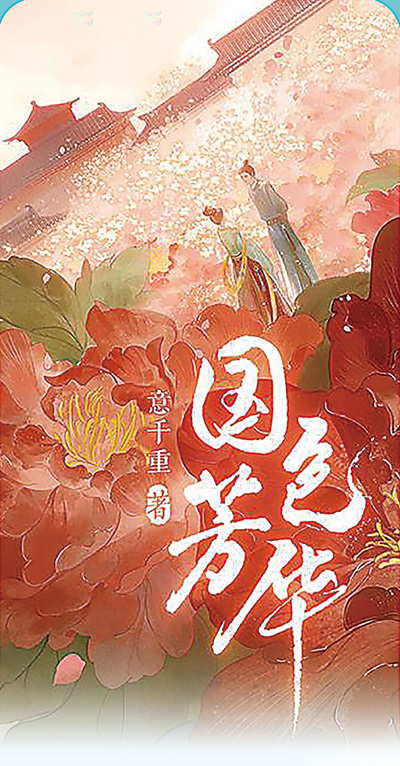
The cover of Chinese web novel *The Splendid Tang Dynasty* that has been included in the collection of the British Library. Courtesy of Qidian Read
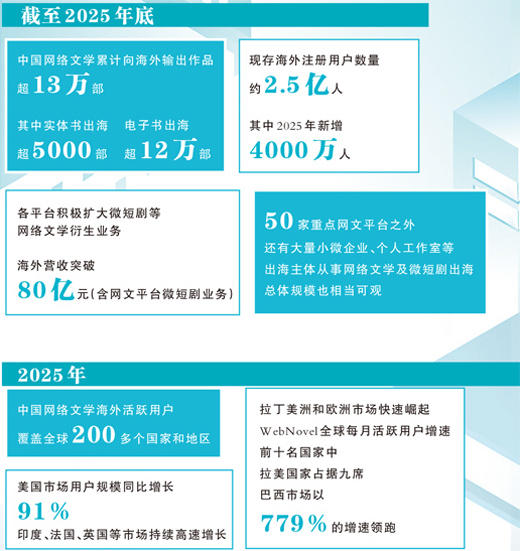
Data Source: *2025 Blue Book of Chinese Online Literature*
The global expansion of Chinese online literature is accelerating into a broader blue ocean.
The *2025 Blue Book of Chinese Online Literature* (hereinafter referred to as the "Blue Book") recently released by the China Writers Association shows that by the end of 2025, Chinese online literature has exported more than 130,000 works overseas in total, with about 250 million registered overseas users, active users covering more than 200 countries and regions around the world, and overseas revenue exceeding 80 billion yuan (including the micro-drama business of online literature platforms)... In 2026, promoting the overseas export of high-quality online literature and other cultural products has been written into the outline of the 15th Five-Year Plan.
Online literature, a literary form engraved with the mark of the Internet and the blood of new mass art since its birth, has become one of the most dynamic carriers for the construction of a cultural power and the global dissemination of Chinese culture. What new features does the overseas expansion of online literature present? How can Chinese online literature integrate into the global cultural industry system? Where is the next stop for its overseas journey?
Opening a new window for overseas young people to observe China
"*Lord of the Mysteries* is the best Chinese web novel I have ever read! Behind the Victorian era background, steampunk aesthetics and mysterious fantasy system, there is a complete worldview system..."
"The author weaves the story so exquisitely, with long-term foreshadowing and callback of hints, which is comparable to classic Western fantasy works!"
On Webnovel, the overseas reading platform, the Chinese web novel *Lord of the Mysteries* has been translated into more than 10 languages, becoming a phenomenal hit in the overseas expansion of Chinese online literature.
"The outer shell of the story seems very 'Western', but the core is very 'Chinese'." In the view of the author "Cuttlefish That Loves Diving", the novel not only depicts the common emotions of human beings, but also attracts overseas readers with the unique traditional value system in Chinese culture. "For example, the worldview of the protagonist Klein that 'when poor, one should preserve one's own virtue; when prosperous, one should spread virtue to the whole world' drives him to make completely different choices from the protagonists in Western stories at the critical moment of fate."
The Blue Book points out that the traditional Confucian and Taoist culture, chivalrous spirit and patriotism embodied in online novel genres such as fantasy, martial arts and historical novels are becoming symbols of Chinese civilization sought after by readers around the world.
"This is also a two-way convergence between the high-quality upgrading of Chinese online literature and the reading expectations of overseas young readers." Li Wei, a professor at Nanjing Normal University, believes that at the moment of accelerating globalization, Generation Z overseas young people are more eager to see a real China that is not obscured by prejudice, and online literature, with its openness and inclusiveness, has become an important window for overseas young people to observe Chinese society and understand the spiritual world of the Chinese people.
The connection is strengthening, and the participation is deepening. Chinese online literature not only provides overseas readers with a large number of high-quality reading texts, but also opens up a new path for them to participate in depth and create independently.
Kevin, a post-90s young man from the UK, is a loyal reader of Chinese web novels. Once, he submitted his own online novel to a traditional publisher, but got rejected. "They said my writing style would never be accepted by them." Kevin then turned to create on Chinese online literature platforms. A few years later, a work that integrates the "system" element of Chinese web novels with Western fantasy settings became very popular overseas.
"It's like Harry Potter meets Sun Wukong." Kevin said that the cultural elements such as "universe" and "level-up" in Chinese web novels, the narrative mode of "system novels" and the creation method of long-form serialization have provided him with a complete set of methodology for online literature creation.
"The global co-creation wave is gestating a new universe of youth cultural IP dominated by young people, and a truly world market is taking shape." said Hou Xiaonan, CEO and President of Yuewen Group. With the rapid development of AI (Artificial Intelligence) translation technology, more and more Chinese web novels are translated into multiple languages with one click to reach global readers. The activated overseas young people also participate in it, telling their own cultural stories with the help of the Chinese online literature model.
The Blue Book also points out that the overseas expansion of Chinese online literature has evolved from the early stage of text export to the stage of narrative export and cultural export. The production mechanism of Chinese online literature has been successfully replicated overseas, forming a sustainable self-development capability.
"Chinese online literature platforms are like a huge and active community where young people from all over the world communicate, interact and create, embarking on a common journey." said Da Z, a post-90s Mexican web novelist. Chinese online literature platforms provide extremely valuable opportunities for writers who want to turn their creative passion into a sustainable career.
"We not only want to bring good Chinese stories overseas, but also hope to bring the creation experience, production mechanism and business model that Chinese online literature has explored for more than 20 years to the outside world, so that people from all over the world who have creative ability and are willing to write can tell their own stories. From 'Chinese online literature going to the world' more than 20 years ago to 'world stories meeting in China' today, a globally co-created online literature ecosystem is being established." said Wang Zhongjie, General Manager of Overseas Business of Yuewen Group.
Deeply integrating into the global cultural industry system
The overseas expansion of online literature never stops at the text itself.
At the beginning of 2026, the micro-drama *A Commoner of High Standing* produced by China Literature Group became a hit overseas. This micro-drama adapted from a web novel made many overseas audiences stay up late to follow the updates, and many audiences even spontaneously made illustrations of various knowledge in the drama, setting off a wave of secondary creation on overseas social platforms.
"The new round of cultural going global is the coordinated overseas expansion of various cultural products such as online literature, online games and online dramas, and online literature has become the largest IP source of all cultural products." said Ma Tao, General Manager of the Strategic Department of China Literature Group Co., Ltd. He believes that compared with the single overseas model of translation and copyright sales, the content export chain of "online literature IP - overseas reading distribution - micro-drama adaptation - global distribution" is becoming the new direction of the industry.
"Under this full-link IP development model, an excellent web novel can also gain loyal audiences of film and television dramas, animation lovers, peripheral fans and so on." said Mu Yihan, Head of Overseas Micro-drama Content of China Literature. "Therefore, users have more channels to learn about an IP and choose their favorite form to enter the story." said Ni Zhongyu, Overseas Editor of Yuewen Group.
"IP adaptation also endows online literature with a second life, and with the help of AI technology, the change is subversive." Ma Tao introduced that in the past, the film and television adaptation of published works had high cost and long cycle, while AI can efficiently screen out works suitable for adaptation from a huge amount of online texts and directly convert them into AI micro-dramas.
"Take the web novel *A Commoner of High Standing* as an example, 4 adapted micro-dramas of the same name have been launched, with a total of 396 episodes." Ma Tao believes that world-class super IP will also be born in Chinese online literature in the future.
In fact, Chinese online literature IP has already sparked a global development boom and deeply integrated into the global cultural industry system.
In 2025, C-Drama (Chinese drama) became a hot word overseas. The dramas adapted from works under Jinjiang Literature City landed on mainstream overseas platforms: the urban drama *Hidden Love* topped the rankings of Netflix in Chinese Taiwan, Chinese Hong Kong, Singapore and other regions, breaking the broadcast record of Chinese dramas on Netflix; the copyright of the costume drama *The Longest Promise* has been sold to 17 countries... Hu Hui juan, Vice President of Jinjiang Literature City, believes that in the early stage of going global, using high-quality cultural products to open up overseas cultural markets and form specific influence, and then carrying out work export or operation will get twice the result with half the effort.
Whether it is using AI empowerment to open up new fields of online literature IP, or polishing high-quality works to achieve success in both domestic and international markets, the overseas expansion of online literature has formed a systematic force that jointly promotes Chinese narratives to the world. The *2025 Report on IP Transformation of Chinese Online Literature* released at the 2026 Chinese Online Literature Forum points out that online literature IP is reshaping the cultural industry ecosystem, and cross-media in-depth integration has entered a new stage.
Starting from text export, online literature works have gradually built a multi-form coordinated three-dimensional communication system. "IP + cultural tourism", "IP + exhibition", "IP + market"... The new stage of global IP ecological co-construction for the overseas expansion of online literature is promising.
Jointly write a more brilliant chapter
As the overseas expansion of online literature enters the next phase, opportunities and risks coexist. It requires the coordinated efforts of overseas enterprises to actively respond to changes and the support of relevant government departments.
Regarding the many challenges faced by the overseas expansion of Chinese online literature, practitioners generally say that the biggest problem is the increasingly prominent pressure of copyright protection.
"At present, the copyright protection laws and regulations in various overseas countries are uneven. Overseas, a web novel may be pirated within 24 hours after its release, and it is real-time, hidden and across the whole network, which is very difficult to trace." Ma Tao feels helpless about this. "Once piracy is found, we will complain to overseas platforms as soon as possible, but their response efficiency is extremely low, and some enterprises have to suffer in silence and simply do not safeguard their rights."
Faced with the widespread dilemma of rights protection, "most enterprises fight alone and lack teamwork" has become a dilemma to be broken through. Tong Zhilei, Chairman and President of China Literature Group Co., Ltd., said that there is currently a lack of corresponding industry associations or institutions in China to help Chinese cultural enterprises fight for their rights and interests overseas. "We expect the government to establish an industry organization to collectively voice the opinions of the industry. The effect will be better."
Xia Lie, Vice President of the Online Literature Research Institute of the China Writers Association, pointed out that the current overseas expansion of online literature is mostly reflected in the market behavior of individual enterprises, lacking the substantive participation of academia, cultural organizations and institutions, which hinders the in-depth exchange and dialogue between different civilizations. The Blue Book suggests that under the background that the overseas expansion of online literature has been incorporated into the top-level national design, more practical supporting policies need to be launched to fully stimulate the enthusiasm and creativity of business entities to go global.
For the standardized development of online literature itself, and how to make good use of AI technology to leverage its advantages without relying on it? The industry and platforms are simultaneously exploring new governance norms, and jointly rectifying problems such as the abuse of AI tools, the overflow of low-quality content, and the vague ownership of copyright.
"We encourage authors to make rational use of AI-assisted creation tools, but the bottom line is to ensure the subjectivity of creation." Ma Tao said that if a work has too obvious traces of AI creation and too high proportion of AI content, which affects the reading experience of readers, the platform will warn the author, even remove the work from shelves and terminate the contract with the author. Jinjiang Literature City has added the judgment criteria for "AI-assisted writing" and corresponding penalty regulations to its original writing specifications, implementing hierarchical management and control over AI-assisted writing behaviors.
In terms of AI translation, many enterprises said that although AI has greatly improved translation efficiency, human translation will not disappear in the short term. "On the one hand, human proofreading is still necessary, especially for the translation of some small languages, AI may not be completely accurate; on the other hand, the translation of literary works has the requirement of 'faithfulness, expressiveness and elegance', and there are always some 'imperfect boundaries' in AI translation, which requires manual optimization to ensure the quality of works." said Wang Zhongjie.
From work export to ecological export, from single text to full IP link, Chinese online literature is becoming an important participant in global cultural co-creation, constantly rewriting the global cultural map in the Internet era. Facing the next phase where risks and opportunities coexist, people in the industry are generally full of confidence, and also expect the government and enterprises to work together to achieve both internal and external improvement, so that Chinese online literature can write a more brilliant chapter on the world cultural map.
Article source: People's Daily