Cultural Global
In 2025, its revenue exceeded 30 billion yuan and it entered 13 overseas countries. Mixue Bingcheng firmly holds the position of "the first in the ne


On March 24th, Mixue Bingcheng released its 2025 financial report, which exceeded market expectations. Its revenue reached 33.56 billion yuan, a year-on-year increase of 35.2%; the net profit was 5.88 billion yuan, a year-on-year increase of 32.7%.
Another set of data behind this financial report is also eye - catching: the total number of overseas stores decreased from 4,895 to 4,467, a net reduction of 428 stores. The store closures were mainly concentrated in Indonesia and Vietnam.
There was a time when Southeast Asia, with its similar food and consumption cultures, shorter supply - chain radiation radius, and higher market acceptance of tea drinks, was the "promised land" for Chinese tea - drink brands going global. As the store density increased rapidly, the Southeast Asian market has changed from a "blue ocean" to a "red ocean", and North America has instead become the next high - ground for leading brands to compete for.
According to media statistics, more than 10 new Chinese tea - drink brands entered the North American market in 2025 alone: Mixue Bingcheng opened a store in Los Angeles, and there was a long queue at the Heytea store in New York's Times Square. Cha Wang Ji and Mo Li Nai Bai successively opened stores there.
Behind Mixue Bingcheng's strategic contraction in Southeast Asia and its shift to North America, the narrative of Chinese new tea - drink brands going global is being rewritten.
01
The Strategically "Slimmed - down"
"Number One Chinese Tea - drink Brand Going Global"

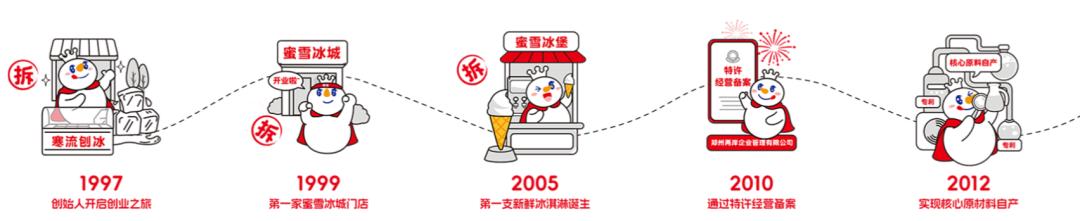
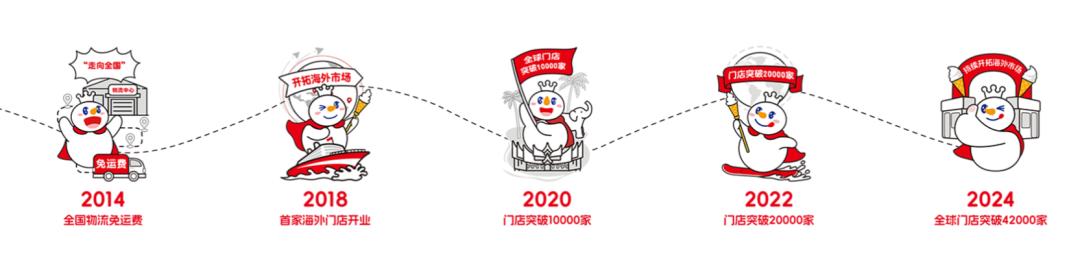
According to the financial report, the reason for Mixue Bingcheng's overall performance growth in 2025 was mainly the increase in revenue from the sales of goods and equipment, as well as franchise and related services. It can be seen that "opening more stores" is still one of the key drivers of Mixue Bingcheng's growth. By the end of 2025, the total number of Mixue Group's global stores was approaching 60,000, still firmly holding the top position in the global scale of freshly - made beverage stores.
In the overseas market, Mixue Bingcheng has also been continuously expanding its layout. In April, it opened its first store in Kazakhstan. In December, three stores opened simultaneously in Los Angeles and New York in the United States. In February 2026, Mixue Bingcheng's first store in Mexico opened. Currently, it has entered 13 overseas countries. Its sub - brand "Lucky Coffee" also started its overseas expansion in 2025, opening its first stores in Malaysia and Thailand.
At the 2025 financial report performance meeting, Yu Xin, the CEO of Mixue Bingcheng's Southeast Asia region, revealed that the first Mixue Bingcheng store in Brazil is also in preparation and will be launched soon. He said, "We are also confident that we can achieve a net increase in the number of overseas stores in 2026."
While opening stores in more new markets, Mixue Bingcheng has adopted a strategic contraction in the previously core Southeast Asian region. "In the Indonesian and Vietnamese markets, we have focused on implementing operational adjustments and optimization measures for existing stores", shifting from pursuing scale growth to optimizing store layout and improving the quality of single stores.
These two markets are also the earliest and largest overseas markets for Mixue Bingcheng, with the number of stores accounting for more than 70% of the total number of overseas stores. Mixue Bingcheng's management once said when disclosing the semi - annual report in 2025 that after optimizing operations and upgrading the store network, there were signs of improvement in the performance of the Vietnamese and Indonesian markets. After some stores were relocated to better locations, their sales increased by more than 50%.
To support the food supply for more than 4,000 overseas stores and ensure cost control and standard quality control, Mixue Bingcheng further strengthened its overseas supply - chain construction in 2025. The financial report shows that by the end of 2025, Mixue Bingcheng had established local warehousing and distribution systems in 8 overseas countries to gradually achieve the supply - chain layout goal of "global sourcing, global manufacturing, and global sales".
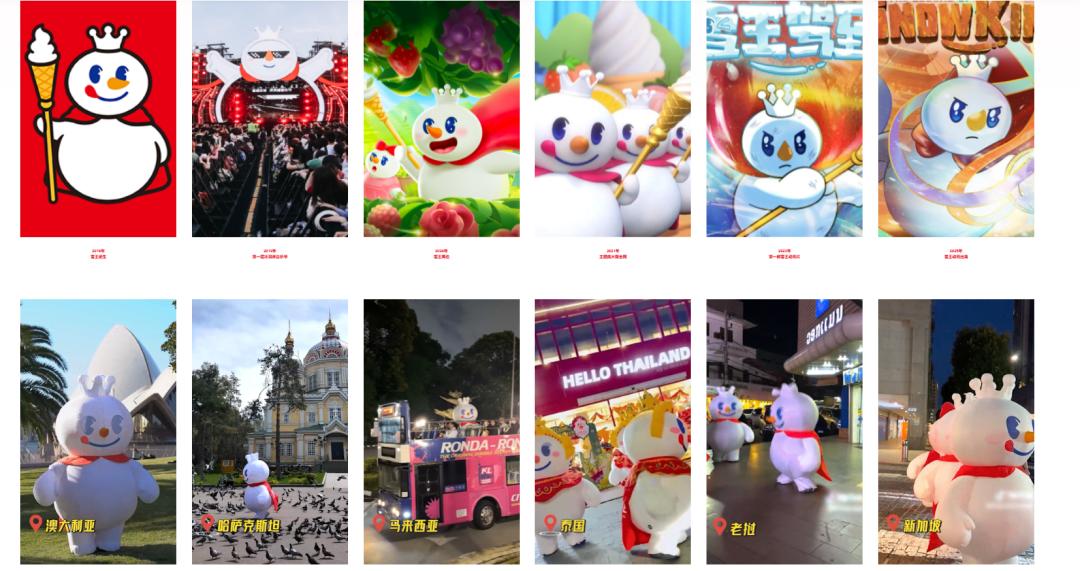
Data shows that currently, the number of Mixue Bingcheng's overseas stores still leads other Chinese tea - drink brands, accounting for nearly half of the total number of overseas stores of all Chinese tea - drink brands. To further strengthen the influence of the "Snow King" IP overseas, in May 2025, Mixue Bingcheng also released an animated work "Snow King Arrives" in five languages, including English and French, globally.

Regarding the development goal of its overseas business in 2026, Mixue Bingcheng said in its financial report that it will continue to deeply cultivate the Southeast Asian market, expand and optimize the local franchise system, and at the same time explore more other regions according to the local market environment, "to build a global food and beverage brand with world - class influence."
02
The "Battlefield" Shifts to North America
The Competition Shifts to Competing in "Internal Strength"

Although other tea - drink brands still have a large gap with Mixue Bingcheng in terms of the number of overseas stores, they have not slowed down their overseas expansion pace.
Heytea experienced an explosion in its overseas business in 2025, with the number of overseas stores exceeding 100, covering 28 overseas cities and metropolitan areas in 8 countries, including Singapore, the United Kingdom, Canada, Australia, Malaysia, the United States, South Korea, and Japan, as well as Hong Kong and Macau of China.
Cha Wang Ji has been making steady progress. As of the end of the third quarter of 2025, it had 262 overseas stores, mainly concentrated in Southeast Asian markets such as Malaysia and Singapore. It plans to enter the South Korean market in the second quarter of 2026, with its first store located in Gangnam, Seoul. Cha Wang Ji's third - quarter financial report in 2025 shows that its overseas GMV has increased by more than 75% year - on - year for two consecutive quarters.
Tianlala, which started its globalization in late 2023, had more than 200 overseas stores by the end of November 2025, with more than 100 stores in Indonesia. Tianlala's data shows that the average daily turnover of some stores in the Southeast Asian market is about 10,000 yuan, and it can reach 30,000 yuan during the opening period of some new stores.
Mo Li Nai Bai also has more than 40 overseas stores, covering six countries, including the United States, Canada, the United Kingdom, Thailand, and Indonesia. Gao Yunxi, the co - founder of Mo Li Nai Bai, once said in an interview with the media at the end of 2025 that since the opening of the first store in the United States more than a year ago, the monthly sales have been stable at about 500,000 US dollars, equivalent to about 3.5 million yuan. In 2026, it plans to have 80 - 100 stores in North America and 40 - 50 stores in the Indonesian market.
Chabaidao has been relatively "laid - back". So far, it has opened more than 20 stores in more than a dozen countries and regions, including South Korea, Thailand, Australia, Singapore, Spain, France, and the United States. In July 2025, Chabaidao opened two stores in Singapore. Half a year later, it signed a strategic cooperation agreement with the local supermarket brand SG Mart in Singapore to promote the accelerated implementation of Chabaidao in the Singaporean market.
Other brands such as Shanghai Aunty and Nayuki's Tea have also tested the waters in Southeast Asian countries but have not yet started large - scale expansion.
In the past year, another significant trend in the overseas expansion of new tea - drink brands is that the main battlefield has shifted from the "red - ocean" Southeast Asian market to the "blue - ocean" North American market. From Los Angeles on the west coast to New York on the east coast, more than 10 new Chinese tea - drink brands opened new stores in large cities in the United States where Chinese people gather in 2025. The "2025 US Freshly - made Tea - drink Data Report" by MenuSifu shows that with the entry of Chinese mainland brands, the number of milk - tea shops in the United States will reach 7,845 in 2025.
Different from the heavy - asset investment of opening stores by leading brands such as Mixue Bingcheng, Heytea, and Cha Wang Ji, Cha Yan Yue Se adopted a lighter exploration model, first going global through the e - commerce channel. To adapt to the local market in the United States, Ningji abandoned its difficult - to - pronounce brand name "ningji" and launched a new brand, BOBOBABA (American young people call Chinese pearl milk tea "boba").
Behind the trend of tea - drink brands shifting to the North American market, there are multiple driving factors. In the past, the Southeast Asian market has always been the first choice for most tea - drink brands as their "first stop going global". As the competition among tea - drink brands in Southeast Asia has become increasingly fierce, it has become inevitable to find new growth points.
Meanwhile, the North American market has stronger consumption power, with a large number of young people such as Chinese overseas students, and the tea - drink market pattern is relatively fragmented, without an absolute dominant brand. Therefore, for Chinese brands aiming to build global brands, the North American market not only has a higher customer unit price but also has a more international symbol.
In addition, the construction of global warehousing and logistics and the expansion of the raw - material market by tea - drink brands in recent years have provided supply - chain support for them to increase the scale of their stores in more distant markets.
From Mixue Bingcheng's in - depth cultivation and contraction in Southeast Asia and its exploration and establishment in North America, it can be seen that Chinese new tea - drink brands going global in the second half are moving from "exploratory layout" to "strategic necessity", and the key dimensions of competition are also shifting from short - term strategies of replicating domestic products and marketing methods to fundamental capabilities such as supply - chain resilience, brand - operation ability, and in - depth localization.
*The information and opinions contained in this article do not constitute any investment advice and are for reference only.
This article is from the WeChat official account "Comprehensive Service Port for Zhejiang Enterprises Going Global", author: Zhejiang Enterprises Going Global.