Cultural Global
Top 10 Chinese innovative drugs going global in 2025: What signals are they sending? | Global Expansion Insights

Author | Sha Xiaowei
Source | Amino Observation
In 2025, the overseas expansion of Chinese innovative drugs reached a new level, achieving a double leap in scale and quality.
Data shows that in 2025, the number of overseas BD licensing transactions of Chinese innovative drugs reached 157, with a total upfront payment of $7 billion and a total transaction value of up to $135.655 billion. Whether in terms of transaction scale, frequency, or the scope of treatment areas covered, it has reached a record high.
Notably, the threshold for the top ten annual transactions has been raised to over $3 billion, significantly increasing the "gold content" of the leading transactions. Meanwhile, the proportion of diversified cooperation models such as Newco and Co-Co has increased significantly, becoming a new industry trend.
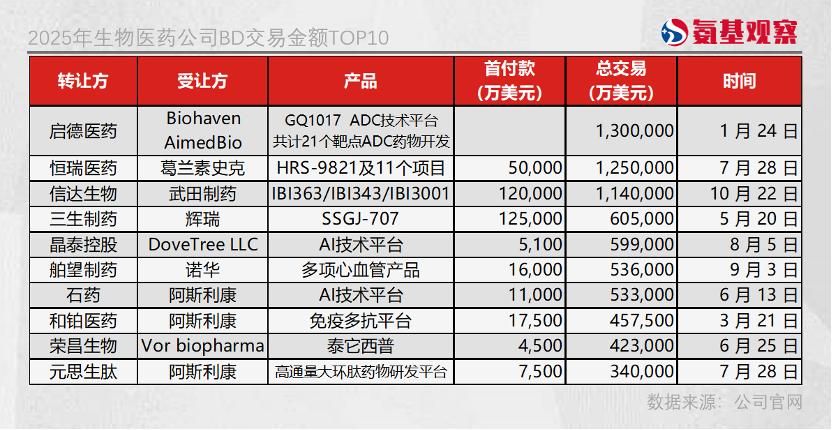
As the "wind vane" of industry development, the top ten overseas transactions of the year hide the key signals of the international advancement of Chinese innovative drugs. So, what new industry logics do these leading transactions reveal to us?
01
Qide Biotech's $13 billion overseas deal
The ADC boom continues

In 2025, Qide Biopharma won the first place in the total BD transaction value with a deal worth $13 billion.
On January 24, 2025, Qide Biopharma reached a major agreement with Biohaven and AimedBio. The content includes the co - development rights of the first - in - class FGFR3 ADC drug GQ1011 and multi - target innovative ADC drugs based on the coupling platform technology license, covering the development of ADC drugs for a total of 21 targets.
This "good start" transaction at the beginning of the year set the tone for the ADC track in 2025: ADC is still hot. Indeed, in 2025, multiple global ADC drugs were successfully launched, and ADCs represented by Enhertu continued to expand the treatment boundaries.
Against the background that many MNCs have clearly laid out their pipelines, domestic ADCs still continued to make efforts in BD transactions. Data shows that in 2025, domestic ADCs reached 25 BD cooperation agreements, with a total upfront payment of $1.772 billion and a total transaction value of up to $37.7 billion, both hitting record highs.
Different from the past, Qide Biopharma's cooperation case tells the market that ADC transactions are no longer limited to a single product but focus on the entire technology platform. Qide Biopharma's R & D layout for 21 targets is the "target pre - emption" strategy implemented by pharmaceutical companies in another round of ADC technology competition.
02
Henrui Medicine's $12.5 billion overseas deal
The popularity of COPD drugs explodes

In the overseas expansion ranking, the old - timer Henrui Medicine is still on the list.
On July 28, 2025, Henrui Medicine reached an agreement with GSK. The two parties will jointly develop HRS - 9821 and 11 R & D projects, covering multiple treatment areas such as respiratory, autoimmune and inflammatory, and oncology. The upfront payment is $500 million, and the potential total amount is as high as $12.5 billion.
The core project of this transaction, HRS - 9821, is a PDE3/4 dual - target inhibitor. PDE3 mediates bronchial dilation, and PDE4 is responsible for anti - inflammatory regulation, which naturally fits the characteristics of COPD. Its inhaled powder aerosol dosage form has obtained the clinical trial approval from NMPA.
Two months before this transaction, GSK's IL - 5 monoclonal antibody Mepolizumab was approved for a new indication, COPD. This transaction aims to strengthen GSK's competitiveness in the respiratory disease track.
In terms of pricing, this transaction is benchmarked against the approved product Ensifentrine. In July 2024, the FDA approved VeronaPharma's PDE3/4 inhibitor Ensifentrine for COPD, and then Merck acquired Verona for approximately $10 billion in July 2025. The difference is that Ensifentrine is currently only available in the nebulized inhalation dosage form, while HRS - 9821 has a dual - dosage form combination of "inhaled powder aerosol + inhaled suspension", which can cover the entire course of COPD.
Henrui Medicine's overseas expansion further reflects that the COPD market is becoming more and more vibrant.
03
信达 Bio's $11.4 billion export
The Co - Co model boosts globalization

The overseas expansion model of Chinese innovative drugs is still evolving.
On October 22, 2025, the $11.4 billion cooperation between Innovent Biologics and Takeda Pharmaceutical clearly reflected this trend.
The cooperation is based on three core assets: IBI - 363 is a PD - 1/IL - 2α bispecific antibody fusion protein independently developed by Innovent; IBI - 343 is an ADC targeting CLDN18.2; and IBI - 3001 is a B7 - H3/EGFR bispecific ADC. Now, the "IO + ADC" era in oncology treatment has entered version 2.0, and these three core drugs have significant clinical potential and application prospects.
As important as the assets is the transaction model. Innovent Biologics and Takeda Pharmaceutical adopted the Co - Co (co - development, shared revenue) model, where the two parties share costs and profits in a 40/60 ratio. This changes the traditional "selling seedlings" licensing model and represents the greater ambition of Chinese innovative pharmaceutical companies.
This transaction model allows Innovent Biologics to obtain cash flow and equity investment in the short term and accumulate R & D, registration, and commercialization capabilities in global cooperation in the long term, which also helps Innovent Biologics promote the implementation of its "2030 Global Strategy". In addition, as one of the few successful globalized Asian pharmaceutical companies, Takeda Pharmaceutical's experience is of great reference significance to Innovent Biologics.
We look forward to Innovent Biologics bringing more successful and replicable experiences for the overseas expansion of Chinese innovative drugs in the practice of the Co - Co model.
04
3SBio's $6 billion overseas deal
Traditional pharma is no longer low - key

In the past few years, the main players in BD transactions were biotech companies. However, in fact, the innovation capabilities of Chinese pharma companies are not inferior. In 2025, 3SBio showed the market with practical actions that traditional pharma will not be low - key either.
On May 20, 2025, the licensing transaction between 3SBio and Pfizer refreshed multiple industry records. The potential total value of this transaction reached $6.05 billion, of which the upfront payment was as high as $1.25 billion, directly setting a new record for the highest upfront payment in the history of Chinese innovative drugs going overseas. Just the $1.25 billion upfront payment is equivalent to about four times 3SBio's net profit attributable to the parent company in 2024, and the effect on improving the company's cash flow is immediate.
The core reason for supporting such a high price lies in the clinical certainty of the pipeline itself. The core asset of this transaction, SSGJ - 707, is a PD - 1/VEGF bispecific antibody, belonging to a typical IO2.0 pipeline. Before the transaction was reached, the drug had obtained the breakthrough therapy drug designation from CDE and had advanced to Phase III clinical trials for the indication of first - line treatment of locally advanced or metastatic non - small cell lung cancer with positive PD - L1 expression. The key Phase II clinical data showed that the objective response rate of single - drug treatment was as high as 70.8%, and the highest objective response rate of combination chemotherapy was 81.3%. Both the efficacy and safety were significantly better than single PD - 1 treatment.
From the perspective of both the industry logic of the value return of innovative drugs and the catalysis of market sentiment, this transaction is of great significance. It not only refreshed the records of the upfront payment and total amount of Chinese innovative drugs going overseas at one stroke but also quickly ignited market sentiment.
05
Jingtai Technology's $5.99 billion cooperation
The large - scale overseas expansion of Chinese AI - powered drug discovery

In the top ten BD transactions in 2025, an AI company appeared.
On August 5, 2025, Jingtai Technology announced that it had officially signed a major pipeline cooperation agreement with DoveTree, with a total order value of approximately HK$47 billion (approximately US$5.99 billion).
According to the agreement, the two parties will cooperate on multiple pre - clinical macromolecular and small - molecule innovative drug assets and conduct new drug R & D for a series of targets specified by DoveTree.
This large - scale cooperation agreement with DoveTree is the further implementation and expansion of the "AI - CRO model". Compared with the model where AI - powered pharmaceutical companies exchange a single pipeline for a licensing fee, this "selling capabilities" business model has more advantages in terms of sustainability and is more in line with the core requirements of large - scale pharmaceutical companies for R & D certainty and efficiency.
This cooperation not only set a new record for the order scale in the field of AI and robotics - enabled new drug R & D but also indicated that the era of Chinese artificial intelligence technology deeply empowering new drug discovery has arrived.
06
Boywang Pharma's deal worth over $5.36 billion
Small nucleic acid drugs regain vitality

In 2025, small nucleic acid drugs returned to the core position in the large - scale BD list.
On September 3, 2025, Boywang Pharma reached a cooperation with Novartis around the siRNA pipeline, with a total potential value of over $5.36 billion. According to the agreement, the two parties will jointly explore the combination therapy of BW - 00112 (hyperlipidemia siRNA) for the treatment of dyslipidemia. The agreement also includes Novartis' option to license the next - generation molecules in Boywang Pharma's pipeline. This is the second transaction between the two parties. In January 2024, Novartis acquired the core product BW - 00163 (hypertension siRNA) with an upfront payment of $185 million and a potential value of $4 billion.
Behind these two transactions is Novartis' "increase in investment" in the cardiovascular pipeline. The cardiovascular disease track has always been the most important area for Novartis, but its blockbuster product Entresto is facing the window of patent expiration and urgently needs new drugs for supplementation.
Novartis' confidence in siRNA comes from the siRNA drug Leqio acquired from MDCO. This drug has been approved by the FDA for the first - line treatment of adult hypercholesterolemia and only needs to be injected once every six months. Its peak sales are expected to exceed $3 billion, which also drives up the siRNA transaction scale.
This year, siRNA transactions have exploded, and the total transaction value has exceeded $30 billion. Boywang Pharma's transaction once again proves that when small nucleic acids meet chronic diseases, the industry ceiling is completely broken.
07
CSPC Pharmaceutical Group's $5.33 billion overseas deal
One of the promises is fulfilled

In the past year, capital has been increasingly enthusiastic about BD transactions. Some companies, for the needs of market value management and other reasons, began to prospectively disclose the progress of pre - announced BD. CSPC Pharmaceutical Group is a typical representative.
On May 30, 2025, CSPC Pharmaceutical Group announced that multiple products including its EGFR ADC were in the negotiation stage of BD cooperation, involving three potential transactions.
The announcement clearly mentioned that the total of potential upfront payment, milestone payment, and commercialization share for each transaction is approximately $5 billion. One of the transactions has entered the late stage and is expected to be completed in June.
On June 13 of that year, the $5.33 billion cooperation between CSPC Pharmaceutical Group and AstraZeneca announced the implementation of the pre - announced BD.
According to the agreement, CSPC will use its AI technology platform to discover pre - clinical candidate drugs (PCCs) with multi - indication potential around multiple targets selected by AstraZeneca. For each PCC, AstraZeneca has the right to exercise the option and obtain global exclusive licensing rights, which clearly includes an oral small - molecule pre - clinical project for immune diseases.
However, CSPC Pharmaceutical Group has no new news about the remaining two transactions for the time being.
08
Harbour BioMed's $4.57 billion overseas deal
A new paradigm for MNCs to invest in Chinese pharmaceutical companies

The previous BD transactions were about the competition of technical routes, while the cooperation between Harbour BioMed and AstraZeneca is a "deep - binding" one.
On March 21, 2025, Harbour BioMed announced that AstraZeneca would subscribe for 9.15% of the company's shares at a price of $1.38 per share, with a total consideration of approximately $105 million. After the transaction is completed, AstraZeneca will become one of the important shareholders of Harbour BioMed. In addition, the two parties announced in - depth cooperation around the new generation, including the licensing of two pre - clinical immunology projects of AstraZeneca and the co - development of new - generation biotherapies such as ADCs and TCEs in the future.
According to the agreement, within the next four years, AstraZeneca will continuously nominate R & D projects to Harbour BioMed and enjoy the corresponding licensing options.
Harbour BioMed's BD capabilities have been fully verified. It has completed multiple BD cooperation with many MNCs such as BMS and Pfizer before, and this is the third time that AstraZeneca has reached a cooperation with Harbour BioMed.
The two parties will also jointly build an innovation center in Beijing to support the long - term promotion of BD projects. This structure means that AstraZeneca is not only "grabbing drugs" but also locking in an innovative source with long - term sustainable output.
Obviously, this is a new paradigm for MNCs to invest in Chinese pharmaceutical companies.
09
Remegen's Taegept's $4.23 billion overseas deal
A new choice for value maximization

Remegen's core product, Taegept, reached a milestone in its "overseas expansion" -
On June 26, 2025, Remegen announced that it had signed a cooperation agreement worth $4.23 billion with Nasdaq - listed company VorBiopharma. VorBio will obtain the exclusive rights to develop, produce, and commercialize Taegept globally except in the Greater China region. Remegen will receive an upfront payment of $45 million and an equity certification worth $80 million from VorBio (which can subscribe for 320 million shares of VorBio), as well as milestone payments of up to $4.105 billion. In addition, Remegen will also receive high - single - digit to double - digit royalty payments.
This cooperation with a capital - type partner and an overseas listed company, the model of "upfront payment + milestone payment + share + equity", is somewhat similar to the licensing of Constellation Pharma by Kangfang Biotech. Compared with the traditional licensing model of multinational pharmaceutical companies, it forms significant differences in terms of clinical advancement efficiency, resource allocation, and revenue structure.
Remegen's current transaction also has the obvious characteristics of a new paradigm for innovative drugs to "go overseas". Remegen will hold 320 million shares of VorBio (accounting for approximately 23%), which means stronger bargaining power in the early stage and more say. The lineup of participating investors is also luxurious, and there are numerous successful cases of this "golden combination".
The discussion on which "overseas expansion" model innovative drugs should choose has never stopped. But for innovative drug companies, in the final analysis, the most suitable one is the best. For Remegen's Taegept, a broad - spectrum blockbuster drug with the potential to be the "king of autoimmune drugs", perhaps this transaction model is the optimal solution to maximize its value.
10
Yuansi Biotech's $3.4 billion overseas deal
Multinational pharmaceutical companies bet on Chinese technology

The last transaction on the list points to AstraZeneca again.
In March 2025, Yuansi Biotech reached a cooperation with AstraZeneca around its Synova™ intelligent high - throughput macrocyclic peptide drug R & D platform, with a total potential value of $3.4 billion. The transaction is also about the R & D platform, including AI algorithm optimization, high - throughput screening equipment expansion, and the large - scale construction of synthetic peptide libraries, focusing on the fields of oncology and chronic diseases.
Yuansi Biotech's peptide platform has shown clear potential in the fields of rare diseases, autoimmune diseases, and metabolic diseases. For AstraZeneca, this transaction will help promote the process of innovative drug R & D in the future and form a multi - point growth layout.
Notably, at the end of the year, Yuansi Biotech completed Series A and Series A+ financing, and AstraZeneca directly participated as the lead investor. This is in line with AstraZeneca's strategy in projects such as Harbour BioMed. It not only buys capabilities but also invests in the future.
Obviously, in the field of cutting - edge technology, MNCs have saturatedly laid out and deeply bound Chinese assets.
11
Summary

Looking back at the landmark BD transactions of Chinese innovative drugs in 2025, the real changes are far more than the increase in transaction amounts. From the popular ADC and IO tracks to cutting - edge fields such as siRNA and AI - driven drug R & D, the transaction logic has shifted from concentrating on a single advantageous pipeline to competing for technology platforms with continuous output capabilities. The BD2.0 era of "platform grabbing" led by MNCs has arrived.
Meanwhile, the international development of Chinese innovative drugs has also reached a new level. The rise of new BD transaction models such as NewCo and Co - Co clearly demonstrates the demand of Chinese pharmaceutical companies to enhance their voice in the internationalization process.
Looking back at this critical node of industry development, the intensive BD transactions in 2025 are more like a clear direction confirmation, marking that Chinese innovative drugs have moved from "single - point breakthrough" to the stage of collective efforts towards "platformization and internationalization".
In 2026, we look forward to more wonderful stories from the overseas expansion of Chinese innovative drugs.
*The views in this article are all reprinted from the original source and are for reference only.
This article is from the WeChat public account "Comprehensive Service Port for Zhejiang Enterprises' Overseas Expansion", author: Amino Jun.