Cultural Global
Is the Japanese e-commerce market underestimated by brands? | Navigators in Global Markets



Introduction:
Going global is no longer an option for enterprises, but there are still many choices in the way of going global. Brand going global, supply chain going global, cross - border e - commerce... Behind each model, there are countless stories of arduous exploration by Chinese companies; North America, Southeast Asia, the Middle East, Latin America... On every distant continent, there are more and more international presences of Chinese brands.
From introducing foreign capital forty years ago to "going global in groups" today, Qiantang, as the main front of Hangzhou's export - oriented economy, has always been the bridgehead for enterprises to transform themselves and break through for innovation. The China Enterprises International Service Center has long been concerned about overseas markets and enterprises going global. Based on this, in 2025, we launched a new column "Wave Riders in Going Global", aiming to find the benchmarks in various fields for going global, disassemble practical cases from a professional perspective, precipitate methodologies in the process of seeking consensus, and explore differentiated development paths in non - consensus.
The following is the fourth article in this column.
Under the "shadow" of the US tariff policy, other markets in the world are being noticed by Chinese cross - border merchants.
For example, neighboring Japan.

A report released by The Economist in 2024 stated that "Japan is undergoing a series of extraordinary economic transformations." From being the后花园 of workers in the Yangtze River Delta region to the opening of the Osaka - Kansai Expo, Japan has once again become an extremely attractive business and cultural market in Asia.
Japan has always been known for its prosperous offline business ecosystem. In the current post - pandemic era, Japanese consumers' acceptance of online shopping is also continuously increasing, especially in categories such as household appliances, household items, and health care. Statista data shows that the scale of the Japanese e - commerce market reached $191.9 billion in 2024, a year - on - year increase of 8.4%, and it is expected to grow to $206.8 billion in 2025.
In the Japanese cross - border market, if traditional large - scale sellers are used to stocking a large number of low - priced products on Amazon, and small and medium - sized factories relieve inventory pressure through the "Four Little Dragons of Going Global" such as Temu and SHEIN, Rakuten Japan is an important channel preferred by brand - type enterprises going global to Japan and deeply cultivating localization. Consumer brands such as Xiaomi, OPPO, Tineco, Ulike, and Florasis have already settled in.
The growth rate of the online e - commerce market is considerable, but the number of Chinese sellers is not large. It can be said that Rakuten Japan and even the Japanese e - commerce market are still huge blue - ocean markets for cross - border merchants and brands.

The Japanese e - commerce market behind 100 million users

Rakuten Japan was founded in 1997, starting with e - commerce business, and was listed on the Tokyo Stock Exchange in 2000. Since then, its business has expanded to fields such as financial services, tourism, and communications, and it has entered markets in the United States, Europe, etc. through acquisitions and investments. In 2010, Rakuten acquired the French e - commerce platform Price Minister and gradually developed it into one of the top five e - commerce platforms in France, attracting an average of 15 million visitor users per month.
Maeri Takama, the General Manager of the Market Organization Department of the Executive Director of Rakuten Group, revealed that currently Rakuten has about 30,000 employees and more than 2 billion users in 30 countries and regions. The e - commerce turnover of Rakuten in Japan reaches about 6 trillion yen (about 300 billion yuan), making it one of the leading e - commerce platforms in Japan.

Maeri Takama, General Manager of the Market Organization Department of the Executive Director of Rakuten Group
In order to expand Rakuten's brand influence and attract high - quality Chinese brands to settle in, in 2019, Rakuten established a Chinese branch in Shenzhen, officially opening up to Chinese sellers, and holds two large - scale summits in China every year. Recently, the 2025 Rakuten Global E - commerce Brand Summit was just held in Shenzhen.
"Through Rakuten Japan, Chinese sellers can not only reach the people behind 100 million membership IDs in Japan, but also achieve efficient going global with the help of Rakuten's logistics network and marketing tools." Maeri Takama said.
For cross - border e - commerce enterprises wanting to enter the Japanese market, Rakuten Japan is a key channel that cannot be bypassed. Currently, Rakuten Japan has 100 million members, with over 44 million monthly active users. The user profile of the Rakuten e - commerce platform covers the general Japanese population from students to housewives, and the main consumer group is concentrated on women aged 30 - 50 who hold the family's financial power and are responsible for the daily household purchases.
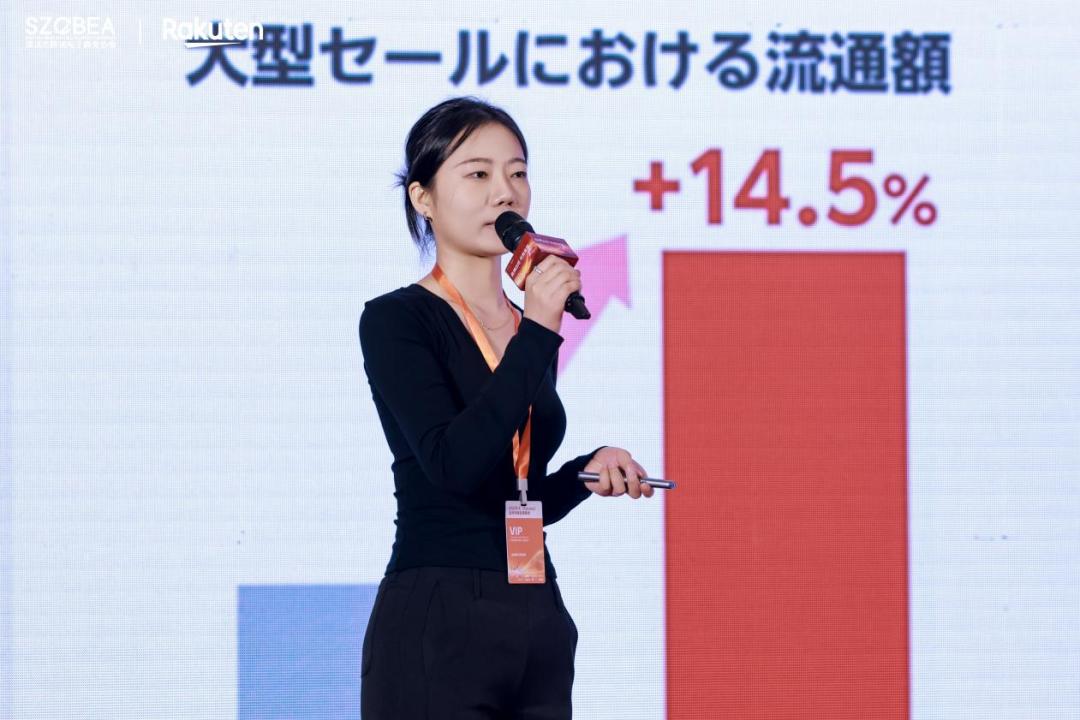
Fia, Operation Manager of Ulike's Overseas Division on Rakuten Japan
"The user profile of Rakuten is highly consistent with the core users of our products. Since settling in, the overall development speed has been quite fast." Fia, the operation manager of Ulike's overseas division on Rakuten Japan, revealed that Ulike settled on the Rakuten platform in 2022 and started key operations in 2023. In less than two years, it achieved a breakthrough from zero to the top in the category.
For Rakuten, Chinese cross - border merchants are upgrading from product going global to brand going global. The competitiveness of products in terms of quality and price also provides Rakuten with a more abundant supply of high - cost - performance products. Maeri Takama said, "Last year, I came to China for the first time and communicated with many merchants. I was very surprised by the quality and affordable prices of their products. I hope more excellent Chinese merchants will expand their business on Rakuten."

Super - point ecosystem and local endorsement

In Maeri Takama's view, the advantage of Rakuten Japan lies in that it is not just an e - commerce platform, but can also mobilize the ecological resources of the entire "Rakuten Economic Circle". The Rakuten Economic Circle is centered around "ID + points". By integrating the underlying databases of different businesses, users can use more than 70 kinds of Rakuten services with the same ID account, covering e - commerce shopping, tourism, finance, communications and other businesses. The general "Rakuten points" obtained by users in the process of using any service can also be used in other businesses.
This system can not only effectively improve user stickiness and loyalty, but also through the analysis of member data, Rakuten can better understand user behavior and consumption preferences, thus promoting the synergy and traffic circulation between different businesses. For example, users often enter the Rakuten Economic Circle through the e - commerce platform, complete payment with a Rakuten credit card, and get a certain amount of points accumulated according to the payment amount. The points system also runs through both online and offline consumption scenarios, meeting the consumption habits of Japanese users in offline scenarios.

In addition to the service ecosystem of the Rakuten Economic Circle, Maeri Takama said, "As one of the largest local e - commerce platforms in Japan, Rakuten has a natural sense of familiarity and trust for Japanese consumers, which can provide local endorsement for Chinese brands."
In the actual operation process, after sellers activate their Rakuten Japan market accounts, the official Rakuten team will assign an operation consulting manager. Based on the sales volume and trend dynamics of categories, the manager will provide sellers with store optimization and product sales strategies, assist merchants in store data analysis, and help Chinese merchants better adapt to the Japanese market environment.

Maeri Takama introduced that Rakuten platform is positioned as an "online shopping mall" that requires merchants to operate in a refined way, which is more similar to Tmall or JD.com in China, focusing on recommending products to consumers from the brand dimension. Compared with cross - border merchants who rely on explosive products to drive short - term sales, the operation model of Rakuten is more friendly to brand - type sellers who value building long - term user awareness.
Therefore, for brand - type sellers, it is crucial to build a personalized brand store on the Rakuten platform to showcase brand tonality; Rakuten also has stricter requirements for sellers' settlement standards and product quality control. Maeri Takama specially reminded, "Japanese customers care a lot about product reviews when shopping. Higher reviews can win more user trust, which is very important for better local penetration in the Japanese market."

How Chinese sellers can quickly adapt to the Japanese market

The demand of consumers in the Rakuten Japan market for Chinese products is mainly concentrated in categories such as household items, outdoor and gardening, fashion and beauty, and health care. "Judging from this year's trend, Chinese sellers in these categories have great growth potential." According to Maeri Takama, Rakuten provides full - link support from logistics to marketing for merchants, and applies the latest AI technology in the store operation system to help Chinese merchants quickly adapt to the Japanese market.

For example, in the marketing aspect, Rakuten launched a "Super Point Rebate" activity. During the big promotion period, consumers can enjoy up to 47 - fold point rebates, which not only strengthens user stickiness but also improves the sales conversion rate of merchants. During the annual Super Sale promotion, the platform traffic will explode several times compared with normal times. Maeri Takama suggests that sellers make advance inventory strategies and advertising investments to double their sales.
Take the "STEP" strategy adopted by Ulike on the Rakuten platform as an example. In the promotion stage, Ulike, with the help of Rakuten's local support, translated the product advantages into language that meets the needs of Japanese consumers, and then combined with activities such as live - streaming and point cash - back on the Rakuten platform to quickly increase brand awareness. At the same time, Ulike used data tools such as competitor analysis and trend prediction in the RMS store management background to concentrate resources at key nodes to detonate sales, and finally achieved a breakthrough from zero to the top in the category.

In the logistics aspect, currently, Rakuten Super Logistics (RSL), a logistics service brand operated by Rakuten Group for store - opening sellers, can provide sellers with one - stop logistics services from inventory management to distribution.
In addition, in order to achieve the "Triple 20" goal - a 20% improvement in marketing, operation, and customer efficiency, Rakuten Japan introduced AI technology into the Rakuten market to promote the convenience of user experience and the efficiency of store operation.
According to Maeri Takama, the search function of traditional e - commerce is centered around keywords, while the AI technology of the Rakuten market supports semantic search. Users can describe their needs in a specific scenario in natural language, which significantly reduces the no - result search rate by 98.5%. Semantic search has driven a maximum 5.3% increase in product sales.

In addition to the optimization of the search function, the AI intelligent recommendation system can guide users to find satisfactory products, increasing the user click - to - purchase rate by 59%; the dynamic advertising optimization uses AI to accurately match highly relevant advertisements, driving a 4% increase in advertising revenue on the Rakuten market homepage; Rakuten also built an AI assistant into the store management background (RMS) to improve the operation efficiency of merchants.
It can be said that by building the "Rakuten Economic Circle", strengthening the application of AI technology and carrying out characteristic marketing activities, Rakuten Japan is not only a bridge for brands to enter the Japanese market, but also provides a high - quality path for the global layout of Chinese brands. Chinese brands can also build their own sustainable competitiveness in the mature market through continuous product and technology innovation and local operation with the help of the Rakuten Japan platform.

This article is from the WeChat official account "Hangzhou Qiantang Enterprise Going Global Service Base". The author is Qiantang Going Global, and it is published with authorization from Qiantang.