Cultural Global
Disinfection equipment enterprises expanding into Saudi Arabia: localized transformation + direct channel connection, how to get through the entire l


Introduction:
Looking at the global market to explore the second growth curve has become an established direction, but how to expand overseas still tests the wisdom and courage of every Chinese enterprise. Brand globalization, supply chain globalization, cross-border e-commerce... there are numerous paths, yet no one-size-fits-all solution; North America, Southeast Asia, the Middle East, Latin America... the markets are vast, but each comes with its own waves and challenges. Behind every long expedition is the down-to-earth exploration of Chinese enterprises; on every distant coastline, more figures from China are emerging.
The "Global Trailblazers" column aims to find benchmark enterprises that have expanded overseas in various sectors, dissect practical cases from a professional perspective, precipitate methodologies through consensus, and discover new possibilities amid differences.
China and Saudi Arabia established diplomatic relations in 1990, and the two sides have gone through more than 30 years of continuous deepening of bilateral economic and trade cooperation. With the in-depth advancement of Saudi Arabia's "Vision 2030", broad opportunities are continuously opening up for Chinese enterprises across sectors from infrastructure to advanced manufacturing.
Focusing on the full life cycle demands of enterprises' overseas expansion, including "pre-planning, mid-term implementation and post-operation", Zhejiang Enterprise Overseas Integrated Service Port has introduced more than 40 leading service institutions in the fields of law, finance and taxation, finance, human resources and other sectors, realizing one-stop handling for enterprises' overseas expansion.
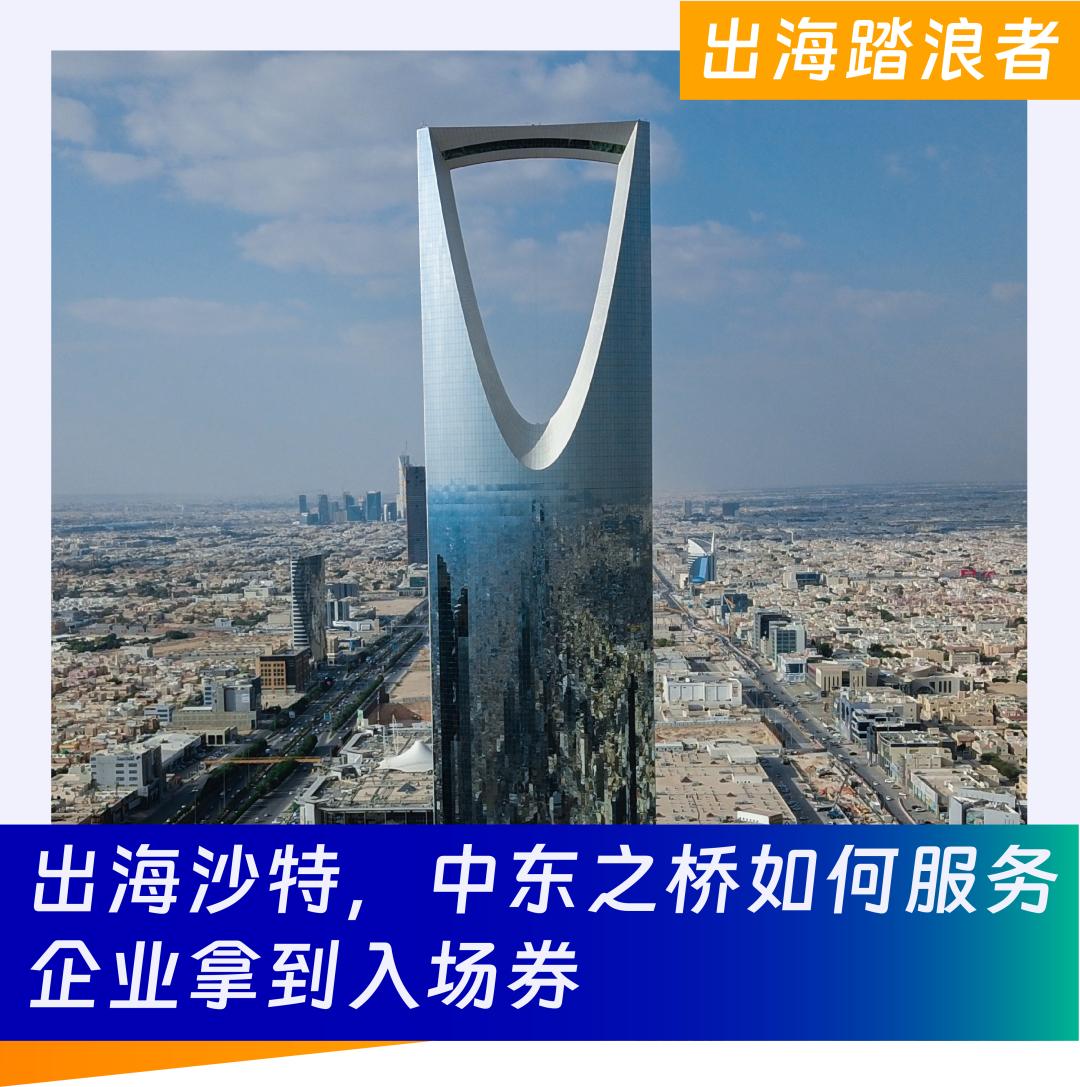
In this issue, we present a case where the service provider helped Chinese enterprises cross the Saudi market access threshold — Bridge to the Middle East helped a disinfection equipment manufacturer successfully enter offline supermarket chains in Saudi Arabia.
01
Enterprise Case Showcase

A domestic disinfection equipment manufacturer whose products are equipped with plasma jet technology to kill coronaviruses plans to develop the Saudi market, but faces three key obstacles in the early stage of overseas expansion: first, without an overseas team, it is difficult to conduct on-site research to gain insight into the real local demands; second, the original all-Chinese instruction manuals and national standard hardware design face the challenges of localization adaptation and shelf compliance; third, it is difficult to independently connect with local chain supermarket stores in Saudi Arabia.
In response to the core demands of the enterprise from product export to channel implementation, Bridge to the Middle East, combining the rules of Saudi Arabia's local consumer goods market and offline retail ecosystem, has rolled out a complete implementation plan including four major measures:
[Product Localization Transformation] Assist the enterprise to redesign the outer packaging according to local consumption habits, and fully upgrade the all-Chinese instruction manual to a bilingual version of "English + Arabic". At the same time, in accordance with Saudi Arabia's power regulations, guide the enterprise to modify the product plug to the British standard, and complete the in-depth adaptation of the device display interface and functions.
[Compliance Certification and Market Access] Saudi Arabia implements strict supervision on imported electronic products. Leveraging its local advantages, Bridge to the Middle East assists the enterprise to quickly obtain the SABER certification required locally in Saudi Arabia, removing the hard compliance barriers before the products enter supermarkets.
[Multi-dimensional Product Testing and Screening] To avoid the risk of inventory backlog caused by blind stocking, before large-scale stocking, select some products for trial sale in cooperating supermarket stores. By collecting real consumer feedback, eliminate products that cannot adapt to the local market, and finally lock in the customized models that best meet local demands.
[Full-link Direct Channel Connection] Directly connect with large Saudi chain supermarket brands including LuLu, Mark&Save, Danube, as well as consumer electronics retailer eXtra, covering more than 200 brand stores.
Finally, with the full-process support of Bridge to the Middle East, the enterprise successfully entered offline supermarkets in Saudi Arabia in about 6 months.
02
Service Provider Dialogue

At present, as Chinese enterprises expand their business to Saudi Arabia, what changes have taken place in the overall market environment compared with the past?
Bridge to the Middle East: In 2014, foreign-funded enterprises faced strict access restrictions when registering companies in Saudi Arabia, and many sectors required local sponsors or partners to hold shares on their behalf. Opportunities were mainly concentrated in early Internet tracks such as e-commerce, games and Arabic social products. Since Saudi Arabia launched the "Vision 2030" in 2016, foreign investment access has been greatly relaxed. At present, about 95% of industries allow foreign investment, and enterprises can register independently in most sectors. With the preparation of international events such as the 2027 AFC Asian Cup and the 2034 FIFA World Cup, the implementation of large-scale infrastructure, new energy and manufacturing sectors is ushering in more comprehensive opening-up dividends.
What do you think is the biggest core challenge for Chinese enterprises that go to Saudi Arabia for the first time for investigation and layout?
Bridge to the Middle East: The biggest challenge lies in the enterprise's "decision-making mechanism". The Saudi market has a high threshold, and it is extremely difficult to generate absolute returns in the short term, which requires continuous investment in the early stage. If the enterprise only sends ordinary professional managers, limited by short-term KPI assessment indicators, it is often difficult to make decisions for long-term persistence. Therefore, when entering Saudi Arabia for the first time, the founder of the enterprise or the major shareholder with decision-making power must personally come to the site for investigation, and judge the medium and long-term growth space of the track from the perspective of overall strategy.
In sectors such as infrastructure and new energy, what kind of competitive environment are Chinese enterprises facing? Compared with European and American enterprises, what are the advantages of Chinese enterprises?
Bridge to the Middle East: The Saudi market is open to the whole world, and Chinese enterprises face direct competition from European and American enterprises in core tracks, especially in standard formulation and design links, where European and American enterprises have more rich experience. However, Chinese enterprises have two major advantages: first, efficiency and cost-effectiveness, with fast construction and material supply speed, high comprehensive cost performance and strong delivery capacity; second, flexible customization. European and American enterprises usually only provide standardized products and are not easy to make adjustments for the special demands of Saudi customers, while Chinese enterprises can flexibly adapt according to the demands of the client, with prominent differentiated competitiveness.
For merchants who hope to expand the Saudi market through cross-border e-commerce, what supporting support do you provide?
Bridge to the Middle East: We mainly provide a series of local practical services for Chinese sellers who settle in local e-commerce platforms in Saudi Arabia. Many domestic merchants often do not know how to open stores, how to launch traffic, or how to handle local orders and returns after registering accounts on the platforms. In response to these practical difficulties, after the sellers settle in the platform, we will provide one-stop services covering local warehousing in Saudi Arabia, order sorting, packaging, labeling and handover, as well as return and exchange processing, after-sales maintenance, etc., effectively helping Chinese merchants solve the pain points of overseas back-end implementation.
03
Service Provider Introduction

Bridge to the Middle East has 200 offline supermarket stores, 11 overseas warehouses, installation and after-sales teams in Saudi Arabia, and is currently mainly engaged in electric bicycles, electric motorcycles, batteries, consumer electronics, etc. In October 2025, it became the official authorized overseas partner of Chengdu "Open Chengdu". Bridge to the Middle East is a partner of Saudi Energy (formerly Saudi National Grid), providing channels, warehousing and implementation services for Saudi Arabia's new energy development and Chinese enterprises' overseas expansion.
* The opinions contained herein are all from the interviewed institutions or individuals, for reference only.
This article is from the WeChat Official Account "Zhejiang Enterprise Overseas Integrated Service Port".