Cultural Global
The Second Half of the Overseas Expansion of Micro-Short Dramas: A Thrilling Leap from "Scale" to "Value"



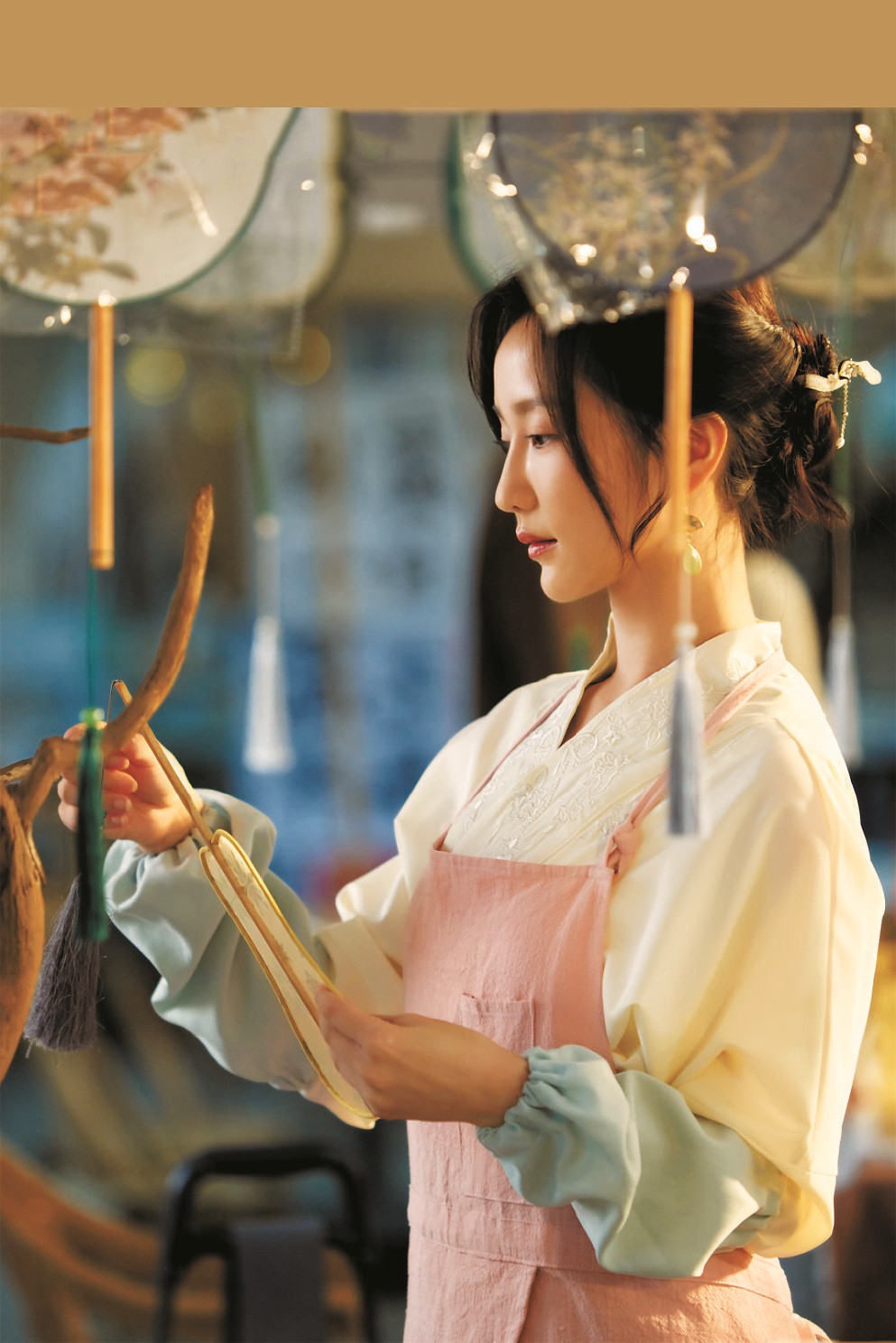
Chinese domestic micro-dramas are shifting from "large-scale overseas expansion" to "value-oriented overseas expansion". The attached pictures (from top to bottom) show stills of *The Young Mistress From Northeast China 2*, *Glimpses of Flowing Years* and *A Dream Resting on Star River*.
Hollywood studios are starting to set up viewfinders optimized for mobile phone aspect ratios: Last autumn, Fox Entertainment invested in a vertical short drama platform, announcing plans to produce more than 200 vertical short dramas within two years, with the first batch of projects already kicking off filming in Atlanta. On the other side of the planet, Malaysian audiences are waiting in front of their screens for the sequel of a Chinese micro-drama. In the first season, the Nyonya costumes and the spread-out durian feast made them recognize their own daily lives in the stories of others. Two scenes thousands of miles apart point to the same fact: Chinese micro-dramas, which have only emerged for six or seven years, have already become a global phenomenon. Statistics from market research institutions show that the in-app purchase revenue of overseas micro-drama applications exceeded the 2 billion USD mark last year, with a year-on-year increase of more than 100%; the vast majority of the top 20 short drama applications by overseas revenue are developed by Chinese teams.
However, behind the booming market lie hidden concerns. In the first half of this year, the volume of advertising materials for overseas short drama promotion increased by more than 300% year-on-year, surpassing the total volume of last year, while the growth of user payment is only around 10%. Industry reports estimate that user acquisition and traffic investment have accounted for half of the total cost of overseas short drama distribution. When super platforms like TikTok enter the market directly, upgrading short dramas to a first-level content category on the main platform, the old model of charging per episode becomes even harder to sustain. At the end of the day, traffic purchases only bring downloads, not audience loyalty; promotional feeds can push works in front of viewers, but cannot make the works stay in the audience's mind for one extra second. The story of scale expansion has almost reached its end at this stage.
From the author's perspective, the industry has reached a critical tipping point: Currently, the "overseas expansion" of Chinese domestic micro-dramas is shifting from the "large-scale expansion" mode that focuses on competing for downloads and traffic investment, to the "value-driven expansion" mode that competes in content, IP and cultural recognition. The three dimensions of competition go deeper layer by layer: the competition for content is the competition of products, the competition for IP is the competition of assets, and the competition for cultural recognition is the competition of meaning. This also means that micro-dramas, as the most active branch of new mass art in the internet era, need to answer a serious question in the global context: besides keeping audiences hooked nonstop, what else can they make people remember?
Compete in content: From the "emotional Esperanto" to "localized storytelling"
It must be acknowledged that "large-scale overseas expansion" has its historical merits. The repeatedly verified "pleasure-focused" plotlines such as overbearing CEOs, counterattacks against adversity, and revenge are almost an emotional Esperanto: no cultural annotation is needed, and everyone can understand them instantly. Relying on translated redistribution and algorithmic traffic promotion, Chinese micro-dramas completed the global market enlightenment in the shortest possible time. But this is also the ceiling of this "Esperanto": it can be used for small talk, but hardly for in-depth communication. In the first wave of overseas expansion, the shelves were full of translated and redistributed "pleasure-focused dramas", and the identical formula quickly exhausted the audience's sense of novelty. After the enlightenment was completed, audience tastes began to differentiate: about two-thirds of short drama viewers in the US are women, who prefer romance and revenge counterattack plots; more than half of the viewers in Saudi Arabia are men, who favor strong conflict narratives such as family feuds and moral conflicts. Once audiences are awakened, they are no longer willing to share the same "meal" with all others. This is not a unique coming-of-age ritual for micro-dramas. Hollywood genre films, Japanese animations, and Korean dramas all started from formulas and routines, and eventually won global recognition with their local temperament and creators' unique touches. The global journey of mass art has always moved from "universality" to "refinement".
As a result, native dramas that are locally planned, locally shot, and tailored for local audiences are replacing translated dramas and becoming the mainstream of overseas distribution. Industry statistics show that in the first half of this year, the market share of native dramas has risen from 27% in the same period last year to 46%. This is a narrow gate with high investment: setting up a film crew overseas costs several times more and takes much longer than in China, and it also needs to go through multiple hurdles from labor unions, regulations and local customs. However, leading platforms are still moving real money from traffic investment accounts to creation accounts, because the calculation is clear: the marginal benefit of traffic purchase decreases year by year, while good stories can continuously appreciate in value through word of mouth. Artificial intelligence has pushed this competition to a purer level: when AI translation greatly lowers the threshold of multi-language distribution, and AI generation makes basic production capacity no longer scarce, the act of "simple redistribution" quickly loses its technical value. It is even more thought-provoking that when AI mass-produces "pleasure points" and complaints about "all dramas look the same" keep appearing in media reports, it confirms one thing: what can salvage a work from the tide of homogenization is never technology, but the irreproducible emotion and culture, and the inherent quality of the story itself. The entry of Hollywood is the final reminder: the regular troops of the global content industry have stood on the same starting line, and content is no longer a cost item, but a matter of life and death.
Compete in IP: From "one-off hit" to "sustainable story assets"
Under the logic of scale, a hit work is like a meteor: ignited by traffic investment, passing through the night sky, and then extinguished quickly, before the platform moves on to light the next one. Under the logic of value, a hit must grow into a star, precipitating into an IP that can be continuously developed and repeatedly appreciate in value. Capital has already shifted its focus: the measurement standard for a short drama company is changing from the return on investment of a single drama, to the ability to continuously produce hits and the depth of global distribution.
This is exactly the advantage of China's story industry. The first tier of leading overseas distribution platforms are mostly incubated by digital reading enterprises, backed by the massive theme library, genre methodology and hundreds of millions of overseas readers accumulated by Chinese online literature over years of "going global". The overseas spread of Chinese online literature has answered the question of "what the world reads", and the overseas spread of Chinese micro-dramas is answering the question of "what the world watches". The former provides inexhaustible raw story materials for the latter — after all, the two share the same narrative genes: strong hooks, fast pace and highly concentrated emotions. The effect of IP-based operation has already emerged: the work that made Malaysian audiences wait for its sequel at the beginning of this article is *The Young Mistress From Northeast China* (overseas distribution name *The Lady from the Northeast*), which integrates northeastern Chinese customs into the life of overseas Chinese in Southeast Asia. According to the producer Tinghuadao, the total views of the first season on the Hongguo Short Drama Platform exceeded 3 billion in the first month, and the total views across all platforms exceeded 1 billion 5 days after the second season premiered. The sequel is not "reheating cold rice", but the compound interest of story assets. Of course, IP operation does not mean endless sequels. The premise of sustainable development is that the characters are well-portrayed and the worldview has enough room for expansion — which is exactly why the industry must liberate screenwriters from the "assembly line of plot fragments".
A more landmark trend is that cooperation is starting to happen "in reverse": Chinese short drama platforms have been selected into the Disney Accelerator Program, and Disney Publishing is in talks to adapt youth fantasy novels into vertical short dramas. Local short drama platforms have been launched one after another in India, South Korea and Germany, and many senior Hollywood film and television practitioners have founded vertical short drama companies. What is being exported is not only the dramas themselves, but also a complete set of methods for creating and selling stories. The vertical short drama, this "Chinese model", is being followed by peers all over the world. Underpinning all this is the depth of the domestic market: according to the National Radio and Television Administration, 33,000 micro-dramas were launched and broadcast in China last year, with nearly 700 million domestic users, and the market size exceeded the 100 billion RMB threshold, doubling compared to the previous year. At the policy level, the "Plan for High-Quality Creation and Dissemination of Micro-Dramas" was deployed and promoted in May this year, and the *Administrative Measures for the Development of Micro-Dramas*, which was announced on July 30 and will come into effect on September 1, explicitly supports the creation, production and dissemination of export-oriented micro-dramas, and supports the simultaneous broadcast of excellent micro-dramas at home and abroad. Once the revolving door between the domestic and overseas markets is opened, good stories can grow in a larger cycle.
Compete in cultural recognition: From "invisible China" to "interactive China"
The deepest level of overseas expansion is cultural encounter. It is intriguing that in the era of large-scale overseas expansion, China was precisely invisible: translated dramas only output standardized "pleasure formulas"; in fully Westernized adapted dramas, werewolves, wealthy families and vampires appeared in turn, and China was only the "producer" behind the scenes, not the "narrator" on the stage. The logic at that time is not hard to understand — minimizing cultural traces can minimize the "cultural discount" defined by communication studies. But a cultural export that only dares to hide behind the scenes cannot be regarded as real cultural export after all.
Value-driven overseas expansion requires the opposite courage, as well as a higher sense of propriety. The courage lies in bringing Chinese culture from the hidden background to the foreground of narrative, making it itself a reason to move audiences. The sense of propriety lies in that recognition can never be obtained by piling up symbols or displaying exotic elements for curiosity. The limited acceptance of costume and family power struggle themes among North American audiences reminds us that "cultural discount" has not disappeared; Chinese-language media practitioners in Japan have also observed that most local micro-dramas directly reproduce domestic Chinese plots, only slightly adjust the scenes and add a small number of local elements for remakes, and the lack of sufficient localization adaptation reminds us that recognition cannot be obtained through simple redistribution.
The truly viable path is to wrap unique culture with shared emotions. In *The Young Mistress From Northeast China*, the patterns on Nyonya costumes and the warm atmosphere of Southeast Asian family banquets are not exotic backdrops, but carriers of the characters' emotions, so that foreign audiences can see their own reflections in other people's stories. Overseas Chinese-language media have also become ferrymen for this cultural encounter: Guo Rui, President of Thai Headline News Agency, introduced that her team has launched works such as *Thirteenth Sister in Chinatown*, integrating Chinese narrative logic into local Thai scenes and regional characteristics; Chen Lin, President of Canada's *Solu* Magazine, introduced that his team has promoted *Glimpses of Flowing Years* which showcases the intangible cultural heritage of Song brocade, turning the intangible cultural heritage from "knowledge" into "emotional resonance". Recognition also happens behind the camera: more and more overseas production crews hire local screenwriters and local actors, so that "Chinese stories" and "local storytelling" complement each other. The so-called "glocalization" in communication studies, when implemented in practice, is nothing more than respecting the other party's right to tell stories. The so-called cultural recognition does not mean forcing the world to listen to our own stories, but finding the things that both sides care about in the life of others — family affection, dignity, homeland and love. The concept put forward by Mr. Fei Xiaotong, "Appreciate the beauty of your own, appreciate the beauty of others, and share the beauty of all to achieve universal harmony", has gained new annotation in the vertical screen era: only when you see the beauty of others, can your own beauty be seen by others.
Besides, there is still vast room for growth. As of September last year, the monthly active users of overseas short drama applications are about 80 million, and the penetration rate is less than 10% compared with the nearly 900 million potential users. The real increment does not lie in the zero-sum involution of the traffic investment market, but in the depths of the hearts of audiences who have not yet been moved.
The shift from "scale" to "value" is almost the common plot of all "Made in China" overseas expansion stories: home appliances have gone through this path, mobile phones have gone through this path, new energy vehicles are going through this path, and now it is the turn of Chinese stories on vertical screens. Marx called the process of commodity value jumping from the commodity body to the gold body "the thrilling leap of commodities", and this leap is even longer for cultural products — it needs to jump from download volume to the hearts of people. The judgment of the public is never vague: it can be reached by algorithms again and again, but it will only stay for truly good stories. When the tide of traffic purchase recedes, what remains in the memory of global audiences is just a few seconds of emotional stimulation, or a unique narrative aesthetics, a batch of solid IPs, and a sense of closeness to Chinese culture? The answer will determine whether the overseas expansion of micro-dramas is a gust of wind, or a long-lasting navigation route.
(The article is sourced from Wenhui Daily, the author is Shao Jiang, Associate Professor of the College of Arts and Science, Beijing Union University)