Cultural Global
I shot a short drama in Japan, and it became a hit.

Are the Japanese also starting to watch short dramas?
In February last year, a short drama called "お嬢様のパワハラ退治" (Eliminating Power Harassment by the Young Lady) was launched on a Japanese short - drama platform.
The shooting location was in Japan, the actors spoke Japanese, and the audience was young Japanese people. The plot was that the daughter of a company president disguised herself as an intern and entered her family's company. During the work, she dared to slap her well - connected boss, retort to her obsequious senior colleagues at work, and successfully exposed the true face of the "vicious female supporting character", the fake young lady. With the exhilarating plot of the young lady's counter - attack, this drama became one of the most - watched and well - received Japanese local short dramas on the platform in the first half of the year.

"お嬢様のパワハラ退治", Image source: Internet
It's hard to imagine that the Japanese are also starting to watch short dramas.
In the past, when we mentioned Japanese dramas, we always thought of shows like "Tokyo Love Story", "Semantic Error", and "Reboot Life", which are emotionally delicate and well - produced. But now, almost every young Japanese person has a short - drama app on their phone. Whenever a popular new drama is launched, the names of these apps will rank high on the Japanese Google Play and App Store charts.
It's not new for short dramas to go global. Leading short - drama platforms going global like ReelShort, TopShort, DramaBox, and Shortmax have long been established in the North American market, making the North American market for short dramas going global extremely competitive. In order to find new opportunities, since the first half of last year, many platform operators have set their sights on the Japanese market, which is closer to China and has a more similar culture.
Initially, most of the short dramas that entered Japan were dubbed dramas, that is, dramas translated from Chinese short dramas, which also gave rise to the profession of short - drama translators. Currently, the market price for short - drama translation in Japan is relatively transparent, mostly 350 yuan per drama, or priced by the minute. Moreover, as the number of short dramas going global gradually increases, so do the translation opportunities. Many young people take it as a part - time job or a side hustle.
However, because the routines of short dramas are too similar, either being about domineering CEOs in exhilarating plots or full of melodramatic stories, "Every time I translate content that is completely worthless," a part - time translator told "The Institute of the Rising Generation". "I can only endure it for the sake of making money."
But the Japanese watch them with gusto.
Nagi, who has been engaged in real - estate investment and brand globalization in Japan since 2015, observed that in early 2024, a dubbed drama called "A Glorious Return in the Year of the Dragon" became a hit in Japan. The plot was that a chairman concealed his identity and accompanied his girlfriend back home for the Spring Festival, but was looked down upon by her family. Finally, his identity was exposed, and it was an exhilarating drama full of reversals. "It's very localized content from rural China, and everyone is wearing bright red scarves," Nagi complained. However, with the double effects of "pretending to be humble secretly" and "giving a good beating to the arrogant", it still attracted many Japanese viewers. "The audience will feel really good after watching it. It really captures human nature."
At the same time, Nagi also realized that the "addictiveness" of short dramas can attract young Japanese people. "Its scripts and payment points are all based on human nature. Human nature is universal, so whether it is high - quality or not, it can attract the Japanese with weaker wills."
After the dubbed dramas received a good response, the "ambitions" of some platforms began to expand to self - produced dramas. So - called self - produced dramas refer to localizing the popular scripts that have been proven successful in the domestic market. Generally, after being invested by domestic platform operators, they are produced by local Japanese companies, performed by Japanese actors, and filmed in Japan.
This has brought a series of new career opportunities. Many young people with a background of living in Japan have decided to enter the industry.
The requirements for "Japanizing" short dramas are not high
In the middle of last year, seeing the promising prospects of the short - drama market, Nagi started to cooperate with Chinese short - drama platforms as a production contractor to assist in the localization shooting of short dramas. "After all, the domestic short - drama market is already so competitive. Japan is so close to China. In the future, there will surely be competition in the Japanese market."
As a production contractor, Nagi has a lot of work to do.
First of all, before shooting, she needs to make local adjustments to the script.
Due to cultural differences, when翻拍ing domestic scripts, there are often some plots that are unreasonable in Japan or unacceptable to the Japanese.
Nagi once read a script where the plot was that the female lead locked her step - father and step - mother in a mental hospital for electrotherapy to take revenge on them. However, in Japan, a mental hospital is not a place for punishment, but a place where people go to see a doctor and get medicine when they are depressed. "They will find this plot very strange. Why lock them up in a mental hospital? They can't associate it with a punitive measure." Later, at Nagi's suggestion, the plot was changed to sending the step - father and step - mother to a family villa and then promising never to see each other again.
After the script is finalized, Nagi also needs to select actors and shooting locations in Japan.
In order to save costs, when selecting actors, Nagi will match them according to the script's settings and the actors' appearances, and then invite actors who usually have little work and are willing to earn money and gain fame through short dramas to participate by posting on LINE or sending emails to talent agencies. When it comes to choosing a location, she also needs to comprehensively compare and select the one with the highest cost - performance ratio.
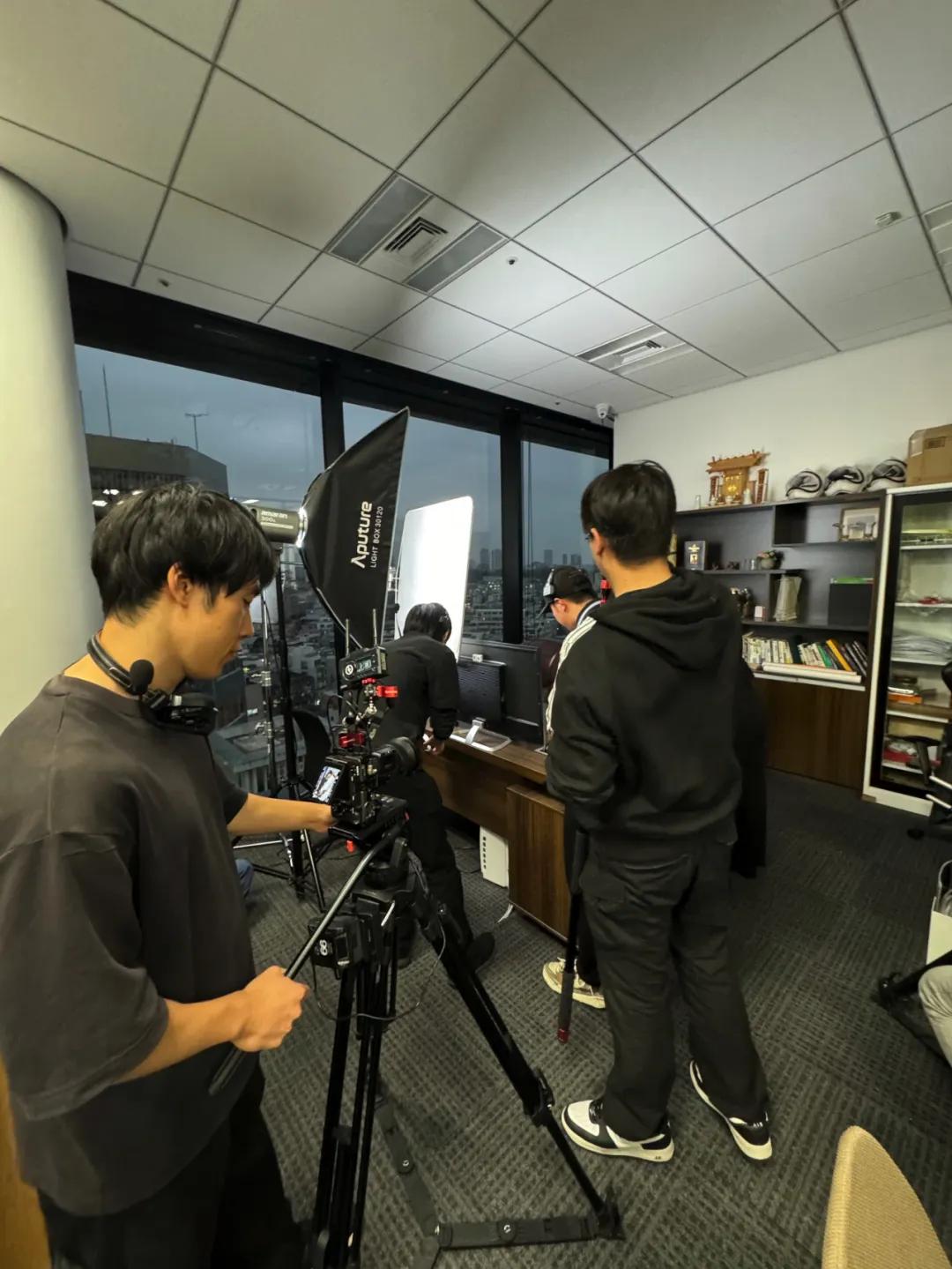
The shooting scene of a short drama, provided by the interviewee
Different from the high requirements for the script and cost, the requirements for directors in Japanese short dramas are not high.
Due to the lack of professional talents, the threshold for this industry is very low. Nagi has met some domestic directors who went to Japan to shoot short dramas. "There are actually not many who shoot well." A short - drama photographer named A Yao from Tokyo also revealed that as a 2021 graduate majoring in film post - production, he has no knowledge reserve of directing and doesn't know how to direct at all. "But if I say I want to be a director now, I can be the director of the next drama." He just needs to gather a group of people for art, lighting, photography, etc.
And it's not difficult to gather these people. In the Chinese film crew resource groups in Tokyo, there are many freelancers waiting to join the crew.
A Yao came into contact with "short dramas" through a resource group. In 2023, he saw a recruitment notice for a "funny short - drama photographer" in the resource group, with a daily salary of 1,500 yuan. At that time, A Yao had never watched a short drama and didn't know what a short drama was. He just said that he could bring his own equipment worth 2,000 yuan and was hired.
Although it was called a "funny short drama", it was not a short drama in the strict sense, but a short promotional video for a dating app. The plot was that a female college student pursued an old man, and finally, the old man successfully married the female college student. The cost was only 100,000 yuan. The director directed the drama, operated the camera, and edited the video by himself. A Yao was the photographer.
The shooting threshold is not very high. The director operated one camera, and A Yao operated the other. No special skills were required. Just point the camera at the actors' faces. "You can shoot with a mobile phone or a camera," A Yao said.
Although it was not standardized and professional, it still allowed A Yao to master the shooting skills of short dramas. So when short dramas began to sweep across Japan, A Yao was able to handle shooting in various short - drama crews with ease. Later, as the shooting demand increased, A Yao even established a small studio dedicated to the shooting and coordination of short dramas.
So far, A Yao has participated in the shooting of three short dramas and has also served as the director of one drama. The crew structure is very simple. There is no lighting, sound recording, art, or props department. A Yao has to serve as both the director and the photographer and is also responsible for contacting the actors. He can earn 3,000 yuan a day.
"What else do you expect me to do?"
If you want to shoot short dramas in Japan, cross - border cooperation is inevitable.
It's either Chinese directors teaching Japanese actors how to act, or Chinese directors cooperating with Japanese cameramen, or Chinese cameramen working with Japanese lighting technicians. However, due to cultural differences, almost every short - drama practitioner has experienced a period of not being able to adapt.
First of all, the work rhythms don't match.
The shooting of a short - drama crew usually takes 15 hours, from 7:30 a.m. to 11 p.m. The continuous high - intensity work makes the Japanese very uncomfortable. A Yao once cooperated with a Japanese lighting technician. At first, the technician did a decent job. But after a few days, he started to be perfunctory and didn't work hard. He started using large - area lighting, and the shots had no texture at all. "It would be better not to use any lighting than his large - area lighting," A Yao complained. "The Japanese just do the minimum required." But A Yao didn't feel comfortable scolding him for fear of hurting their relationship.
The same goes for Nagi. As a production contractor, she has to mediate between Chinese platform operators and Japanese teams every day.
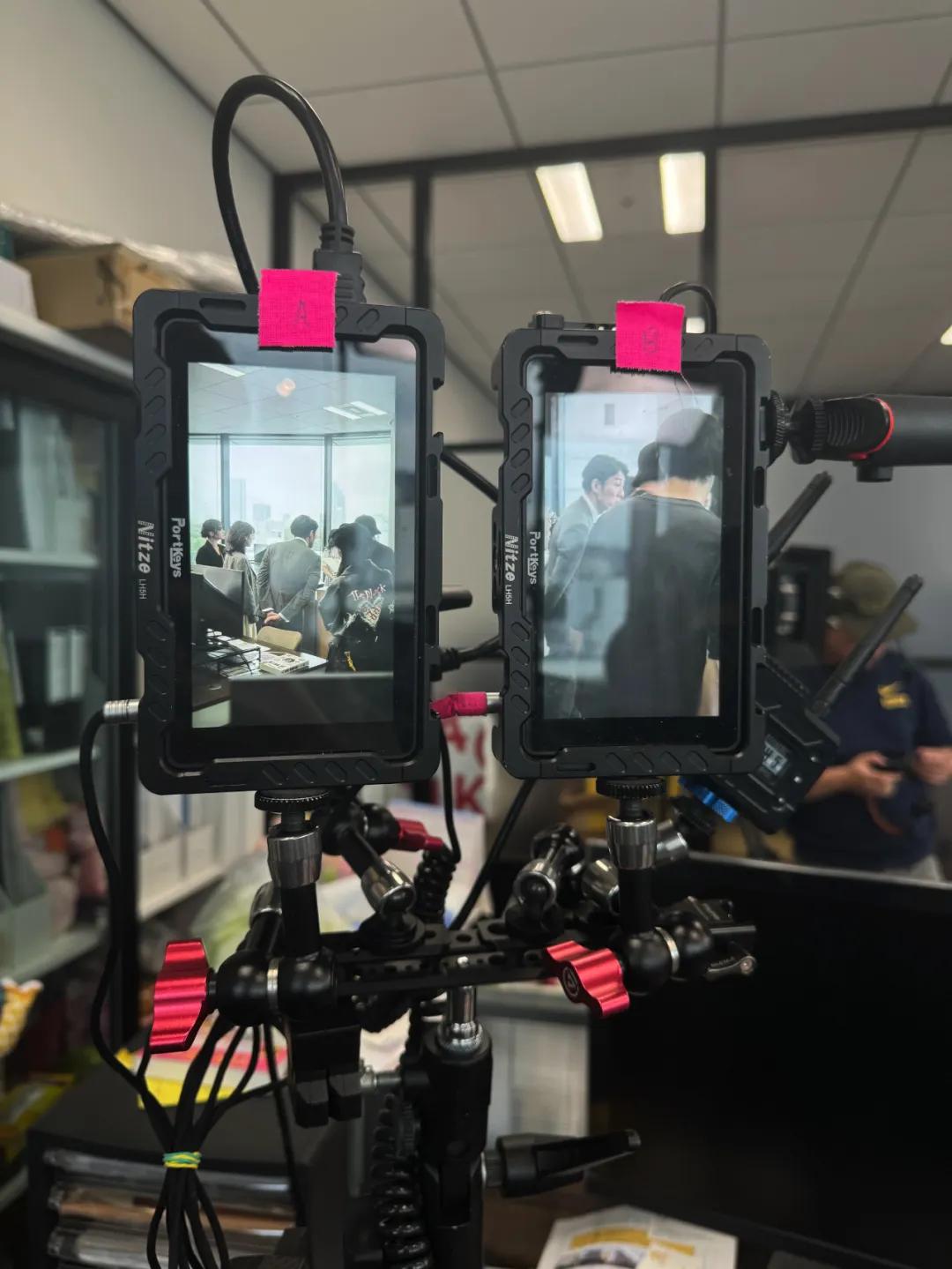
The shooting scene of a short drama, provided by the interviewee
Chinese platform operators focus on a fast - paced work style. They only give a maximum of three months for the production cycle from shooting to editing. In these three months, Nagi has to find Japanese actors, book Japanese shooting locations, and recruit a shooting team. But considering the Japanese work efficiency, "It's very tiring for us to meet the Chinese requirements, but the platform won't give you more time to prepare."
In the most extreme case, Nagi completed the production of a short drama in only 45 days. She had to urge the crew and negotiate business matters. After the production was over, Nagi felt "exhausted and tortured herself a lot."
Secondly, there are differences in cultural backgrounds.
Erica, a short - drama producer for a platform, started working on the Japanese market last year. The script styles mainly focus on wealthy heiresses and domineering CEOs. But every time when choosing costumes, the Japanese props team always prefers the Uniqlo style, emphasizing simplicity and plainness. Erica always has to tell the props team, "We need to make it more dramatic and exaggerated."
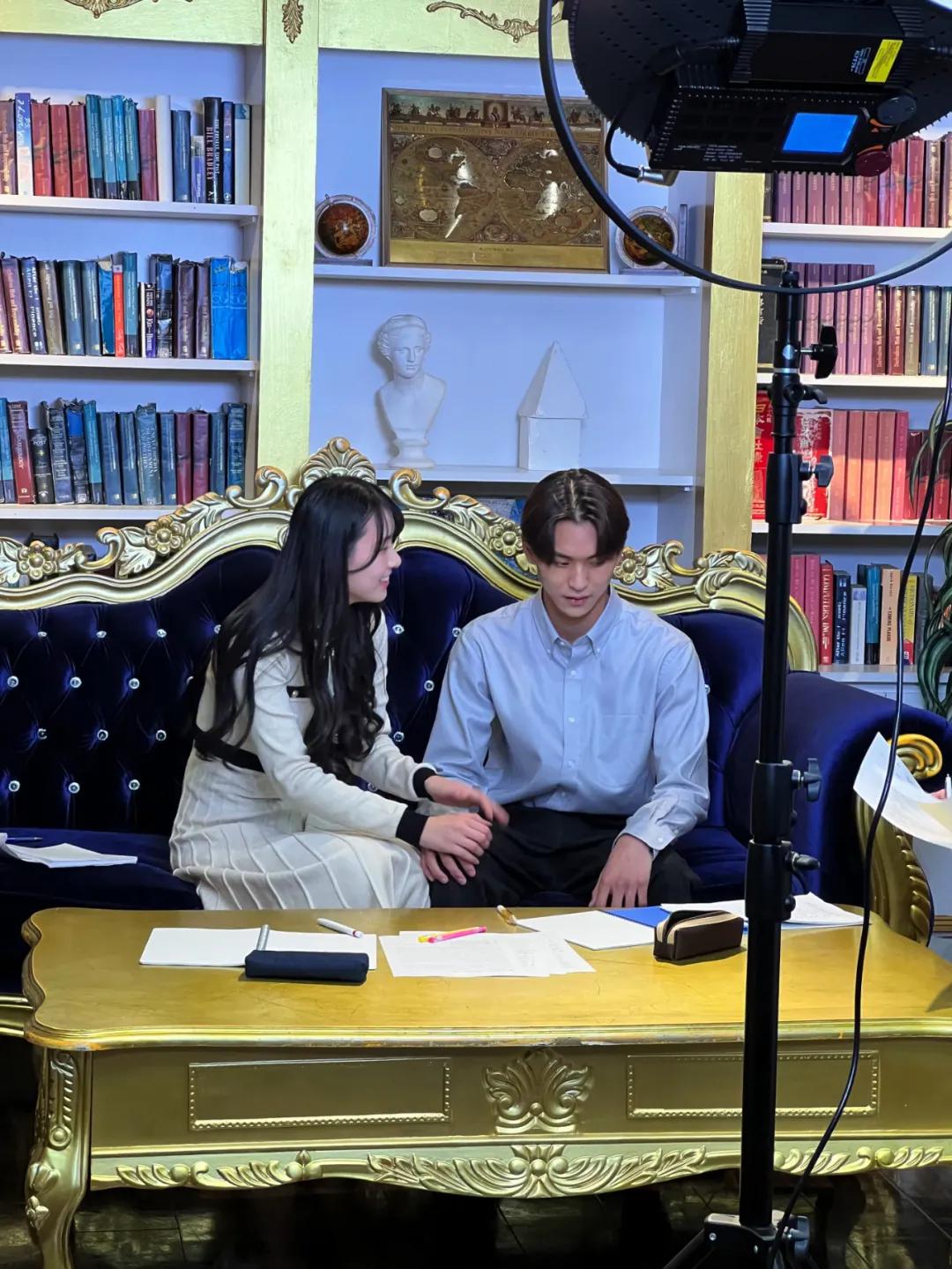
Erica's short - drama actors
In a crew that started shooting around the same time as Nagi's, the staff from a Chinese platform flew directly to Japan to shoot. The main director was Chinese, while the assistant director, cameraman, lighting technician, and other positions were all held by Japanese people. The main director controlled the main camera, and the assistant director assisted, mainly learning the shooting rhythm from the main director. However, because this assistant director has a certain influence in the industry, the main director was too embarrassed to assign tasks to him, and each communication required a lot of effort.
Moreover, problems may also occur during the cross - border cooperation of Chinese directors. Once, a domestic director lifted an actress's skirt during a rehearsal for the sake of the plot. The actress immediately called the police, and her agency broke off the cooperation with the platform. So later, when Nagi was looking for a director, she would give priority to Chinese people with a Japanese background, as they would be more familiar with the rules of the Japanese entertainment industry.
Moreover, short - drama shooting focuses on low - cost and high - return. In order to save the budget as much as possible, almost every crew has a shortage of manpower, and the staff also have to take on multiple roles on set.
This has also made most young people reluctant to take on short - drama shooting projects from Chinese producers. "Because it's very tiring and doesn't pay well. It's better to shoot a commercial. It's easy and pays more. Why suffer in short - drama shooting?" Nagi said.
During the shooting of the previous drama, A Yao served as the photography director. But because the props always went wrong, A Yao had to pay for the props himself and iron the clothes all night. Later, the props person told him that the hourly wage at a 7 - Eleven convenience store is 1,300 yen (about 60 yuan), and in the crew, he has to work 15 hours a day for a salary of 15,000 yen. "What else do you expect me to do?"
The competitive Japanese short - drama market
Since last year, the competition in the short - drama industry has also heated up in Japan.
First, some Japanese local enterprises began to enter the short - drama market. According to Nikkei Chinese Net, in September last year, Japanese Internet company DMM.com announced its entry into the short - drama industry, with an annual investment of 2 billion yen. FAN, a subsidiary of Japanese talent agency Yoshimoto Kogyo Co., Ltd., also launched a short - drama platform called "FANY:D" in December, planning to launch about 50 projects a year.
Subsequently, Japanese TV stations such as NHK, TV Tokyo, Asahi TV, and Tokyo MX also started to layout in the short - drama market and invest in short dramas.
The entry of capital has given Japanese short - drama platforms more funds and opportunities, but it has also brought a lot of competition to Chinese short - drama platforms going global. "Japanese investors won't leave a single cent for these Chinese platforms," Nagi said. "Chinese platforms will definitely lose to Japanese platforms."
Moreover, Japanese short - drama platforms rarely hire Chinese cameramen, art designers, and lighting technicians. "There are plenty of talented Japanese people, and they are cheap and easy to work with. Why should I hire you Chinese?" A Yao also told "The Institute of the Rising Generation" that currently, "99% of my business comes from Chinese clients."
However, in the view of producer Erica, the influx of Japanese platforms will increase the variety of short - drama content samples and help her better position the market. "It will expand the market and make it better."
Erica once produced a popular short drama called "大富豪のバツイチ孫娘" (The Divorced Granddaughter of a Millionaire), which was a cooperation with Japanese Asahi TV and successfully made the platform rank first on the free charts of the Japanese Google Play and App Store. Based on this success, the actors' status and the production team for Erica's subsequent works have been upgraded.

A short drama previously produced by Erica
However, in the eyes of every industry practitioner, Chinese people still have an overwhelming advantage in shooting short dramas in the Japanese market. After all, until now, the Japanese still don't have a thorough understanding of short dramas.
In November last year, a revenge - themed short drama called "The Last Lesson - Only the Survivors Can Graduate" produced by a Japanese TV station was launched in Japan. The lead actor was a well - known local Japanese celebrity. With his online acting skills and a certain star effect, it became a huge hit in Japan.
In Nagi's view, although Japanese - produced short dramas also have reversals and drama, they seem more like compressing a 40 - minute long drama into 10 minutes. After watching several short dramas directed by Japanese directors, A Yao also said that "That's not a short drama at all. It's just cutting a long drama into one - minute - long segments."
Nagi speculated that the reason behind this is Japan's "conservatism". The craftsmanship spirit makes the Japanese think more rigidly, and they have a poor ability to accept new things. "They are not willing to learn new things. They just focus on perfecting one thing." She once tried to get the Japanese to write short - drama scripts but found that they always couldn't write real short - drama scripts. Either they weren't melodramatic enough, or they didn't know how to break down the plot. "Their way of thinking is different."
"Their shooting skills are still good, but they don't shoot according to a more mature set of systems and processes." Erica also said. That's why so many domestic platforms going global have achieved success in the Japanese market.
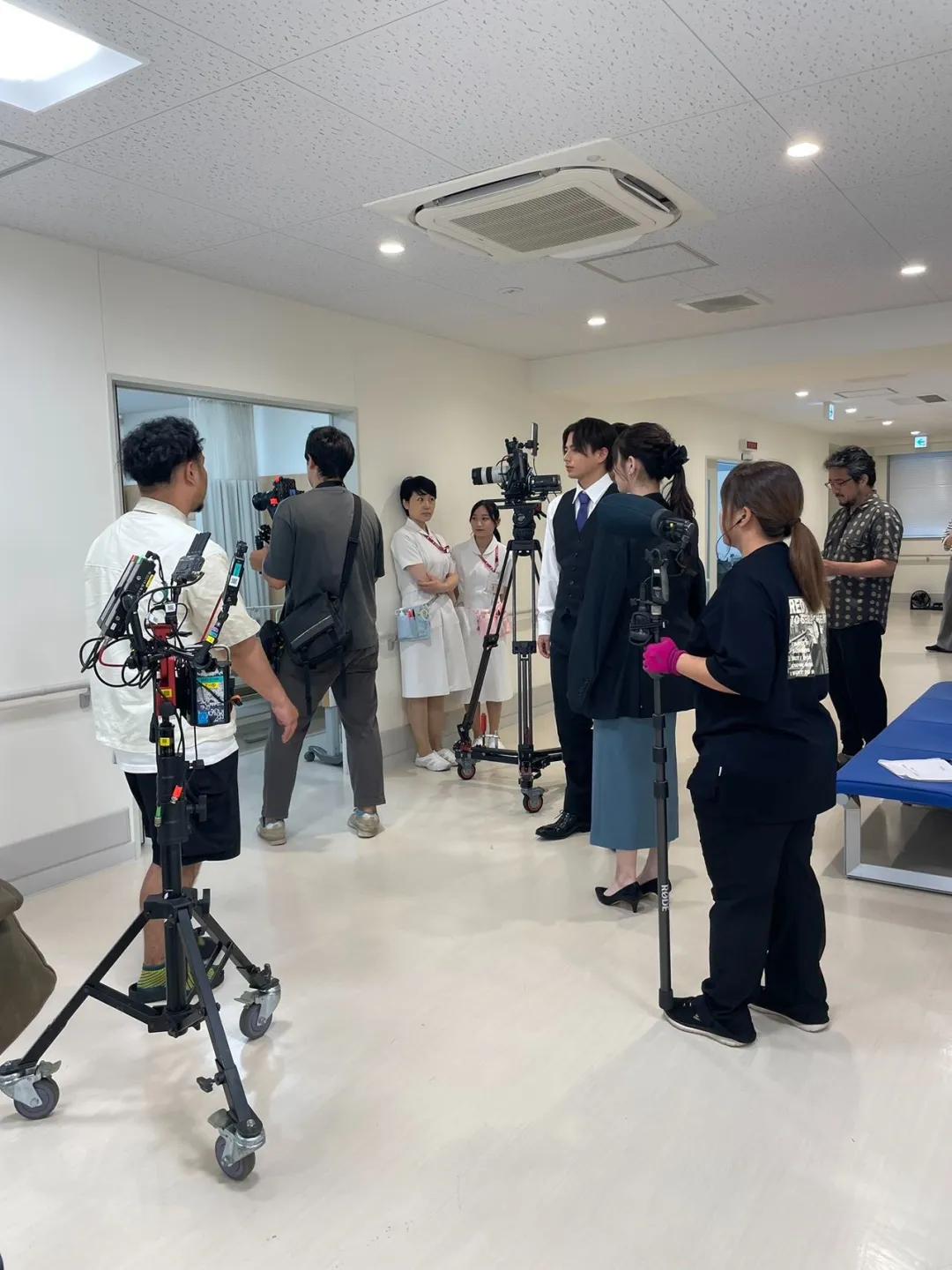
The shooting scene of a short drama, provided by the interviewee
Moreover, in Erica's view, the popularity of short dramas is also closely related to the strategies of the platforms.
Some days ago, a self - produced short drama from a South Korean local platform that was made half a year ago suddenly became a hit. Next month, Erica will join a South Korean short - drama crew for shooting, and it is expected to be launched in June. Erica thinks that in South Korea, the birthplace of domineering CEO dramas, short dramas may have a greater influence than in other markets.
(Source: The Institute of the Rising Generation)