Cultural Global
Latin Americans are falling in love with Chinese romance novels. This presents a shared opportunity for Yuewen and Spanish and Portuguese writers.

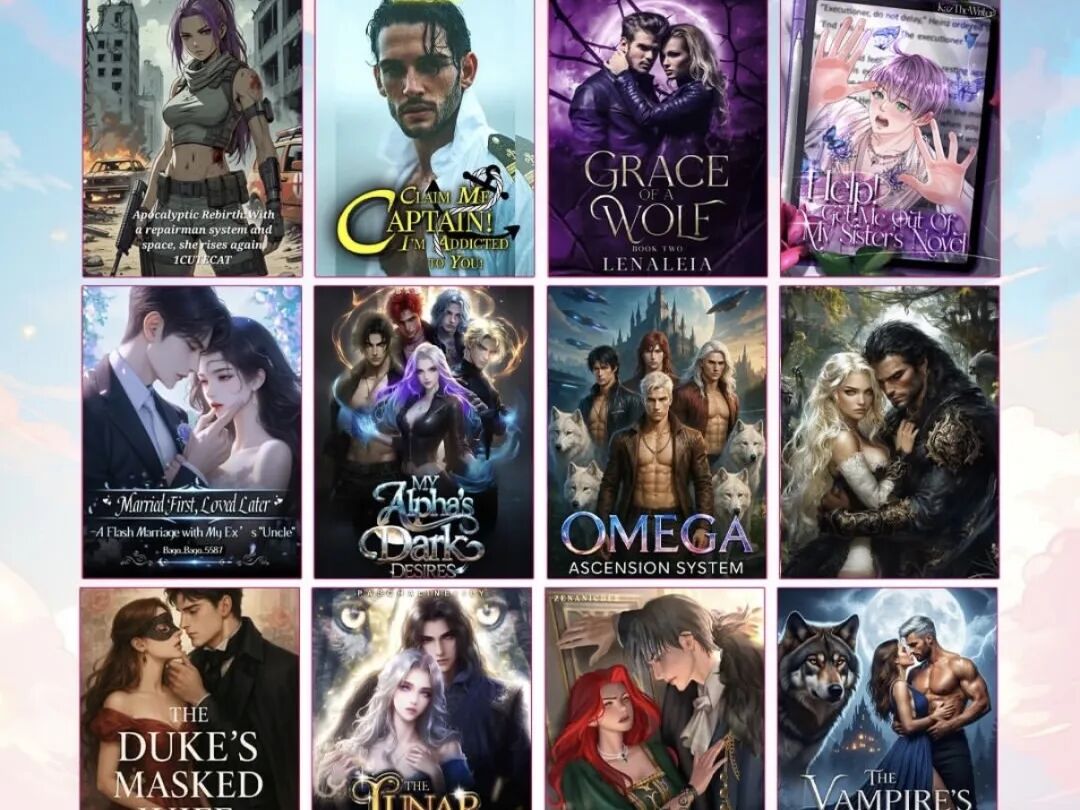
On December 18th, Tencent Reading Group released a set of interesting data related to going global. Two of the data points were the most surprising: among the top ten countries with the fastest-growing monthly active users on the overseas platform, nine were Latin American countries; and half of the signed authors on the overseas platform were post-2000s.
Newcomers and new markets are bringing new impetus to the old industry.
The "2025 China Online Literature Going Global Trend Report" released by the China Audio-Video and Digital Publishing Association, which is mainly based on industry surveys and materials from Tencent Reading Group, shows that the relatively "old" online literature industry is still growing. In 2024, the revenue scale of the Chinese online literature market reached 49.55 billion yuan, a year-on-year increase of 29.37%, with the growth rate accelerating for three consecutive years. During the same period, the revenue scale of the overseas market was 4.815 billion yuan, a year-on-year increase of 10.68%.
It's not new that foreigners like Chinese online literature. What's new is that Tencent Reading is getting more foreigners to join the ranks of writers. As of October 31, 2025, Tencent Reading's overseas business, WebNovel (Qidian International), has nurtured nearly 530,000 writers and over 820,000 original works globally. The total number of works increased by 20% year-on-year, and there were 538 blockbusters with over ten million reads.
Foreign online literature creators are also getting "younger". Among the signed authors on WebNovel, post-2000s account for 50%, and the number of post-2005s authors increased by 55.9% year-on-year.
The Chinese online literature market has long entered a period of extreme saturation. As of the end of 2024, the cumulative number of Chinese online literature works had reached about 42.1 million. Even if the 20 million permanent residents in Shanghai read one book a week, it would still take half a month to finish them all. In contrast, the overseas online literature market is still in its very early stage. With 820,000 original works on WebNovel, it can only be considered to be in the starting stage.
The Chinese online literature market has experienced strong external stimuli. Now it's the overseas market's turn. The simple business model of "paying by chapter" in the past has been baptized by various formats such as long dramas, short dramas, comics, manhua dramas, and derivatives. The industrial chain of IP development has been infinitely extended, and the commercial value brought by an excellent online literature work has been continuously magnified. In the future, this path will be repeated many times in various overseas markets.
Wang Zhongjie, the general manager of Tencent Reading Group's overseas business, said in an interview with 36Kr that the most important goals for the overseas business this year are to do two things: cover more languages; and conduct more in-depth overseas IP development.
Different Languages, Similar Interests
What kind of online literature do readers like to read the most in each country?
In the European and American markets (the United States, Canada, Germany, France, and the United Kingdom), the work with the highest number of reads is "Lord of Mysteries" (Western fantasy, written by A Willing Fish Who Loves to Dive, China). In the Southeast Asian market (Indonesia, Thailand, and the Philippines), it is "Supreme Lord of the Void" (Eastern fantasy, written by Overlord of the Heavens, China). Readers in the Latin American market (Brazil, Mexico, Uruguay, and Argentina) like "dominant CEO" stories. The work with the highest number of reads is "Shock! The Heavenly Husband Turns Out to Be the Richest Man" (Modern romance, written by Gongzi Yan, China).
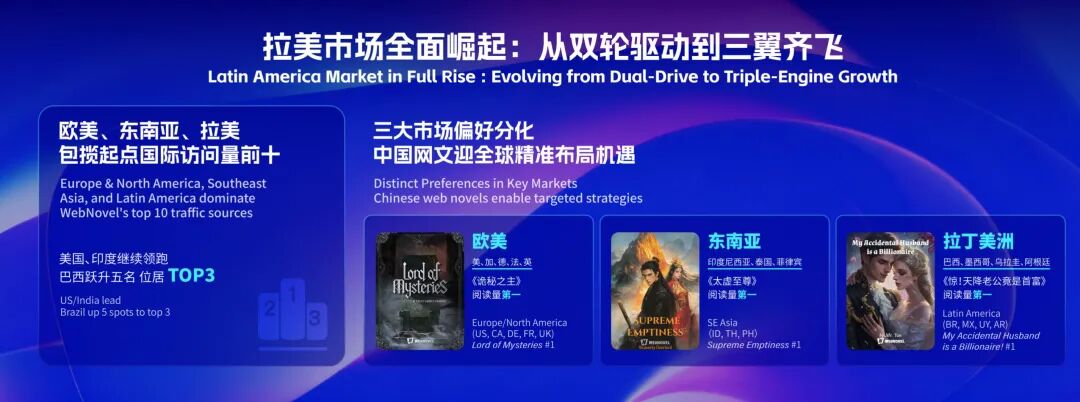
Image source: "2025 China Online Literature Going Global Trend Report"
"Readers in different countries have the same love for the core of a good story. The human resonance for love, hatred, and affection is the same," Wang Zhongjie said. "It's just that in terms of 'how to tell a story', readers with different cultural backgrounds will prefer different 'outer shells'." For example, European and American readers prefer werewolf, vampire, and science fiction themes, while readers in East Asia and Southeast Asia have a higher acceptance of Chinese traditional culture. Moreover, surprisingly, Latin American readers also like stories with a traditional Chinese style.
The data released by Tencent Reading shows that among the top ten countries with the fastest-growing monthly active users on WebNovel globally this year, nine are Latin American countries, changing the market pattern long dominated by North America, Europe, and Asia. Among them, the Brazilian market led the way with a monthly active user growth rate of 779%, and the user access volume also jumped five places. The top five themes that Latin American readers like to read the most are fantasy romance, urban romance, urban supernatural powers, Eastern fantasy, and fantasy.
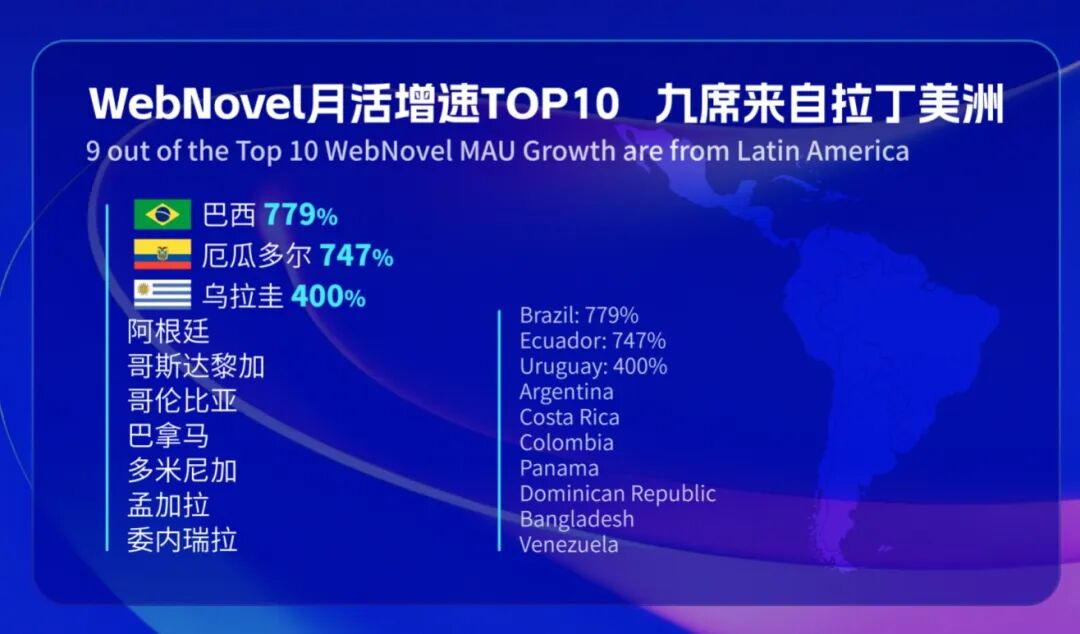
Image source: "2025 China Online Literature Going Global Trend Report"
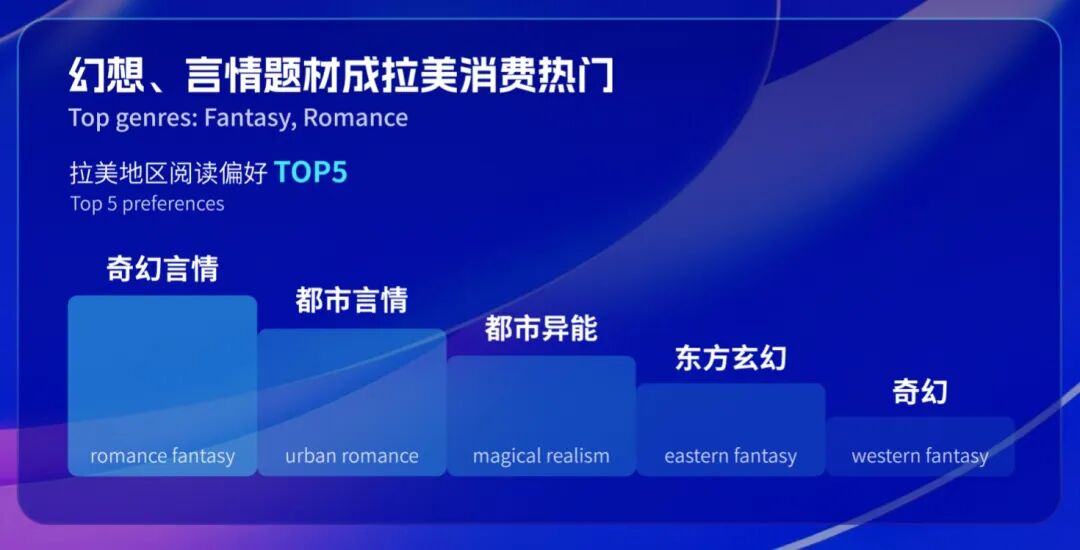
Image source: "2025 China Online Literature Going Global Trend Report"
"The rapid growth of the Latin American market exceeded our expectations," Wang Zhongjie said. Tencent Reading believes that on the one hand, this is the result of years of friendly diplomatic relations between China and Latin America. "Many Latin Americans have watched many Chinese TV dramas and played many Chinese games," accumulating an interest in Chinese-style content. On the other hand, it is because Latin Americans are naturally fond of entertainment activities. The "new three exports" - online dramas, online literature, and online games - have all been well received in Latin America.
The first hurdle for the "new three exports" to go global is to overcome the language barrier, and AI is making this easier. In the past year, WebNovel added tens of thousands of AI-translated works, and the total historical scale increased by 281% month-on-month.
But using AI for translation doesn't mean being a "hands-off manager". Taking the category of "xianxia novels" on Tencent Reading as an example, abstract concepts unique to xianxia online literature, such as qi refinement, nascent soul, foundation building, and great achievement, require more professional human control. Tencent Reading has established a "cultural term library" to translate these abstract and commonly used terms into corresponding foreign languages one by one.
In 2025, AI has improved production efficiency in many industries, but its integration with culture and art still faces controversy. Can AI translation ensure that the flavor and artistic value of the article are not damaged?
Wang Zhongjie said that Tencent Reading's application of AI translation is relatively restrained. First, it uses a comprehensive model rather than a single model and has its own "cultural term library". Second, AI translation is only the "first process". After a significant increase in efficiency by AI, human proofreading will be involved. Finally, the content operation team will track the content in real-time and pay attention to readers' feedback. "It can be understood as'multiple insurances'," Wang Zhongjie said.
The significance of AI in boosting the creative industry is a bit like the invention of the steam engine for the human transportation industry. Because of the new technology, we can reach a bigger world. One of the goals of Tencent Reading's overseas business this year is to cover more languages. As Wang Zhongjie said, the current reserve of small-language talents in China is not that rich, which shows the usefulness of AI.
The "2025 China Online Literature Going Global Trend Report" shows that as of 2025, the total number of Chinese online literature works translated and exported overseas has exceeded 13,600. Compared with 2024, the translation scale of multiple languages has achieved a leapfrog growth, reaching 3.5 times that of the same period. Among them, the translation volume of Indonesian increased by 349% year-on-year, Spanish by 336%, and Portuguese by 278%. Languages such as Thai, Korean, Filipino, and Turkish have achieved a breakthrough from scratch. There are already 898 Thai-translated works.
Of course, simply transporting domestic works overseas is not enough. Tencent Reading wants to nurture more foreign writers who create in local languages overseas.
According to Wang Zhongjie, in some markets, such as Latin America, the proportion of original works is already close to surpassing that of translated works. Online literature in English, Spanish, and Portuguese is not restricted by a single country's market and can generate revenue in multiple countries globally.
"Latin America is a fertile ground for creation," Wang Zhongjie said. "WebNovel has already nurtured several top writers in the Latin American region, and their income levels are quite high. In this case, more and more local writers will be willing to transform towards professionalism."
Only with a better commercialization model can there be more foreign-language writers willing to write full-time, and there will be more foreign-language online literature IPs worth developing, ultimately promoting commercialization to a higher stage.
"We have a complete training chain for writers. There are special training programs for writers at each stage. Whether it's a small inspiration of a writer or the conception of the entire work framework, they will get support from our editorial team," Wang Zhongjie said. "When the IP reaches the stage of copyright sales, we will also help the writer choose the top cooperation partners."
Tencent Reading has currently reached in-depth cooperation with Amazon, many film and television companies, and the world's largest and second-largest audiobook platforms, Audible and BookFM. "These are real support for writers," Wang Zhongjie said.
Overseas IP Development: "Recreate a Tencent Reading Overseas"
Not long ago, in an exclusive interview with Forbes, Hou Xiaonan, the CEO and President of Tencent Reading, mentioned that his goal is to "recreate a Tencent Reading overseas". This "recreation" doesn't mean simply sending Chinese stories abroad, but completing a "three-step process": from translating Chinese stories, to exporting the creation model, and then to jointly building a global creative ecosystem.
Currently, Tencent Reading is approximately between the second and third steps. As Hou Xiaonan said, Tencent Reading's domestic model is a commercial closed-loop of "farm - factory - paradise". The farm cultivates and screens IPs through Qidian Reading and WebNovel. The factory transforms IPs through movies, long dramas, animations, and short dramas. The paradise realizes the commercialization of emotional value through products and experiences - "forming a flywheel where creativity, fans, and business empower each other".
In terms of business operations, Tencent Reading has made intensive investments in companies in the IP industrial chain in recent years. At the end of 2023, it acquired Tencent Animation's related business and IP assets for 600 million yuan. In 2024, it invested in the card company Hitcard and jointly launched a variety of IP peripherals. In 2025, it invested in the animation and game development company "Yihua Kaitian", the plush trendy toy brand "Super元气工厂", the AI manhua drama production company "Jiangyou Animation", etc. Through these intensive capital operations, we can see Tencent Reading's ambition in the IP industrial chain.
These new contents derived from online literature IPs are taken overseas. Currently, Tencent Reading Group has launched over 1,300 published works, over 2,100 comics, more than 80 animations, and over 100 film and television works overseas.
Among them, the animation series of "Battle Through the Heavens" has been played 1.18 billion times on YouTube, with a cumulative viewing time of 159 million hours and a score of 8.44 on MyAnimeList. In June 2025, after the global simultaneous release of the animation of "Lord of Mysteries", it scored 9.3 on IMDb, becoming the first Chinese animation with over ten thousand ratings. Many TV dramas such as "A Great Cultivator in the mundane World", "A Record of Mortal's Cultivation to Immortality", and "The Grace of the Nation" have also topped relevant lists on global platforms such as Netflix and Disney+.
Of course, most of the online literature that has received full IP development so far is in Chinese. But the company is promoting its global IP development model to get more foreign-language online literature to join this industrial chain. This is what Wang Zhongjie said, another important goal of Tencent Reading's overseas business besides "covering more languages": to conduct more in-depth overseas IP development.
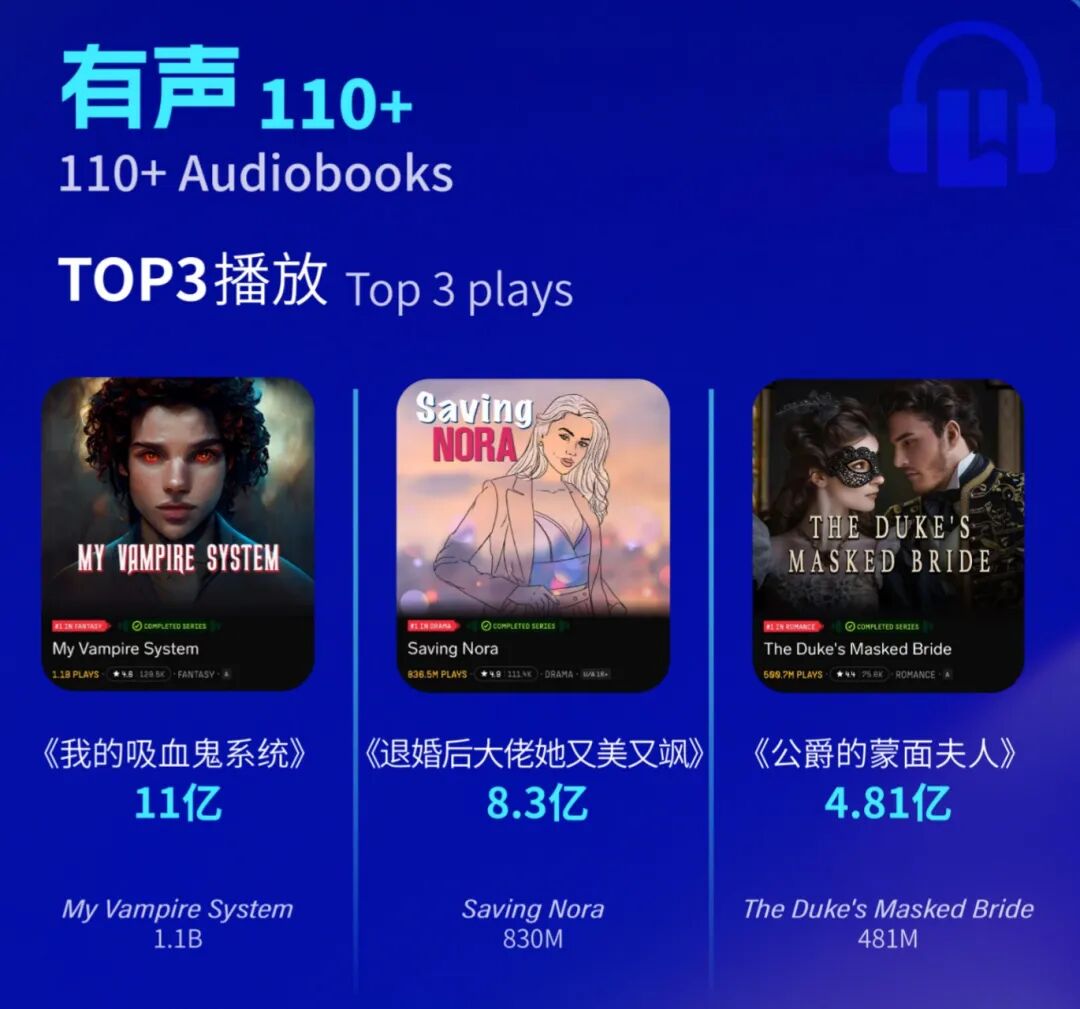
Image source: "2025 China Online Literature Going Global Trend Report"
Specifically, in 2026, Tencent Reading hopes to publish physical books for more foreign-language works and develop audiobooks, comics, animations, and even film and television and games. The current benchmark case is "My Vampire System" written by the British online literature writer JKS Manga. The audiobook adapted from this English online literature has been played 1.1 billion times, and the comic has also been launched.
Hou Xiaonan said that among the award-winning works of the annual Qidian International Writing Contest (WSA) over the years, over 70% have entered IP development. In 2025, WebNovel and WSA also added honors such as "Book of the Year" and "Comic Adaptation Award". The award-winning works can be directly adapted into comics, audiobooks, and short dramas.
Regarding whether the future overseas IP development model will be mainly based on investment or self-operation, Wang Zhongjie said that he thinks "both will exist". "The current global cooperation situation is in a state of being both conservative and radical. Being conservative means that if a company doesn't think you will cultivate the market in the long term, it will tend not to cooperate. Being radical means that once the other party recognizes us, the speed of promoting cooperation will be very fast. So we hope to find cooperation partners who recognize each other, and we will also develop our own development capabilities locally."
(Source: 36Kr Future Consumption Author: Wang Yuchan Editor: Qiao Qian)