Cultural Global
Analyze the industrial advantages of the four Southeast Asian countries to avoid the "mismatch pitfalls" when going global | Global Expansion Insight



From "Made in China, for the Chinese market" to "Made in China, for the global market", Chinese enterprises' production and sales models are moving towards a new stage of "Global manufacturing, for the global market". Against this backdrop, with its natural advantages in labor costs and geographical location, Southeast Asia has naturally become the preferred destination for Chinese manufacturing industries to go global and build a global supply chain.
There is no "one-size-fits-all destination country" in Southeast Asia, only "industry-suited countries" - Malaysia has a solid foundation in semiconductors, Vietnam has prominent cost advantages in manufacturing, Thailand has an active consumer market, and Indonesia has rich resource endowments. Enterprises must accurately select their overseas destinations based on their own industries. In summary -
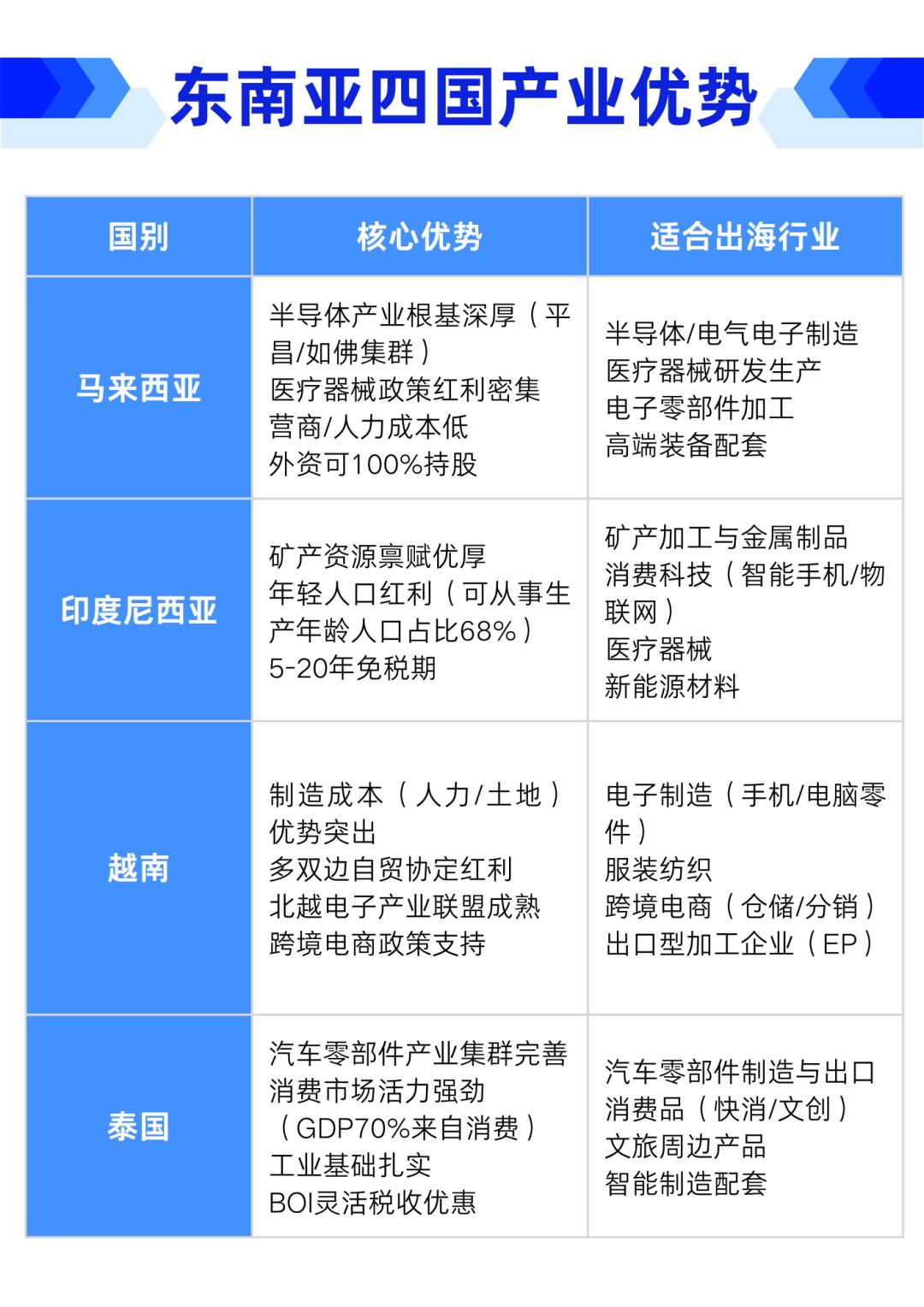
01 Policy dividends for semiconductors and medical devices in Malaysia
As a key player in Southeast Asian manufacturing, Malaysia has become the preferred destination for electronic semiconductor and medical device enterprises, thanks to its mature industrial chain support, low business costs (wages and living costs are at a relatively low level in Southeast Asia), and targeted tax incentives.
Semiconductors/Electrical and electronics
Significant industrial cluster effect in Pingchang and Rufo regions
Malaysia is home to the Malacca Strait, one of the world's busiest shipping lanes, which provides logistical convenience for the import of raw materials and the export of finished products in the semiconductor industry. Currently, large-scale semiconductor and electrical and electronics industrial clusters have been formed in the Pingchang and Rufo regions, attracting many multinational enterprises to set up operations. The enterprises that have settled in include US chip giants Intel and Micron, and European semiconductor companies Amos Osram and Infineon.
In terms of policies, Malaysia's support for this field is reflected in tax concessions: enterprises can choose between "income-based incentives" or "investment tax credits" according to their own circumstances. If the annual income is relatively high, they can apply for a 70%-100% income reduction (with a preferential period of 5-10 years); if the capital expenditure is large, they can enjoy tax credits based on the investment amount, further reducing the tax burden.

Medical devices
Entry window period for the emerging track
Many people may not know that Malaysia has listed medical devices as a key supported industry and has launched several targeted investment projects to encourage foreign investment in R & D and production. The core advantages of entering this track are cost control and flexible policies: on the one hand, the labor cost of medical device production in Malaysia is relatively low, and the education level is higher compared with countries such as Vietnam and Thailand, making it easier to recruit workers with basic technical skills; on the other hand, if an enterprise meets the requirement of 40% local value addition (i.e., the value-added ratio of products processed in Malaysia is not less than 40%), it can not only simplify customs procedures but also apply for "sales tax and service tax exemption".
02 Resource dividends for mineral processing in Indonesia
With a population of 285 million (the third largest in Asia) and a working-age population ratio of 68%, Indonesia has become the most promising consumer and manufacturing market in Southeast Asia, and its industrial opportunities are concentrated in resource processing.

Minerals/Metal products
An export-oriented track relying on resources
Indonesia is an important global mineral resource country, with reserves of coal, nickel, tin, etc. ranking among the top in the world, providing an advantage of being close to raw material sources for the mineral processing and metal products industries. Enterprises setting up operations here can enjoy two policy dividends: one is "long-term tax exemption". If they are recognized as "pioneer industries" (such as nickel processing and new metal materials), they can apply for a full exemption from corporate income tax for 5-20 years, and are also exempt from import duties and value-added tax on imported equipment; the other is "dividends from trade agreements". Indonesia has signed 71 CPD trade agreements. When exporting products to markets such as China and the EU, enterprises can enjoy tariff reductions with the certificate of origin.
It should be noted that Indonesia has requirements for local value addition for mineral processing enterprises. The value-added amount of products needs to reach at least 40%; otherwise, it will be difficult to handle export-related procedures. At the same time, foreign investment in the mineral field needs to meet the condition of a "minimum registered capital of 10 billion Indonesian rupiah".
03 Dividends for electronics manufacturing and cross-border e-commerce in Vietnam
Relying on the dual advantages of low-cost manufacturing and multiple bilateral free trade agreements, Vietnam has become the preferred destination for the production capacity transfer of Chinese electronics and clothing enterprises, and cross-border e-commerce has also risen with the trend.
Electronics/Clothing manufacturing
Cost and efficiency advantages of the "industrial alliance" in northern Vietnam
The electronics manufacturing industry in Vietnam has formed a mature alliance in northern Vietnam. The supply chains of enterprises such as Wistron and TCL have been established here, and supporting component suppliers and logistics service providers have gathered, which can reduce the supply chain costs of enterprises. From a policy perspective, if an electronics manufacturing enterprise is recognized as a supporting industry (it needs to first apply to the Vietnamese Ministry of Industry and Trade to have its products included in the designated list), it can enjoy the preferential policy of "a 50% reduction in income tax for 4 years + a 10% tax rate for 15 years". If the investment exceeds 12 trillion Vietnamese dong (about 3.6 billion yuan), it can trigger the "large-scale investment incentives", further extending the tax exemption period.
Clothing manufacturing can rely on the tariff advantages of the "EU-Vietnam Free Trade Agreement (EVFTA)" - Clothing produced in Vietnam can enjoy zero tariffs when exported to the EU, while the tariff for similar Chinese products is about 10%-12%.
Enterprises setting up operations need to pay attention to the rules of origin: if the yarn and fabric of clothing are produced locally in Vietnam or imported from free trade agreement partner countries, they can meet the requirement of 30% local value content and enjoy tariff preferences smoothly. At the same time, although the minimum basic wage in Vietnam has been rising year by year (about 1,800-2,200 yuan per month in 2024), it is still lower than that in the Yangtze River Delta and Pearl River Delta regions of China, with obvious labor cost advantages.
Cross-border e-commerce
Market opportunities brought by free trade agreements
The boom in Vietnam's cross-border e-commerce stems from the dividends of its free trade agreements - On the one hand, the free trade agreements signed by Vietnam with the EU, ASEAN, etc. allow foreign e-commerce platforms to enter the local market (for example, Chinese enterprises can operate e-commerce businesses through their Vietnamese subsidiaries and target more than 100 million consumers in Vietnam); on the other hand, products produced in Vietnam can be exported globally through free trade agreements. For example, if a cross-border e-commerce enterprise sets up a warehousing center in Vietnam, simply processes Chinese products, and then exports them to the EU, it can avoid some trade barriers.
The support for cross-border e-commerce at the policy level is reflected in tax convenience: if an enterprise applies to be an "Export Processing Enterprise (EP)", it can be exempt from import duties and value-added tax, and can apply for a refund of the value-added tax on export income (the refund will be received within 1-2 weeks if the conditions are met). In terms of cities for setting up operations, Ho Chi Minh City and Hanoi are the core hubs. The logistics and distribution in these two cities are fast (next-day delivery within the city), and there are many cross-border e-commerce service providers that can provide local operation support.
04 Thailand: A place for both manufacturing and consumer markets
Thailand's automotive parts industry ranks among the top in ASEAN in terms of export scale. At the same time, the per capita disposable income is constantly increasing, and the consumption willingness is strong. It provides a dual market of domestic demand and exports for consumer goods enterprises and is an ideal place for both production and sales.
Automotive parts
An export base relying on a complete industrial cluster
Thailand's automotive industry has formed a complete industrial chain of "vehicle manufacturing - parts supporting - logistics and export". Core areas such as the Rayong Industrial Park have gathered vehicle manufacturers such as Toyota and Honda. After automotive parts enterprises settle in, they can quickly connect with customers and reduce logistics costs. From a policy perspective, if an automotive parts enterprise applies for the incentives from the Thailand Board of Investment (BOI), it can enjoy "3-8 years of corporate income tax exemption + exemption from import duties on imported equipment". After the implementation of the 15% minimum tax in 2025, the BOI can convert the tax exemption incentives into cash subsidies. For example, the original 100% tax exemption will be changed to a 50% tax rate + 50% cash rebate, ensuring that the actual tax burden of enterprises is controllable.

Consumer goods
A "brand incubation ground" supported by high consumption willingness
The core advantage of Thailand's consumer market lies in "stable purchasing power and strong consumption willingness". According to Euromonitor data, from 2015 to 2024, the total consumption of Thai residents increased from $232.4 billion to $327.2 billion, with a compound annual growth rate of 3.9%. It is the third-largest consumer market in ASEAN. During the same period, the per capita consumption expenditure increased from $3,306 to $4,565, with a compound annual growth rate of 3.7%, higher than the compound annual growth rate of 3.3% of per capita disposable income. Moreover, Thai young people have a strong demand for "personalized" consumer goods. Pop Mart entered the Southeast Asian market through the Thai market in the early days, also taking a fancy to its consumption vitality.
However, it is worth mentioning that the Thai National Economic and Social Development Council released the social white paper for the first quarter of 2025, showing that the unemployment rate in Thailand is only 0.88% (close to full employment). Enterprises may encounter difficulties in recruiting workers. Many local enterprises offer additional benefits (such as flexible working hours) in addition to wages to retain talents.
This article is from the WeChat official account "Hangzhou Qiantang Enterprise Going Global Service Base". Author: Zhejiang Enterprises Going Global. Republished with permission from Qiantang.